Can You Use Isopropyl Alcohol to Clean? A Practical Guide
A practical, evidence-based guide on using isopropyl alcohol for cleaning—covering safety, surface compatibility, proper dilution, drying times, and alternatives, from Cleaning Tips.


Yes, you can use isopropyl alcohol for many cleaning tasks, but effectiveness depends on concentration, surface type, and safety considerations. This quick guide explains when IPA is appropriate, how to use it safely, and when to choose alternatives.
Can You Use Isopropyl Alcohol to Clean? Key Considerations
If you’re asking can you use isopropyl alcohol to clean, the short answer is that it can be effective on many non-porous surfaces. However, the suitability depends on concentration, contact time, material sensitivity, and ventilation. In this guide from Cleaning Tips, we examine when IPA shines, and when to choose safer or alternative cleaners. Throughout, you’ll see practical steps, real-world scenarios, and clear cautions to help you clean confidently without damaging surfaces.
Safety first: handling, ventilation, and storage
Always use IPA in a well-ventilated area and away from open flames. Wear gloves if you have sensitive skin, and avoid prolonged skin contact. Store bottles upright, away from heat sources, and keep out of reach of children and pets. When using IPA around electronics or heat sources, ensure devices are powered down and unplugged. For storage, opt for a cool, dry cabinet and never mix IPA with household cleaners unless the product instructions explicitly permit it. These precautions reduce exposure risk and help maintain air quality in occupied spaces.
Surface compatibility: what works and what doesn’t
Isopropyl alcohol is generally suitable for hard, nonporous surfaces like glass, metal, ceramic, and certain plastics. It can remove oils, inks, and light residues effectively. Avoid using IPA on finished wood, untreated stone, certain rubber seals, and some types of acrylics or coatings, as solvents can cause swelling or discoloration. Before broad application, test a small, inconspicuous area and observe for any adverse change. For textiles and porous materials, IPA may leave a residue or cause color fading, so use caution or skip entirely.
Step-by-step cleaning workflows
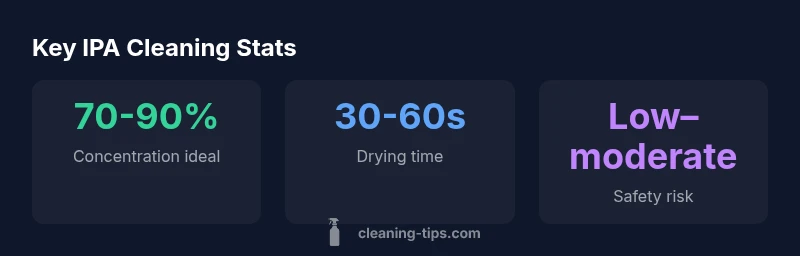
- Identify the surface and confirm it is nonporous and compatible with IPA. 2) Choose a concentration in the 70-90% range, or follow product manufacturer guidance. 3) Apply IPA to a microfiber cloth, not directly onto the surface, and wipe with steady, even strokes. 4) Allow a brief air-dry period (30-60 seconds) and inspect for streaks or residue. 5) If needed, buff with a dry cloth to improve clarity and finish. 6) Dispose of used wipes properly and ventilate the area after cleaning.
Myths vs. reality: common misconceptions
Myth: Higher IPA concentration always cleans better. Reality: 70-90% balances disinfection potential with material safety; higher concentrations evaporate faster and may be harsher on some finishes. Myth: IPA is safe on all plastics. Reality: Some plastics can craze or discolor with solvent exposure; always test first. Myth: IPA can replace all cleaners. Reality: IPA is excellent for certain residues but isn’t a universal disinfectant or degreaser. Match the cleaner to the surface and soil.
Alternatives and complementary cleaners
- For delicate surfaces: use water and a mild detergent or a specialized cleaner designed for that material.
- For electronics: use manufacturers’ approved cleaning methods; IPA can be used in small amounts on non-lubricated contacts if the device is powered down and dry.
- For odor and residue: consider alcohol-free cleaners or ethanol blends, depending on surface compatibility.
- Always pair IPA with proper ventilation and personal protective equipment as needed.
Isopropyl alcohol cleaning guidelines by surface type
| Surface Type | Recommended IPA Concentration | Estimated Drying Time |
|---|---|---|
| Glass | 70-90% | 30-60 seconds |
| Metal | 70-90% | 30-60 seconds |
| Plastic (certain types) | 70-90% | 45-90 seconds |
Questions & Answers
Can isopropyl alcohol be used to disinfect electronics?
IPA can be used on certain nonporous electronics components when powered off, with careful application and ample drying time. Avoid liquid exposure to internal parts and follow manufacturer guidance. Use sparingly on sensitive coatings.
IPA can be used on some electronics when devices are off, but follow the manufacturer’s guidance and allow to dry completely.
Is IPA safe on wood finishes?
Most wood finishes are sensitive to solvents. Test in an inconspicuous area and avoid prolonged contact. If in doubt, use a wood-safe cleaner or a damp microfiber cloth with a mild detergent.
Wood finishes can be damaged by solvents; test first and use a wood-safe cleaner if unsure.
Should I dilute IPA, and how?
Concentrations around 70-90% are typical for cleaning; higher concentrations evaporate quickly and can be harsher. If dilution is necessary, mix with distilled water to aim for the target range and validate on a small area.
Use IPA around 70-90%. If you dilute, do it with care and test first.
Can IPA kill mold or mildew?
IPA can remove surface residues, but it is not a comprehensive mold solution. For mold, address moisture, use appropriate cleaners, and consider EPA-registered products for mold remediation.
IPA helps clean surfaces but is not a full mold solution; address moisture and use proper products.
Is IPA flammable and how should I store it?
IPA is highly flammable. Store in a cool, ventilated area away from heat sources and flames. Keep containers tightly closed and out of reach of children.
IPA is flammable; store it away from heat and keep the cap on.
Can IPA leave a strong odor or residue?
IPA can leave a faint odor that dissipates with ventilation. If residue remains, wipe again with a clean cloth and allow to air dry completely.
IPA may leave a brief odor; ventilate well and wipe again if needed.
“Isopropyl alcohol is a versatile cleaner when used with care, but its effectiveness depends on surface type and proper dilution. Always test first and follow safety guidelines.”
The Essentials
- Test a small area before wide use
- Use 70-90% IPA for balance of cleaning and safety
- Ventilate and avoid flames during use
- Avoid IPA on sensitive finishes and porous materials
- Consider alternatives when dealing with wood, fabric, or electronics