Difference Between Clean and Power Clean: A Comprehensive Guide
Understand the difference between clean and power clean, their mechanics, benefits, and programming implications for athletes and lifters. Clear cues, safety tips, and practical progressions.


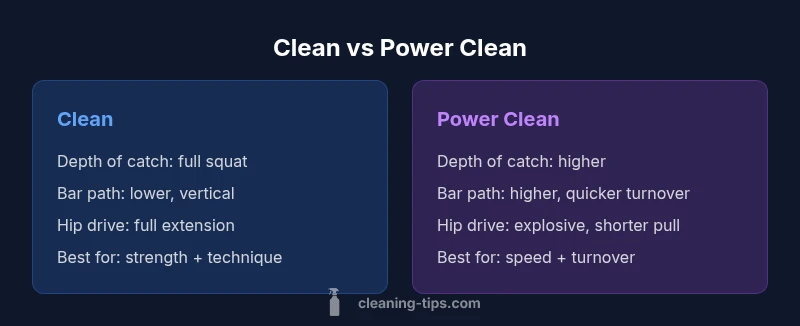
The difference between clean and power clean lies in depth of the receiving position, bar path, and hip drive. The clean finishes in a full squat catch, while the power clean ends higher with a quicker turnover. Both lifts develop strength and power, but they serve different training goals based on technique, mobility, and athlete needs.
Understanding the difference between clean and power clean: definitions and basics
The difference between clean and power clean centers on depth of the receiving position and the bar path. The clean typically ends in a full squat catch, while the power clean finishes with a higher catch and a quicker turnover. Both lifts train different aspects of athletic performance and require distinct coaching cues, mobility, and rhythm. This article explains the mechanics, cues, and programming implications so you can choose the most appropriate option for your goals. According to Cleaning Tips, clarity in terminology helps lifters avoid confusion and progress more effectively in home gyms and clubs alike.
Setup and prerequisites: mobility, warm-up, and readiness
Before attempting either lift, prioritize ankle and hip mobility, thoracic spine flexibility, and wrist readiness. A well-structured warm-up reduces injury risk and improves bar speed and control. This section outlines a practical sequence of mobility drills, activation work, and warm-up progressions that prepare the body for both lifts. Emphasis is placed on establishing a solid athletic stance, neutral spine, and appropriate grip width. Cleaning Tips highlights the value of a graduated approach—start with lighter loads and build confidence before adding complexity and depth to the receiving position.
Technique differences: grip, stance, bar path, and rhythm
Grip width and stance angle set the foundation for each lift but diverge as technique evolves. The clean typically uses a slightly wider stance and a vertical bar path with a longer pull, while the power clean emphasizes a rapid hip drive and a higher catch position. Both lifts rely on a fast elbows extension and a secure rack when receiving the bar. In coaching terms, early cueing—such as maintaining a tall chest, keeping the bar close, and driving the hips through—helps lifters lock in correct rhythm and reduce faults like early bar drop or rounded shoulders.
Range of motion and catching position: full squat vs high catch
A central difference is where the bar is caught. The clean often ends with a full squat catch, demanding significant ankle dorsiflexion and knee flexion, whereas the power clean finishes higher, allowing for a quicker turnover and less depth. This section details progressive drill work—from footwork and pulls to receiving position—to help lifters learn the appropriate catching depth safely. The goal is to match bar speed with a stable catch, regardless of depth, while protecting the spine and shoulders.
Training outcomes: strength, power, hypertrophy, and athletic transfer
Because the lifts train different aspects of power and strength, they yield distinct adaptations. The clean supports maximal strength development, technique refinement, and stable lifting mechanics, while the power clean emphasizes bar speed and quicker hip extension. The combined development from both lifts can improve overall athletic performance, including jumping, sprinting, and change-of-direction. Training should align with goals, equipment, and technical readiness, with a clear plan for progression and deloads as needed.
Programming implications: progression, cues, and common errors
Programming the two lifts involves planning for technique work, loading, and recovery. Beginners benefit from drills that establish position and rhythm before heavy attempts. More advanced lifters can use periodized blocks that alternate emphasis between depth and speed, while incorporating accessory work for posture, hip hinge, and ankle mobility. Common errors include insufficient hip drive, failing to maintain a neutral spine, and receiving position drift. Consistent coaching cues, video feedback, and controlled tempos help minimize errors and accelerate improvement.
Safety considerations and coaching cues
Safety starts with proper footwear, a clear shelter area, and a plan for spotting when appropriate. Prioritize progressive overload, avoid rushing into heavy loads, and use slower tempo work to reinforce form. COaching cues should emphasize posture, bar path, and receiving position. Cleaning Tips reminds readers that when uncertainty arises, seek qualified coaching and never push through pain. A cautious, methodical approach reduces injury risk while maintaining progress.
Myths, misconceptions, and how to coach both lifts
A number of myths persist about which lift is 'better' for all athletes. The truth is that the best choice depends on mobility, goals, and the athlete’s overall program. Coaches can integrate both lifts by separating focus blocks—one for depth and control, another for speed and turnover. Proper assessment, individualized cues, and progressive overload are essential to maximize benefits from either lift without compromising safety or form.
Practical progressions: for beginners to intermediates
Practical progressions start with floor-to-bar drills, transition drills, and reception-position practice, moving toward full lifts only after mastering the basics. For beginners, emphasize stance setup, grip, and hip hinge before attempting heavy loads. Intermediates can incorporate tempo work, pause positions, and partial range lifts to refine technique gradually. Cleaning Tips provides practical drills and cues to implement in home gyms, ensuring steady, safe progression.
Comparison
| Feature | Clean | Power Clean |
|---|---|---|
| Depth of catch | Full squat catch | Higher catch (mid-thance) |
| Bar path and height | Lower, vertical path | Higher path with faster turnover |
| Hip drive emphasis | Full hip and knee extension through catch | Explosive hip drive with shorter pull |
| Strength vs. speed focus | Maximal strength and technique | Power and speed development |
| Learning curve | Steeper learning curve due to depth and rack | |
| Common cues | Elbows high, catch in front of rack | Fast turnover, high elbows |
| Ideal use cases | Strength and technical mastery for lifts | Speed development and transfer to athletic movements |
Strengths
- Develops full-body strength and mobility
- Enhances bar speed and power transfer
- Offers versatility for athletic development
- Provides options for progression and coaching cues
Weaknesses
- Technique-heavy with learning curve
- Higher risk if rushed or coached poorly
- Requires consistent coaching and feedback
- May require more time to master safely
Understanding both lifts enables balanced athletic development
Choose the clean for depth and technique; the power clean for speed and turnover. A blended approach generally yields the best overall athletic performance.
Questions & Answers
What is the main mechanical difference between the clean and the power clean?
The primary mechanical difference is the depth of the receiving position and the bar path: the clean ends in a full squat catch, while the power clean finishes higher with a quicker turnover. Cueing should emphasize hip drive and fast elbows in both lifts.
The clean uses a full squat catch; the power clean finishes higher with a quicker turnover. Focus on hip drive and fast elbows.
Which lift is safer for beginners and why?
For beginners, the power clean can be safer initially due to a higher receiving position and less depth, reducing knee and ankle demand while building speed. However, proper coaching and gradual progression remain essential for both lifts.
Power clean can be safer to start, but coaching and gradual progression matter for both lifts.
Can you mix the clean and power clean in a single program?
Yes. A well-structured program can alternate or combine both lifts, using the clean to build strength and technique and the power clean to emphasize speed and transfer to athletic movements.
Yes, you can combine both lifts in a balanced program.
What coaching cues help with technique for both lifts?
Useful cues include 'elbows high during turnover', 'hips through', 'soft knees', and 'catch position in line with midfoot'. Video feedback and slower tempo drills aid learning.
Try elbows high, hips through, soft knees, and a midfoot catch. Use video feedback.
How should training volume differ between the two lifts?
Volume should be lower for the technical variants and higher for supporting exercises. Prioritize technique work with lighter loads before increasing intensity, and space sessions to allow recovery.
Keep technique work light and controlled, then increase intensity slowly.
The Essentials
- Identify your main goal: strength vs speed.
- Prioritize mobility and technique before adding load.
- Use progressive drills to bridge from power clean to clean.
- Monitor cue clarity and video feedback to refine form.
- Incorporate both lifts when possible for balanced power.