Do You Need a Clean Driving Record for CDL: Requirements and Best Practices
A data-driven guide explaining CDL eligibility, how a clean driving record affects licensing, what violations count, and steps to improve your record across states.


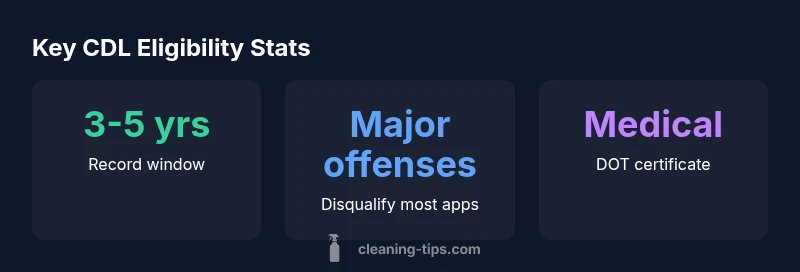
In most states, CDL eligibility hinges on a clean driving record within the recent history, typically the past 3-5 years. Major offenses such as DUI, reckless driving, or multiple serious violations can disqualify you, while minor infractions may be mitigated with time and a clean current record. Always verify state DMV requirements before applying.
What qualifies as a clean driving record for CDL?
According to Cleaning Tips, a clean driving record for CDL purposes goes beyond a single clean ticket. It emphasizes recency, pattern, and resolution of past incidents. Most states look back over a window—commonly 3 to 5 years—for major violations, motor vehicle incidents, and license suspensions. A clean record typically means either no major violations in that window and a consistent history of compliant driving, or a recent, uninterrupted period of safe driving with no new red flags. While some minor infractions may be reported, they are often weighed against the overall record and time since the incident. Employers also review the context: fault in an accident, frequency of tickets, and compliance with probation or court orders. Keeping a strong safety track record demonstrates reliability, which is especially important when applying to truck driving programs or fleet jobs. The Cleaning Tips team found that applicants who pair a clean record with a solid DOT medical clearance tend to progress through hiring pipelines more smoothly. A proactive approach—checking your MVR, disputing errors promptly, and maintaining a clean record going forward—can materially improve CDL prospects.
How different offenses affect CDL eligibility
CDL eligibility hinges on the nature of violations and their timing. Major offenses—such as driving under the influence, excessive speeding with a history of defensive driving failures, hit-and-run incidents, or reckless driving—often trigger immediate or extended disqualification, with the length of ineligibility varying by state and endorsement type. Repeated violations or a pattern of infractions can amplify risk, sometimes prompting stricter scrutiny or a longer wait before reapplication. Conversely, minor infractions (e.g., single speeding tickets) may be forgiven if they occurred outside the look-back window and a driver maintains a clean record since then. States also consider whether violations involved CDL-specific activities, such as hauling hazardous materials or operating commercial vehicles under suspension. When in doubt, request your MVR, review for accuracy, and consult the DMV for how a given offense affects your eligibility for particular endorsements and job opportunities.
The role of the medical certificate and driving record
The medical certificate (DOT physical) is a parallel pillar to the driving record. A CDL holder must meet medical fitness standards, and failing a medical check or having a restriction can affect eligibility regardless of record quality. While the driving record reflects safety history on the road, the medical certificate reflects the driver’s physical ability to operate a commercial vehicle. A driver with serious medical concerns or unaddressed conditions may be prohibited from licensure until medical issues are resolved or cleared by a healthcare provider. In practice, trucking companies weigh both: a strong driving history and a valid, current medical certification. If you’re rebuilding your record, make sure your medical status is up to date to avoid a secondary barrier to entry.
State-by-state variations you should know
CDL requirements and how records are evaluated differ by state. Some states emphasize a longer look-back period for violations than others, and endorsement-specific rules (e.g., hazmat, tankers) can impose stricter standards. Other variables include the treatment of out-of-state violations, the handling of suspensions or revocations, and the process for reinstatement after disqualification. Before applying, contact the state DMV or visit its official site to understand the precise thresholds, required waiting periods, and any steps to appeal or reinstate. If you plan to move between states, review how those states treat reciprocal records to avoid surprises. The goal is to have a plan that aligns with the state you’ll operate in and the endorsements you intend to pursue.
How to check and clean up your driving record
Begin by requesting a copy of your Motor Vehicle Record (MVR) from the state DMV or equivalent agency. Review it carefully for inaccuracies, such as misattributed tickets or errors in dates. If you find errors, file a correction request promptly and provide supporting documentation. For legitimate but blemished entries, gather evidence of safe driving, completion of defensive driving courses, and any court or DMV dismissals. Maintain ongoing records of your driving performance and keep a clean slate in the years ahead. Regular monitoring can prevent small issues from becoming roadblocks during CDL applications.
Steps to improve eligibility if you have a bad record
If you carry a less-than-ideal record, focus on concrete steps: drive safely to rebuild trust, complete defensive driving or traffic school when offered, and ensure compliance with all CDL-related requirements (medical, endorsements, training). Understand your look-back window and wait times; some improvements require months or years before they influence eligibility. Consider working with employers or training programs that understand your full record and look for pathways such as probationary or restricted CDL programs that may have more flexible entry criteria while you demonstrate safe driving habits.
Alternatives and path to CDL without a perfect record
For drivers with past issues, alternative paths exist: enrolling in reputable CDL training programs that emphasize safety, seeking employers known to hire drivers with prior blemishes, and exploring programs that sponsor entry with probationary conditions. Some fleets offer mentorship and graduated responsibilities to help you prove reliability while you rebuild your record. If a full CDL is blocked, you might explore entry routes like non-CDL operating licenses or regional routes that allow you to demonstrate training and safety compliance before scaling to full CDL endorsements.
Practical checklist before applying for CDL
- Obtain and review your MVR from your state DMV.
- Verify the look-back window and whether any offenses count as disqualifying.
- Ensure DOT medical clearance is current.
- Correct any inaccuracies in your record before applying.
- Gather evidence of defensive driving or corrective actions you completed.
- Contact potential employers to understand their acceptance criteria and timelines.
- Prepare to explain past incidents honestly and demonstrate what you’ve learned and how you’ve improved.
CDL eligibility data by common requirements
| Aspect | Typical Requirement | Notes |
|---|---|---|
| Record history window | 3-5 years | Varies by state; check DMV |
| Major violations | DUI, reckless driving | Typically disqualifying; severity matters |
| Medical fitness | DOT medical certificate | Required for CDL; renews periodically |
Questions & Answers
Do all CDL programs require the same driving record standards?
CDL programs share core standards for driving records but exact thresholds vary by state and endorsement. Check your state DMV for specifics.
CDL programs vary by state; check your DMV for specifics.
What counts as a major violation for CDL?
Major violations include DUI, driving under the influence, hit-and-run, reckless driving, and excessive operating while impaired. They often result in disqualification; some states require waiting periods.
Major violations usually disqualify CDL applicants.
How can I check my driving record for CDL eligibility?
Request your MVR from your state DMV; many states provide online access. Review for errors and remedy any inaccuracies.
You can request your record from the DMV online.
Can I get a CDL if I have a DUI on my record?
A DUI does not automatically disqualify you in all cases, but it often results in a period of disqualification or heightened scrutiny. Timing and rehabilitation matter.
A DUI can block or delay CDL eligibility.
How long do violations stay on a CDL record?
Duration varies by state and violation type; many records persist for years. Some infractions disappear with time and continued clean driving.
It depends on the state; some stay for years.
What should I do if my state disqualifies me?
Consult the DMV about reinstatement steps, possible training programs, and any appeal options. Follow prescribed remedies and document progress.
If disqualified, talk to the DMV about reinstatement.
“A clean driving record is essential for CDL eligibility, but it’s not the only gatekeeper—medical clearance and state rules also play critical roles.”
The Essentials
- Know your state's 3-5 year look-back window
- Major offenses commonly disqualify CDL applicants
- Check your MVR for errors and dispute inaccuracies
- Medical clearance interacts with driving record for eligibility
- State rules vary; verify requirements before applying