How to Check Clean IMEI: A Practical Guide for Buyers
Learn how to verify that a phone’s IMEI is clean using official databases, carrier checks, and cross‑registry comparisons. Step-by-step guidance helps you avoid stolen or unusable devices and protect your investment.


Learn how to check if an IMEI is clean and safe to use before buying or activating a phone. This quick guide outlines essential checks, including blacklist databases, carrier verification, and regional records. By following these steps, you can avoid stolen or unusable devices and protect your investment. It also helps you spot fraudulent sellers and end up with a legitimate device.
What does a clean IMEI mean?
A clean IMEI means the device isn’t reported stolen, lost, or fraudulently used across major networks. According to Cleaning Tips, a clean IMEI should not appear on any national or international blacklists and should be eligible for activation with typical carriers. This status gives you confidence that the phone can be used legally and without unexpected service blocks. In practice, a clean IMEI is linked to a record that shows the device was legally activated and has a verifiable ownership trail.
Understanding this concept helps you assess risk when buying used devices. If an IMEI is flagged, you might face problems like an inability to connect to networks, voided warranties, or disputes about ownership. While databases aren’t always perfectly synchronized, cross‑checking several sources dramatically lowers the chance of purchasing a problematic phone. The goal is to establish a multi‑source verification routine you can repeat for every used device.
Key sources to verify IMEI status
Verifying an IMEI involves consulting trusted databases and carrier records. The most authoritative source is the GSMA IMEI Database, which aggregates device information used by carriers worldwide. In addition, your national or regional carriers maintain their own blacklists and fraud registries that can flag a device for loss, theft, or fraud. Finally, government or official consumer protection sites often provide guidance on how to report stolen devices and how to verify authenticity when purchasing secondhand electronics. Cleaning Tips recommends cross‑checking across at least two sources to ensure accuracy and to avoid false positives.
Useful practical steps include confirming the IMEI against the device’s packaging and settings, then requesting a status printout or clearance letter from the carrier. If you’re shopping online, ask the seller for recent status screenshots from the carrier portal and a photo of the original receipt. Keeping a log of confirmations creates a solid paper trail should a dispute arise.
Home checks you can perform in minutes
Most checks can be done without specialized tools. Start by locating the IMEI on the device and on its original packaging, then verify that both numbers are identical. A common quick check is dialing *#06# on most phones to bring up the IMEI on screen. Compare this IMEI with the one printed on the SIM tray, box label, or purchase receipt. If any mismatch exists, stop and request clarification from the seller. Finally, copy the IMEI somewhere safe and run a quick online search for any obvious red flags associated with that number.
In addition to the on‑device checks, ensure the device’s model, color, and storage match the listing. A mismatch might indicate swapped hardware or improper labeling, which could be a sign of deeper issues. Document all findings in a simple note for later reference.
How to verify with a carrier and national databases
Contact the carrier directly via their official app or customer service channels and provide the IMEI. Ask specifically whether the IMEI is blacklisted, reported lost or stolen, or associated with any fraud cases. Depending on the carrier and country, you may receive an immediate answer or a verification within 24–72 hours. For regional compliance, check how the IMEI status aligns with national registries and consumer protection portals. Cleaning Tips emphasizes keeping records of every inquiry, including dates, names, and reference numbers, to support any future disputes.
If the carrier confirms a clean status, request a formal document or screenshot that confirms this status. If a problem is found, ask the seller for a resolution and consider returning the device if you purchased it recently.
What to do if the IMEI is flagged or inconsistent
When you encounter a flagged IMEI, pause the transaction and contact the seller for clarification or a refund. A reputable seller should provide documentation proving ownership and a legitimate origin. If the device is reported stolen, contact local authorities and avoid attempting to bypass the flag, which could expose you to legal risks. In cases of inconsistency between databases, request a carrier clearance and compare it with the GSMA database; discrepancies may indicate database synchronization delays or fraudulent tampering. Cleaning Tips recommends focusing on verifiable proof of purchase and carrier confirmations before finalizing any sale.
Best practices to prevent issues when buying used phones
To reduce risk, buy from trusted sellers with a clear return policy and a traceable ownership history. Ask for original receipts, unlock status, and carrier activation history. Before purchase, perform the home checks described above and save screenshots of the IMEI checks. Finally, maintain a personal log of all verifications and communications to support any future warranty or dispute needs.
Quick-start recap: your checklist for a clean IMEI
- Locate IMEI on device and packaging; ensure matches.
- Dial *#06# to display IMEI; compare with labels.
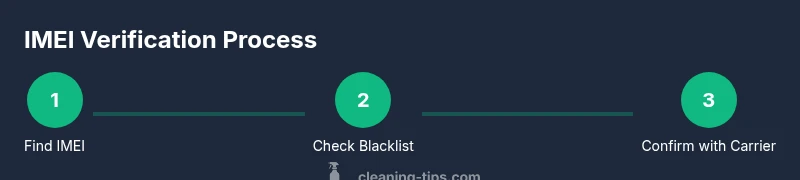
- Check GSMA IMEI database and carrier status.
- Request carrier clearance or proof of ownership from the seller.
- Keep records of all verifications for future reference.
Tools & Materials
- Smartphone/device to check(Fully functional or seized from seller with intact IMEI labels)
- Stable internet connection(For database lookups and carrier portals)
- Original packaging or receipt(IMSI/IMEI label must match device)
- SIM card (optional but helpful)(To confirm carrier service after verification)
Steps
Estimated time: 25-40 minutes
- 1
Find the IMEI on the device
Inspect the device’s settings menu (About phone/Status) and the SIM tray label to locate the 15-digit IMEI. If the device is sealed or inaccessible, rely on the packaging label that matches the serial number. Document the IMEI in your notes for cross‑check later.
Tip: Tip: Use two sources (settings and packaging) to verify accuracy. - 2
Display IMEI on-screen
Dial the common US/UK code *#06# to display the IMEI on the screen. If the device is locked, the on-screen code may still show an IMEI during startup or in the boot menu. Confirm the IMEI on screen matches the one you found earlier.
Tip: Tip: Take a photo of the on-screen IMEI for your records. - 3
Cross-check with packaging/receipt
Compare the IMEI shown on the device with the label on the box and the purchase receipt. Any mismatch should be resolved with the seller before proceeding.
Tip: Tip: If packaging is missing, request official documentation from the seller. - 4
Verify status with GSMA database
Access the GSMA IMEI database or your country’s equivalent and search the 15‑digit number. Look for flags such as stolen, lost, or fraud; absence of flags is a positive sign, though it’s not a guarantee.
Tip: Tip: Note the database search date for reference. - 5
Check carrier status
If possible, contact the carrier to confirm the IMEI status. Ask whether the device is clean, unlocked, and eligible for service on their network. If needed, request a carrier clearance letter.
Tip: Tip: Use official carrier apps or websites—not third‑party services. - 6
Ask for proof of ownership
Request the seller’s proof of purchase and a written statement of device origin. This reduces risk if the IMEI status changes after the sale.
Tip: Tip: A notarized bill of sale or retailer invoice adds credibility. - 7
Record results and plan next steps
Keep a consolidated file with all IMEI checks, dates, and contact references. If any red flag remains, consider returning or canceling the purchase.
Tip: Tip: Create a simple checklist you can reuse for future purchases.
Questions & Answers
What does it mean if an IMEI is not clean?
An IMEI not marked as clean can indicate the device is stolen, lost, or involved in fraud. It may be blacklisted by carriers or flagged in databases, which could prevent activation on networks. Always verify with multiple sources before purchasing.
A non-clean IMEI usually means the phone is flagged for theft or fraud and may not work on networks. Verify with carriers and databases before buying.
Can I check IMEI for a stolen phone without the original seller?
Yes. You can verify the IMEI status with the carrier and by checking international and regional databases. If the status is unclear, ask for a return or choose a different device. Always request official documentation when possible.
You can verify with the carrier and registries even if you don’t have the seller. If in doubt, return the device.
How do I find the IMEI on iPhone and Android devices?
On iPhone, go to Settings > General > About and look for the IMEI. On most Android devices, go to Settings > About phone > Status. You can also check the SIM tray label or the original box. Cross-check all three sources.
On iPhone, check Settings > General > About. On Android, go to Settings > About phone. Also verify the SIM tray and box labels.
Are there risks to checking IMEI status?
The act of checking an IMEI is generally safe and private, but beware of sites offering paid lookups or promising instant approval. Use official portals and reputable carriers. Avoid providing details to unreliable third-party services.
IMEI checks are usually safe if you use official portals. Be cautious with shady sites.
How long does carrier verification take?
Carrier verification times vary by country and carrier. Some provide instant results, while others may take several hours or a day. Plan ahead if you’re buying from a marketplace with tight timelines.
Carrier checks can be instant or take a few hours to a day depending on the carrier.
What records should I keep after verification?
Keep copies of all IMEI checks, carrier confirmations, receipts, and any correspondence with the seller. These documents support warranty claims or disputes later.
Save all IMEI check results and receipts to protect yourself if problems arise.
Watch Video
The Essentials
- Check IMEI across multiple databases before purchase
- Match IMEI on device, packaging, and settings
- Request carrier clearance and ownership proof
- Keep records for warranty or disputes