How to Fix Cleaned Contacts in Mailchimp: A Practical Guide
Learn a practical, step-by-step method to fix cleaned contacts in Mailchimp: restore legitimate subscribers, deduplicate, re-import correctly, and maintain long-term audience hygiene for compliant campaigns.


To fix cleaned contacts in Mailchimp, identify the Cleaned status, restore legitimate emails, remove duplicates, and re-import valid subscribers. Enable double opt-in and schedule periodic audits to keep your audience healthy. See our detailed step-by-step guide.
Understanding Mailchimp contact status
According to Cleaning Tips, understanding the status codes in Mailchimp is the first step to fixing cleaned contacts. When a contact is labeled Cleaned, Mailchimp no longer sends campaigns to that address; this usually happens after repeated bounces or complaints. In this section we’ll explain what each status means and how to safely reverse a Cleaned status when appropriate.
Why contacts get marked as Cleaned
Cleaned status typically results from repeated hard bounces, spam complaints, or inactivity signals. Mailchimp uses suppression to protect deliverability, and legitimate subscribers can sometimes be caught in the sweep. To reduce future Cleaned flags, maintain clean signup lists, avoid purchased emails, and validate addresses at capture. Regularly review suppression lists and ensure approved signups are not mistakenly suppressed.
Safely restoring legitimate subscribers
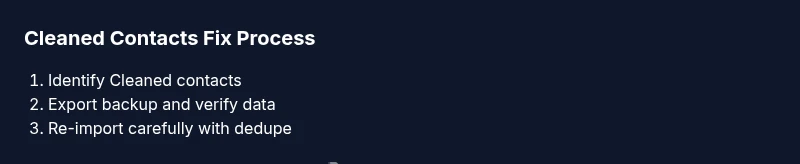
Before reactivating any contact, confirm consent and verify the contact’s history. Start by exporting the current audience, reviewing bounce details, and segmenting out contacts with suspicious activity. Rebuild a clean list by re-adding only confirmed subscribers, and use a controlled re-import process with de-duplication to prevent accidental duplicates.
Cleaning vs suppressing vs archiving
Understanding the differences helps you maintain hygiene without losing data. Cleaning marks a contact as Cleaned due to issues in the delivery path. Suppression is a strategic list that prevents emails from being sent. Archiving preserves records without active engagement. Use suppression for ongoing delivery control and archive older, inactive contacts to reduce clutter.
Re-importing and deduping strategies
When you re-import, use a clean CSV with headers that match Mailchimp fields (email, first name, last name, etc.). Enable deduping by email and set the action to update existing contacts where appropriate. Exclude rows with unsubscribe status. Validate that bounced addresses are not re-added and test with a small batch first.
Best practices to maintain list health
Adopt a routine that includes double opt-in, periodic list hygiene checks, and clear opt-out processes. Segment your audience by engagement, re-engage inactive subscribers with targeted campaigns, and monitor deliverability metrics. Keep your subscriptions compliant with anti-spam laws and Mailchimp guidelines to sustain high inbox placement.
Tools & Materials
- CSV export of current audience(Backup before making changes; export with headers for re-import.)
- Mailchimp account access (admin recommended)(Ensure you have authority to re-import and modify lists.)
- Spreadsheet app (Excel/Google Sheets)(Use for deduping and validating addresses.)
- Backup storage (external drive or cloud)(Store the original export for rollback.)
Steps
Estimated time: 60-90 minutes
- 1
Identify Cleaned Contacts
Open Mailchimp and filter your audience to the Cleaned status. Review a sample to confirm the criteria used by Mailchimp and note any legitimate addresses that might have been flagged.
Tip: Take a backup before proceeding to avoid data loss. - 2
Export and Back Up
Export the current audience to CSV and store it securely. This snapshot protects you if you need to revert changes.
Tip: Label the file with a date and reason for traceability. - 3
Verify Legitimacy
Cross-check the flagged emails against recent signups and activity logs. Exclude any that lack consent or engagement evidence.
Tip: Use a secondary confirmation method (e.g., welcome email) before re-importing. - 4
Deduplicate and Prepare
Remove duplicates and prepare a clean list of emails to re-import. Ensure headers align with Mailchimp fields.
Tip: Keep a separate note of any changes you make to the source data. - 5
Re-import with Care
Import the curated list in small batches, enabling deduping and checking for unsubscribe status. Validate that bounced emails remain excluded.
Tip: Test a sample (e.g., 50-100 contacts) before full import. - 6
Implement Double Opt-In
Enable double opt-in to reduce future Cleaned statuses. Send a confirmation email and monitor engagement.
Tip: Document opt-in settings for compliance audits.
Questions & Answers
What does the 'Cleaned' status mean in Mailchimp?
Cleaned indicates Mailchimp has suppressed delivery to that contact due to previous issues like bounces or complaints. A cleaned contact is not sent campaigns until reactivated with proper consent.
Cleaned means Mailchimp has suppressed that address because of delivery issues; you may reactivate with consent after review.
Can I reactivate a Cleaned contact?
Yes, but only after verifying consent and updating data. Re-import in a controlled way to avoid immediate re-cleaning.
Yes, you can reactivate after verification, but do it carefully and in small batches.
What steps reduce future Cleaned statuses?
Implement double opt-in, clean signups at capture, and regularly audit your list to remove invalid or inactive addresses.
Use double opt-in and regular audits to prevent future Cleaned statuses.
Difference between cleaning and suppressing?
Cleaning marks as Cleaned due to issues, while suppression is a strategic list-based block used to prevent sends.
Cleaning flags a contact; suppression blocks sends intentionally.
How often should you audit Mailchimp lists?
Run a list hygiene check at least monthly, and after major campaigns or imports.
Audit monthly or after big campaigns to maintain health.
Watch Video
The Essentials
- Identify Cleaned statuses before acting
- Back up audience data prior to changes
- Deduplicate and verify legitimacy carefully
- Enable double opt-in to protect future health