How to Put Cleaning on Your Resume: A Practical Guide
Learn how to showcase cleaning experience on your resume with clear sections, transferable skills, and ATS-friendly formatting that impress hiring managers.


This guide explains how to put cleaning on your resume by translating cleaning tasks into transferable skills, choosing the right sections, and using quantifiable language. You’ll learn to tailor content to the job, optimize for ATS, and present clear examples that demonstrate reliability and safety awareness.
Why Cleaning Skills Matter on a Resume
If you’re targeting custodial, facility, healthcare support, or hotel housekeeping roles, your cleaning responsibilities can translate into powerful, job-ready competencies. The question of how to put cleaning on resume often trips people up because cleaning tasks sound routine, but they embody essential professional strengths: dependability, attention to detail, safety compliance, time management, and teamwork. According to Cleaning Tips, presenting these duties as outcomes that support business operations helps recruiters understand your value quickly. In this article you’ll learn to reframe tasks, align keywords with job postings, and structure content so a hiring manager sees relevance within seconds. The goal is to show that your cleaning work isn’t just chores—it’s a set of transferable skills with measurable impact on safety, efficiency, and guest or patient satisfaction.
A strong resume tells a story: you’re someone who can maintain high cleanliness standards, reduce risk, and keep operations running smoothly. By the end of this guide, you’ll have a clear plan to highlight cleaning experiences across sections, with precise language and convincing examples that resonate with employers across industries.
Translate Cleaning Tasks into Transferable Skills
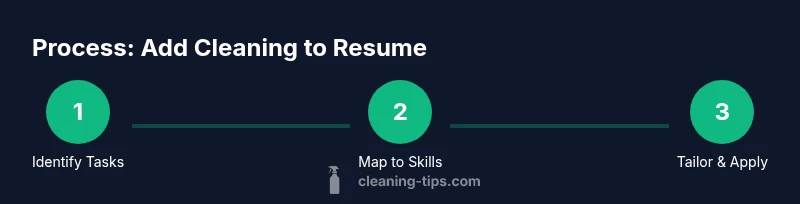
Cleaning work is a practical laboratory for skills that employers across industries value. Start by listing routine duties (sanitizing surfaces, restocking supplies, following safety protocols) and map each task to a corresponding skill category: time management, quality control, safety compliance, teamwork, and customer service. For example, routine sanitization requires attention to detail and adherence to protocols; restocking demonstrates organization and inventory awareness; coordinating with teams shows collaboration and communication. By framing tasks this way, you demonstrate that cleaning work builds a robust baseline of professional competencies. As you craft bullets, focus on verbs that convey action and outcomes, such as maintained, enforced, trained, or implemented. Also remember to tailor terms to the job posting—use the exact keywords the employer is likely to search for, including industry-specific phrases where applicable.
Because the Cleaning Tips team has found, employers value candidates who can describe how their cleaning routine reduced risks and supported operations. Translate your everyday duties into terms that hiring managers recognize as business-driving activities: reducing hazards, improving efficiency, and ensuring a consistently safe environment.
Structure Your Resume to Highlight Cleaning Experience
There are three practical places to spotlight cleaning work: the Summary, the Skills section, and the Experience bullets. In the Summary, include a concise line that positions you as a reliable cleaning professional with a track record of maintaining high standards. In Skills, assemble a short list of hard and soft skills: sanitation protocols, safety compliance, inventory management, customer service, teamwork, and equipment operation. In Experience, craft bullets that begin with an action verb and end with the result or impact. Where possible, align bullets with keywords from the job description. If you have limited history, consider a dedicated Cleaning Experience subsection under Experience, or a separate Projects section for freelance or volunteer cleaning work. Finally, ensure your formatting is ATS-friendly: simple bullet formatting, no unusual fonts, and standard headings.
Craft Clear, Action-Oriented Bullet Points
Bullet points are your primary vehicle for conveying cleaning competence. Each bullet should start with a strong verb and follow the pattern: action + scope + result. For example, instead of saying you 'cleaned bathrooms,' write 'maintained restroom cleanliness and sanitization in a high-traffic facility, meeting safety standards and improving guest satisfaction scores.' If you can quantify, include a metric (e.g., 'reduced restocking frequency by coordinating supplies with a centralized system'). Keep bullets concise—one line per duty—so recruiters skim quickly. When possible, tie the bullet to a job requirement you’ve seen in postings for the role you want. This focused approach makes your cleaning experience relevant rather than generic.
Keywords, ATS, and Compliance
Applicant Tracking Systems (ATS) scan for keywords. Create a keyword bank from the job posting and integrate it naturally into your bullets, but avoid keyword stuffing. Include terms like sanitation protocols, PPE, chemical storage, OSHA standards, hazard communication, and equipment operation for cleaning machines. Use regional or industry-specific terms when applicable (e.g., 'hospital-grade disinfectants' for healthcare settings). A carefully crafted Skills section can also help: include both hard skills (equipment operation, sanitation procedures) and soft skills (time management, reliability). The key is to present cleaning as a professional capability rather than a series of chores. This approach aligns with best practices from Cleaning Tips and helps you pass ATS checks and capture human attention.
Examples of Resume Snippets for Cleaning Roles
Here are representative bullet examples you can adapt. Each demonstrates how to turn a routine cleaning task into a strong, results-focused statement:
- Maintained high sanitation standards across restrooms and kitchens, adhering to safety protocols and reducing complaints.
- Operated floor care equipment and implemented routine maintenance checks to ensure consistent cleanliness and safety compliance.
- Collaborated with team members to coordinate inventory and cleaning schedules, improving workflow efficiency and on-time task completion.
- Trained new staff on PPE usage and chemical handling, reducing incidents and enhancing overall safety culture.
- Implemented a centralized supply system, cutting downtime for cleaning tasks and improving response times to requests.
Tailoring for Different Cleaning-Related Roles
Different roles value different aspects of cleaning work. For custodial positions in schools or offices, emphasize reliability, safety, and consistent quality. For healthcare or laboratory environments, highlight infection control training, environmental services procedures, and strict PPE compliance. For hotel or hospitality roles, emphasize guest-facing service, speed, and flexibility during peak times. When tailoring, adjust your bullet emphasis to match the job description, reorder sections to prioritize the most relevant experiences, and consider adding a brief Certifications or Training section if you hold relevant credentials. The tailoring process should feel deliberate, not generic.
Common Pitfalls to Avoid and a Quick Check-List
Avoid vague statements like 'did cleaning stuff' or 'worked hard.' Replace with targeted, outcome-focused bullets. Don’t overstate responsibilities or imply duties you didn’t perform. Use numbers sparingly and only when you have a verifiable basis. Always proofread for grammar, consistency, and formatting. Finally, run your resume through an ATS-friendly checklist: plain fonts, standard headings, and clean bullet structure. A deliberate, clean presentation communicates professionalism and helps your cleaning experience shine.
Sample Final Snippet You Can Adapt Today
Dedicated cleaning professional with a track record of maintaining high sanitation standards in fast-paced environments. Proficient in PPE usage, chemical handling, and equipment operation. Strong communicator and team player who consistently meets safety and quality targets while delivering reliable service.
Final Recommendations and Next Steps
Before sending your resume, review the job posting again to ensure alignment with the required terms. Consider a short portfolio or document listing notable cleaning projects, certifications, or reference statements from supervisors. Aim for a clean, ATS-friendly layout and a strong, reader-focused narrative that demonstrates how your cleaning experience supports the employer’s goals. Remember: the way you present cleaning work matters as much as the work itself.
Tools & Materials
- Updated resume template (Word/Google Docs)(ATS-friendly, clean typography)
- Job description or target posting(To tailor keywords and bullets)
- Action verbs bank(Include varied, strong verbs)
- Metrics and outcomes examples(Templates to quantify impact when possible)
- Certifications or training records (optional)(OSHA, safety, or cleaning-related courses)
- Glossary of cleaning terms (optional)(Industry terms to increase relevance)
Steps
Estimated time: 45-60 minutes
- 1
Gather the job description
Collect the posting you want to apply to and highlight required skills. This provides the keywords you’ll target in your resume when describing your cleaning experience.
Tip: Note the phrases that show expectations (e.g., 'safety protocols', 'PPE', 'time management') and plan to incorporate them verbatim. - 2
List cleaning tasks you performed
Create a master list of duties from your work history, volunteer roles, or internships. Include routine tasks and any special projects (e.g., deep cleans, equipment maintenance).
Tip: Be honest and precise; omitted tasks should not imply you did more than you did. - 3
Map tasks to transferable skills
For each duty, identify the skill it demonstrates (e.g., attention to detail, safety compliance, teamwork).
Tip: Use a one-to-two-word skill label and then a brief outcome sentence. - 4
Choose the right resume sections
Decide where to place cleaning experience: Summary, Skills, Experience bullets, and/or a dedicated Cleaning Experience subsection.
Tip: Keep consistent formatting and ensure the sections are easy to scan. - 5
Draft impact-focused bullets
Write bullets that start with a strong verb and end with a result or alignment to the job posting.
Tip: Avoid generic phrasing; tailor each bullet to align with the target role. - 6
Incorporate relevant keywords
Integrate exact keywords from the posting, including industry terms and acronyms where applicable.
Tip: Don’t overstuff; ensure natural reading flow and readability. - 7
Refine for ATS and humans
Ensure simple formatting, standard headings, and accessible language for both ATS and a human reader.
Tip: Test the resume by running it through an ATS-friendly checklist. - 8
Add certifications or training (optional)
If you have safety, cleaning, or equipment certifications, place them where recruiters expect to see credentials.
Tip: Include cert names, issuing organizations, and dates when possible. - 9
Proofread and finalize
Check for spelling, grammar, and consistency in tense and formatting. Save as PDF for submission when required.
Tip: Have someone else review for clarity and impact.
Questions & Answers
How long should the cleaning experience section be on my resume?
There’s no fixed length, but focus on the most relevant and recent cleaning-related responsibilities. Prioritize quality over quantity and ensure each bullet adds value for the target job.
Keep it concise and relevant; focus on the most impactful cleaning duties that match the job posting.
Where should I place cleaning experience if I have a short work history?
Place a concise Cleaning Experience subsection under Experience or blend it into your Summary and Skills. Use a bullet for each role that highlights key results and transferable skills.
Highlight the most relevant cleaning duties and skills early, then add any supporting experiences later.
Should I include certifications related to cleaning on my resume?
Yes, include certifications such as safety, PPE handling, or equipment operation where relevant. They reinforce safety and professional capability.
Certifications strengthen your candidacy by proving you meet safety and operational standards.
Is it okay to generalize cleaning duties for different jobs?
Generalizing can help when you’re applying across industries, but tailor at least a core set of bullets to reflect industry-specific requirements.
Tailor bullets to emphasize how your cleaning work translates to the new role.
How do I tailor my cleaning experience to a healthcare cleaning job?
Emphasize infection control, chemical handling, and compliance with health and safety standards. Mention PPE and trainingSpecific to healthcare settings.
Highlight safety and infection control training, and your ability to work in sensitive environments.
Watch Video
The Essentials
- Identify and map cleaning tasks to transferable skills
- Structure content into Summary, Skills, and Experience with a dedicated Cleaning section if needed
- Use strong verbs and job-aligned keywords to pass ATS and engage recruiters
- Quantify impact where possible and tailor bullets to the role
- Proofread thoroughly and keep formatting clean and consistent