How to Stop DiskPart Clean All Safely: Step-by-Step Guide
Learn how to safely stop a DiskPart clean all operation, when to abort, and how to minimize data loss. Cleaning Tips provides clear steps, warnings, and recovery guidance for safe interruption and post-event checks.


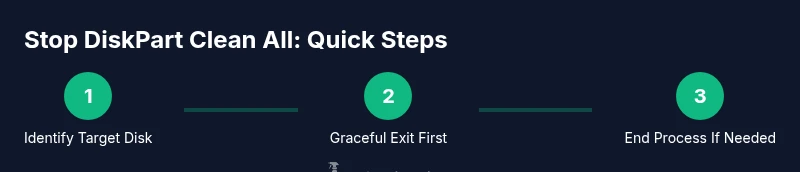
To stop a DiskPart clean all operation, immediately exit DiskPart and close the command prompt, or end the diskpart.exe process in Task Manager. If the command is actively writing, aborting may leave the disk in an unstable state. When possible, power down gracefully or allow the operation to finish before handling the drive. According to Cleaning Tips, plan backups and safety checks before destructive commands.
how to stop clean all diskpart safely
DiskPart is a powerful Windows utility that can completely erase a drive when you run the command clean all. If you realize a mistake or the operation is not wanted, your first priority is to stop further writes and prevent additional data loss. In this guide, how to stop clean all diskpart is addressed with a practical, safety-first approach. According to Cleaning Tips, always back up data before attempting any destructive operation and confirm you are targeting the correct disk. This reduces the risk that an accidental stop becomes a data-recovery nightmare. The moment you suspect you need to halt the process, begin with calm, deliberate steps to minimize potential damage and preserve options for recovery.
Immediate signs that you may need to interrupt
When DiskPart begins a clean all, you will see a progress indicator or a blank screen under the command prompt as sectors are overwritten. If you discover you selected the wrong disk or you are not ready to erase the drive, you should begin the interruption process immediately. Note that interrupting a clean all can leave partitions in an unstable state, so every second counts for safety. The Cleaning Tips team emphasizes preparation: backups, a clear target, and a plan for recovery before you ever start a destructive task.
Immediate abort methods: graceful vs hard stop
A graceful abort means exiting DiskPart cleanly and stopping the command session, which is preferable to a hard shutdown. Start by typing exit to leave DiskPart, then close the command prompt window. If DiskPart is unresponsive, you can try pressing Ctrl+C to interrupt the current command, then close the window. In stubborn cases, you may need to end the diskpart.exe process via Task Manager. Each method has its own risk; graceful exits reduce the chance of leaving a corrupted partition table, whereas a hard stop increases recovery complexity.
If DiskPart is unresponsive: forceful termination
When DiskPart refuses to exit, you may need to force the process to end via Task Manager. Open Task Manager, locate diskpart.exe, and End Task. Do not end other critical system processes. After termination, reboot gracefully if possible and use the OS disk management tools to inspect disk health. For systems with important data, observe that forceful termination can leave the drive in an inconsistent state, which may require partition re-creation or data recovery steps described later in this guide.
Verifying drive state after an interruption
Once the operation is stopped, verify the disk status before performing any new actions. Use Disk Management or diskpart to list disks and partitions, checking for missing or corrupted entries. If partitions are intact but unformatted, you may need to re-create them. If the drive shows unexpected free space or a blank state, run chkdsk and a surface scan to assess integrity. Always cross-check with backups to ensure no valuable data was irretrievably lost.
Recovery options and backups: what to do next
If you backed up before starting, you can restore data from the backup after stopping the operation. If you did not back up, data recovery becomes more challenging and may require professional services. At minimum, document what you attempted, capture error messages, and avoid writing new data to the drive until you’ve assessed health. The goal is to recover the usable state of the disk and move forward with a safe plan for re-partitioning or reformatting if needed.
Safer alternatives to destructive cleaning and prevention tips
In general, reserve DiskPart clean all for cases where you truly intend to wipe a drive. For routine maintenance, prefer safer commands like clean (not clean all) or partition management without erasing user data. Implement a robust backup routine, double-check disk selection before executing commands, and consider using a virtual environment or non-critical test drives when practicing DiskPart. These practices reduce the need to stop mid-operation and protect your data assets.
Troubleshooting common issues after stopping a drive operation
If you observe any boot issues or missing partitions after an interruption, run a recovery plan: boot from Windows installation media, access Repair options, and use diskpart to re-scan the disk. If partitions appear damaged, use partition recovery tools or backup restoration to bring the disk back to a usable state. Keep in mind that each interruption changes the disk’s state, so proceed cautiously and verify with multiple diagnostics.
Tools & Materials
- Windows PC with DiskPart access(Run as Administrator to access full DiskPart capabilities)
- Backup media (external drive or cloud storage)(Crucial before destructive operations; keep latest copy)
- Accurate disk identification tools(Use diskpart, Disk Management, or vendor tools to verify target disk)
- Task Manager access (optional for unresponsive cases)(End diskpart.exe if it won’t respond to exit)
- Uninterruptible power source (UPS)(Minimizes risk of mid-operation power loss)
Steps
Estimated time: Total time: 20-45 minutes
- 1
Identify target disk before proceeding
Open DiskPart and run list disk to confirm the exact disk you plan to erase. Cross-check size, model, and status against your equipment inventory. This minimizes the risk of stopping at the wrong drive.
Tip: Double-check the disk number with two independent identifiers (size and model) before selecting. - 2
Prepare backups and a recovery plan
Ensure a verified backup exists on separate media. Document the exact drive and partitions involved, and establish a rollback plan in case the stop action disrupts the disk state.
Tip: Backup verification saves time if data restoration becomes necessary. - 3
Attempt a graceful exit first
If the operation is still in the command prompt, type exit to leave DiskPart, then close the console. This minimizes risk compared to hard termination.
Tip: Graceful exit is preferred; it reduces the chance of partial writes on the target disk. - 4
Use Task Manager only if unresponsive
If DiskPart ignores exit or the console is frozen, open Task Manager and end diskpart.exe. Do not end other critical processes. Then perform a safe reboot if necessary.
Tip: Ending the wrong process can destabilize the system; proceed carefully. - 5
Verify disk health after stopping
Boot back into Windows and use diskpart or Disk Management to list disks and partitions. Run checks like chkdsk when appropriate to confirm integrity.
Tip: Document any anomalies observed for future reference. - 6
Restore from backup if data was lost
If data was erased unexpectedly, restore from the backup you created beforehand. If backups are unavailable, prepare for potential data-recovery options.
Tip: A restore plan is faster than scrambling to recreate data.
Questions & Answers
Can I pause DiskPart clean all once it starts?
DiskPart does not support pausing a clean all operation. If you need to stop, exit DiskPart or end the process gracefully or via Task Manager, then assess the disk state afterward.
DiskPart can’t be paused. Exit DiskPart or end the process, then check the disk.
What happens if I forcibly end DiskPart during a clean all?
Interrupting mid-write can leave the disk in an unstable state with partially overwritten sectors or corrupted partitions. Recovery can be more complex and may require partition re-creation or professional services.
Interrupting may leave partitions unstable and require re-creation or recovery.
Is there a safe way to stop DiskPart without data loss?
The safest approach is to exit DiskPart gracefully before triggering a destructive operation and to ensure a current backup exists. If the operation is already in progress, end the process and proceed with recovery steps as needed.
Safe stopping means exiting gracefully and having a backup.
How can I recover data after stopping a DiskPart clean?
If you backed up beforehand, restore from the backup. If not, data recovery becomes uncertain and may require professional services. Always document the steps you took and avoid writing new data to the drive during recovery.
Restore from backup first; otherwise seek professional data recovery and avoid more writes.
How do I avoid accidentally running a destructive DiskPart command?
Double-check the target disk with list disk and detail disk before selecting. Use read-only or non-destructive commands when practicing, and keep destructive operations behind explicit confirmations.
Always verify the target and use non-destructive commands when practicing.
Should I run DiskPart again after stopping?
Only after you confirm the disk is healthy and partitions state is correct. Reassess the need for any destructive action and proceed with caution.
Only retry DiskPart if the drive is healthy and you understand the risks.
Watch Video
The Essentials
- Identify the correct disk before taking action.
- Prefer graceful exits to avoid partial writes.
- End the diskpart process safely if needed, then verify health.
- Restore from backup if data loss occurs.
- Adopt safer workflows to prevent needing to stop in the first place.