Are Cleanser and Face Wash the Same? A Practical Guide
Explore whether are cleanser and face wash same, how formulations and routines differ, and how to choose the right product for your skin. Learn distinctions, myths, and practical tips from Cleaning Tips.


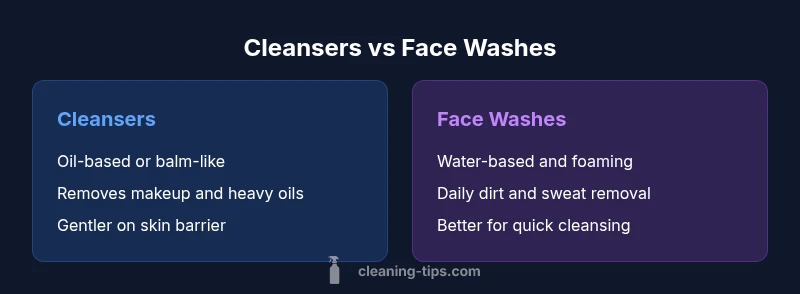
Bottom line: are cleanser and face wash same? Not always, though both cleanse the skin. Cleansers are often oil-based or balm-like for makeup removal and barrier-friendly cleansing, while face washes are usually water-based foaming cleansers for daily dirt. This quick comparison helps you decide which to reach for in your routine. Understanding the distinction can improve hydration, irritation risk, and makeup removal.
The core distinction: are cleanser and face wash same
A common question is: are cleanser and face wash same? The short answer is no, though the terms are often used interchangeably in stores and tutorials. In practice, cleansers are typically oil-based or balm-like products designed to dissolve makeup, sunscreen, and heavy oils, while face washes are water-based cleansers that produce a gentle or moderate lather to lift dirt and sweat from the surface. Understanding this distinction helps you pick the right product for your skin and routine. According to Cleaning Tips, clarifying product categories can reduce confusion and improve outcomes. Separating these concepts is not merely semantic; it shapes how you approach makeup removal, hydration, and barrier support. If you regularly wear sunscreen or makeup, a balm or oil cleanser can simplify removal before a secondary cleanse. The opposite approach—starting with a foaming face wash—might be more convenient for a quick morning cleanse but could be less effective at dissolving heavy products. The key is to align your cleanser type with your skin’s needs and the rest of your routine, rather than relying on marketing claims alone.
Are cleanser and face wash same? In practice, the categories overlap, but the default difference lies in formulation and primary function. Cleanser types tend to prioritize makeup removal and barrier-friendly cleansing, while face washes focus on surface dirt and oil control.
Comparison
| Feature | Cleansers | Face Washes |
|---|---|---|
| Key purpose | Dissolve makeup/oil; often gentle hydration support | Daily surface cleansing; removal of dirt and sweat |
| Typical formulations | Oil-based, balms, or blends that emulsify with water | Water-based gels or creams with surfactants; foaming action |
| Best for | Dry or sensitive skin; makeup removal and gentle cleansing | Oily or combination skin; quick daily cleansing |
| Texture/foam | Creamy, balm-like; minimal foam | Foamy gel or cream with noticeable lather |
| pH balance | Often slightly acidic; varies by formula | Usually balanced toward skin-friendly pH; can be more surfactant-heavy |
| Skin type suitability | Gentler on fragile barriers; good for makeup days | Effective for oil control and larger cleansing areas |
| Recommended frequency | Daily use; often twice daily with makeup removal | Daily use; avoid aggressive scrubbing or over-cleansing |
| Price range | Low to mid-range depending on formula | Low to mid-range; pricing varies by brand and ingredients |
Strengths
- Helps tailor cleansing to skin goals (hydration vs. oil control)
- Broad range of textures and sensitivities across products
- Clear labeling helps reduce confusion for shoppers
- Supports skin barrier when chosen by skin type and climate
Weaknesses
- Labeling and marketing claims can still be inconsistent
- Over-choice can lead to decision fatigue
- Some products overpromise exfoliation or hydration without evidence
- Prices do not always reflect efficacy, leading to trial-and-error purchasing
Neither option is universally superior; choose based on skin type and cleansing goals.
For most people, the right choice depends on your skin’s needs and your routine. If you wear makeup or have dry, sensitive skin, a balm or oil cleanser followed by a gentle cleanser can improve outcomes. If you’re managing oil and daily grime, a well-formulated face wash may suffice. The best path is to test and adapt to your skin’s response.
Questions & Answers
What is the main difference between a cleanser and a face wash?
The main difference lies in formulation and primary function: cleansers are often oil-based or balm-like to dissolve makeup and heavy residues, while face washes are typically water-based foaming cleansers designed for daily cleansing of surface dirt. Both aim to clean but approach cleansing differently.
Cleansers tend to be oil-based for makeup removal; face washes are often foamy and water-based for daily cleansing.
Can I substitute a cleanser for a face wash in my routine?
You can substitute in many cases, but you may notice differences in residue, hydration, and barrier feel. If you wear makeup or have dry skin, a balm/oil cleanser followed by a gentle rinse may be preferable. For a simple, quick cleanse, a mild face wash can work but may require moisturizer afterward.
You can swap them, but expect different results in hydration and makeup removal.
Is a face wash suitable for dry or sensitive skin?
Some face washes are formulated for dry or sensitive skin, using gentler surfactants and soothing ingredients. However, many foaming cleansers can be drying, so look for labels like 'hydrating' or 'fragrance-free' and consider patch testing.
Look for gentler formulas and fragrance-free options for sensitive skin.
Should I use a cleanser every day?
Most people benefit from cleansing daily, but how often depends on your skin type and environment. If you have oily skin or sweat a lot, a twice-daily routine may help; if you have very dry or reactive skin, you may reduce cleansing frequency or use a gentler product.
Daily cleansing can be fine, but pick a gentle option if your skin is dry or sensitive.
Do cleansers have exfoliating properties?
Some cleansers include gentle exfoliating ingredients or physical scrubs, but most cleansing products focus on makeup removal and dirt removal without exfoliating. If exfoliation is a goal, look for products labeled as exfoliants or containing AHA/BHA in controlled concentrations.
Exfoliation is usually separate from cleansing unless specified.
How do I know if a cleanser or face wash is right for my skin?
Start with your skin type, climate, and routine requirements. Patch-test new products, observe changes in moisture, irritation, and breakouts over 2-4 weeks, and adjust. Reading ingredient lists helps identify potential irritants or triggers.
Test and observe how your skin responds over a few weeks.
The Essentials
- Identify your skin type before choosing
- Prefer oil-based cleansers for makeup removal
- Opt for water-based cleansers for quick daily cleansing
- Check pH and fragrance to minimize irritation
- Test products and adjust your routine over time