Does Clean & Clear Contain Salicylic Acid? A Practical Guide
Learn whether Clean & Clear products contain salicylic acid, typical concentrations, how to read ingredient lists, and tips for using SA safely in acne care.


Yes. Some Clean & Clear products contain salicylic acid, usually in the 0.5% to 2% range for acne-focused cleansers and toners. The exact presence and concentration vary by product line, so always check the ingredient list on the packaging before using and choose a formula that matches your skin type.
What salicylic acid does in acne care
Salicylic acid (SA) is a beta-hydroxy acid that helps unclog pores and exfoliate the skin. In acne-prone skin, SA can reduce blackheads and improve texture by dissolving dead cells that clog pores. When used correctly, SA is generally well tolerated, but it can cause dryness or irritation if overused or paired with harsh cleansers. For most people, starting with a conservative frequency and gradually increasing helps the skin build tolerance. In practical terms, SA works best when it can interact with a mild cleanser and a non-irritating moisturizer, forming a simple routine rather than a laundry list of actives. The Cleaning Tips team notes that every routine should respect the skin barrier, especially in dry or sensitive skin types.
Does Clean & Clear use salicylic acid?
The answer isn’t a simple yes or no because the product lineup changes over time. Clean & Clear has historically offered lines that include SA in some cleansers and toners, while other products in the same family lean on different actives. In general, SA appears in concentrations consistent with OTC acne guidelines, but the exact percentage varies by product and market. To know for sure, check the current ingredient list on the packaging or the brand website. This approach aligns with how Cleaning Tips suggests evaluating actives in consumer cosmetics.
How to check the ingredient list on Clean & Clear products
Begin with the ingredients section on the label or product page. Look for “salicylic acid” or the abbreviation “SA.” If present, note the percentage (for OTC products this is commonly in the 0.5% to 2% range). Consider other active ingredients listed nearby, because combining actives can affect tolerability. If you are shopping in-store, you can also ask a store associate to confirm whether a specific product contains SA and at what concentration. When buying online, scan the customer questions and accompanying images to verify SA content.
Typical SA ranges by product type in Clean & Clear
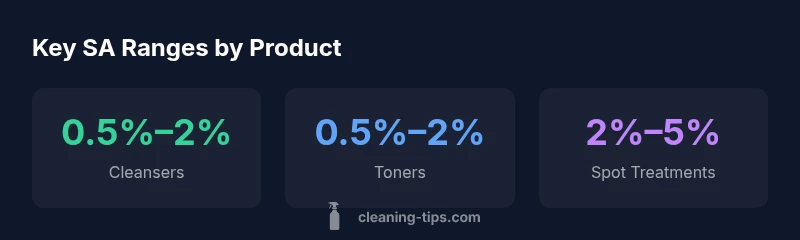
Product type: Facial cleansers – typical SA range: 0.5% to 2%; Notes: label varies by line and market. Product type: Toners – typical SA range: 0.5% to 2%; Notes: some toners emphasize SA as a pore-clearing agent. Product type: Spot treatments – typical SA range: 2% to 5%; Notes: higher concentration targets blemishes with care.
These ranges reflect common OTC formulations and are useful for planning a routine. Remember that actual percentages depend on the country, product line, and regulatory requirements, so always verify the exact values on the bottle.
How formulation affects SA performance
The performance of salicylic acid depends on formulation. Gel and foam cleansers behave differently due to contact time and rinsing. Toners are leave-on, so their SA stays on the skin longer and may require more balancing ingredients to prevent dryness. The pH of a product also influences SA’s ability to penetrate pores. Lower pH typically increases SA activity, while higher pH can reduce efficiency. Finally, interactions with other actives, such as benzoyl peroxide or retinoids, can alter tolerability; many users prefer to alternate products rather than combine them in the same routine.
Safety tips and patch testing
If you’re new to SA, start with a patch test: apply a small amount on a discreet area for 24–72 hours to monitor reaction. Begin with once-daily use and gradually adjust. Hydration matters, so pair SA products with a gentle moisturizer and a fragrance-free formula to reduce irritation risk. Always use sunscreen during the day, since SA can heighten sun sensitivity. If you notice burning, redness, or excessive dryness, reduce frequency or discontinue use and consult a clinician.
Alternatives if SA isn’t suitable for you
Not every Clean & Clear product lineup uses SA. If you prefer to avoid SA, you can opt for non-SA cleansers and moisturizers that focus on gentle cleansing and barrier support. Other active options for acne-prone skin include benzoyl peroxide and non-medicated formulations designed to minimize irritation. Regardless of choice, consistency and sun protection remain essential.
Building a simple SA-inclusive routine
A straightforward approach: start with a Clean & Clear SA-containing cleanser once daily, then apply a lightweight moisturizer afterward. If your skin tolerates it, you can add a leave-on SA toner after cleansing on alternate days. In the evening, consider a separate moisturizer to lock in hydration. Finish with broad-spectrum sunscreen every morning. Track how your skin responds over several weeks and adjust frequency accordingly.
Common myths about SA and Clean & Clear
Myth: SA always causes dryness. Reality: dryness depends on concentration, frequency, and skin type. Myth: SA thins the skin. Reality: SA exfoliates surface cells but does not thin the deeper layers. Myth: SA cannot be used with other actives. Reality: many people combine SA with careful planning and tolerance, though some combinations require staggered timing. By understanding product formulations and listening to your skin, you can use SA effectively without overdoing it.
SA ranges by Clean & Clear product type
| Product Type | Typical SA Range | Notes |
|---|---|---|
| Facial Cleanser | 0.5% to 2% | Label varies by line |
| Toner | 0.5% to 2% | Check exact % on packaging |
| Spot Treatment | 2% to 5% | Higher concentration for targeted acne |
Questions & Answers
Do all Clean & Clear products contain salicylic acid?
No. Not every product contains SA; it appears mainly in acne-focused cleansers, toners, or spot treatments. Always check the ingredient list.
Not every product has salicylic acid; check the label to confirm.
How can I tell if a Clean & Clear product contains SA?
Look for ‘salicylic acid’ or the abbreviation ‘SA’ in the ingredients and note the percentage on the label.
Check the ingredients and the percent on the label.
What if I have sensitive skin—should I use SA products?
If you have sensitive or dry skin, start with a low concentration and limit usage to 2–3 times weekly, monitoring for irritation.
Start with low concentration and watch for irritation.
Are there non-SA alternatives in Clean & Clear lineups?
Yes; some Clean & Clear formulas use benzoyl peroxide or non-medicated cleansers. Read labels to find fragrance-free and gentle options.
There are other options; check the label.
How should I build a simple SA skincare routine?
Start with an SA cleanser, then a lightweight moisturizer; add a leave-on SA toner on alternate days if tolerated; finish with sunscreen.
Start with SA cleanser, moisturize, and protect with sunscreen; patch-test.
Can SA be used with benzoyl peroxide?
Yes, but many people stagger usage to avoid irritation; follow product guidelines and listen to your skin.
Stagger usage to avoid irritation.
“Salicylic acid can be effective for acne when used correctly, but product formulations vary widely. Always verify ingredients and start with a low concentration.”
The Essentials
- Check the label to confirm SA presence and concentration
- Choose a formula matching your skin type and sensitivity
- Patch-test before full routine adoption
- Concentrations vary by product line within Clean & Clear
- Pair SA products with sunscreen to protect skin