How to Tell If Your Cleanser Is Water-Based: A Practical Guide
Learn a practical, label-reading approach to determine if your cleanser is water-based. This guide covers ingredient cues, texture signals, home tests, and routine fit for 2026.


Under the topic of how to tell if cleanser is water based, you’ll learn practical label-reading and at-home tests. Water-based cleansers usually list water (Aqua) as the first ingredient and rinse clean with water. Look for light textures like gels or foams and check for mild surfactants rather than heavy oils. This quick check helps you pick a cleanser suited for sensitive or oily skin.
What water-based means for cleansers
From a practical standpoint, how to tell if cleanser is water based hinges on the base solvent and the way the product behaves during rinsing. Water-based cleansers rely primarily on water (Aqua) as the main solvent and typically rinse away with plain water, leaving minimal oil residue on the skin. According to Cleaning Tips, this structure is reflected in the ingredient order and in the product’s texture. When you skim the label, you’ll often see water listed first, followed by mild surfactants and humectants. For many daily routines, this type of cleanser is favored because it tends to feel light and non-greasy after washing, making it a reliable option for combination and oily skin types while still offering adequate cleansing for sensitive skin.
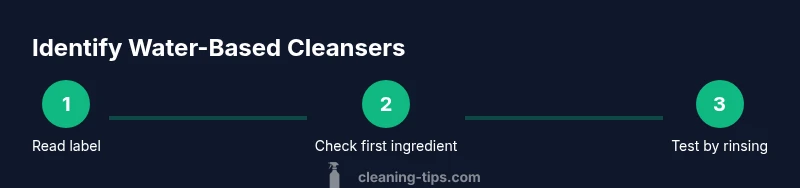
If you’re new to rating cleansers, remember this: the exact phrase "how to tell if cleanser is water based" is commonly echoed in consumer guides and product labels—sticking to the ingredient order is the simplest path to a correct assessment. This initial check helps set expectations for texture, rinse-off, and post-wash feel. Cleaning Tips emphasizes starting with the label, then moving to physical cues like texture and rinse behavior to confirm your assessment.
Tools & Materials
- Magnifying glass(To read tiny ingredient text on labels)
- Bright lighting(Natural daylight or a bright lamp helps identify tiny print)
- Small dish(Hold a small amount in a dish for controlled testing)
- Clear water source(Tap or distilled water for rinse tests)
- White towel(Blot and observe any residual film after rinsing)
- Smartphone or camera(Capture labels or residue for reference)
Steps
Estimated time: 15-25 minutes
- 1
Open the label and locate ingredients
Begin by removing the cap and locating the ingredients list. Read the list from the top down; the first ingredients dominate the formula. Note whether Water/Aqua appears at the very start, and scan for other water-friendly terms. This initial scan sets the baseline for your assessment.
Tip: If you need better readability, use a magnifying glass or photograph the label for later review. - 2
Identify the first ingredient
Record what the first ingredient is. If it’s Water/Aqua, that’s a strong signal of a water-based base. Some regional formulations may vary, but the top ingredient remains the most influential predictor of base content.
Tip: Keep a quick note of whether Aqua/Water is the first ingredient to compare across products. - 3
Look for Aqua/Water at the top of the list
Confirm whether Aqua or Water is listed among the first three ingredients. A water-first base is common in gels, foams, and liquid cleansers. Oils and heavy esters must appear after the water base to maintain a water-based formulation.
Tip: If Water/Aqua is not first, check the rest of the list and marketing claims carefully before concluding. - 4
Scan for oils and heavy emollients
Search the list for oils and long-chain emollients (e.g., various triglycerides). If such ingredients appear high in the order, the product may be a mixed base but can still be predominantly water-based depending on sequencing.
Tip: Remember that some water-based cleansers include moisturizing oils low in the list; the top ingredient is the most telling factor. - 5
Assess texture and viscosity
Feel or visually inspect the texture: gels, foams, and clear liquids are typical of water-based formulas, while balms and oils are not. Texture hints help you confirm what the label already suggests.
Tip: If the product is a gel or foam, it’s more likely water-based; however, always verify with the ingredient order for confidence. - 6
Note the presence of mild surfactants
Water-based cleansers rely on mild surfactants that create lather and aid rinsing. Look for terms like cocamidopropyl betaine, decyl glucoside, or sodium lauroyl isethionate—these indicate cleansing action without heavy oil engagement.
Tip: Avoid products that rely primarily on heavy oils or silicones as the base without water being first. - 7
Perform a quick rinse test on skin
Place a small amount on the back of your hand or forearm, add a splash of water, and rub gently. Rinse and observe if the residue feels light and disappears with rinsing.
Tip: A clean rinse with no lingering slickness strongly suggests a water-based base. - 8
Observe emulsification with water
During the rinse, notice whether the cleanser emulsifies and rinses off easily or leaves an oily film. Water-based cleansers typically emulsify and wash away cleanly with water.
Tip: If you notice oiliness or a film, reassess the ingredient order and consider cross-checking with other sources. - 9
Check post-rinse skin feel
After drying, evaluate your skin. Water-based cleansers usually leave a refreshed, non-greasy feel; oil-based cleansers may leave a residual dew or slip.
Tip: If your skin feels tight or dry after rinsing, it can still be water-based but with low lubrication—consider your skin type and routine. - 10
Cross-check brand claims
Review marketing language for terms like 'oil-free' or 'water-based' and compare to the ingredient list. Marketing can be promotional, but reliable claims should match the formulation.
Tip: If in doubt, compare the ingredient order with multiple reputable sources or the brand’s official site. - 11
Patch test for sensitive skin
Apply a small amount behind the ear or along the jawline for 24 hours to check for irritation. Even water-based formulas can irritate some individuals.
Tip: Perform patch tests before full-face use, especially if you have sensitive or reactive skin. - 12
Record your verdict and product notes
Document your assessment: base (water or oil), texture, rinse behavior, and any skin reaction. This helps you build a personal reference library for future shopping.
Tip: Keep a simple checklist you can reuse across products.
Questions & Answers
Is a water-based cleanser always gentler on the skin?
Not always. Water-based cleansers can be gentle for many skin types, but the overall gentleness depends on the chosen surfactants and additional active ingredients. Check labels for fragrance, essential oils, and drying agents if you have sensitive or reactive skin.
Water-based cleansers are often gentler for many people, but ingredients matter. Look for mild surfactants and fragrance-free options if you’re sensitive.
Can a cleanser be both water-based and oil-based?
Yes. Some formulas blend water-based cleansing agents with small amounts of oils for moisturization. In such cases, water may still be listed first, but the presence of oils appears later in the ingredients list. Read the order carefully to confirm the base.
Yes. A product can be mostly water-based yet include some oils later in the list for moisture.
What ingredients indicate a water-based formula beyond Water/Aqua at the top?
Look for mild surfactants such as decyl glucoside or cocamidopropyl betaine, and lower amounts of heavy oils. A predominance of water with these surfactants is a strong signal of a water-based formula.
Strong indicators are water-based surfactants and water as the primary ingredient.
Why do some cleansers claim 'water-activated'?
‘Water-activated’ often refers to ingredients that become effective when in contact with water or rely on emulsification with water to rinse away. It doesn’t alone confirm a water-based base, so verify with the ingredient order.
‘Water-activated’ can describe how a cleanser behaves with water, but the base still needs checking on the label.
How reliable is the ingredient list for determining the base?
The ingredient list is the most reliable source for base determination, with water or aqua typically at the top for water-based formulas. Marketing claims alone are less reliable without corroborating ingredient order.
The ingredient list is your best source; water at the top is the key cue.
How can I test a sample if the label is unclear?
Use the at-home rinse and emulsification test described in the steps: apply a small amount, rinse with water, observe residue, and compare the feel to expectations for water-based formulas. Patch test for skin compatibility as needed.
If the label is unclear, do a rinse test on your skin and watch for emulsification and post-rinse feel.
Watch Video
The Essentials
- Check the first ingredient to confirm base.
- Gels or foams often indicate water-based formulas.
- Rinse-test to verify water rinse behavior.
- Oil-based cleansers leave more residue; confirm with label.
- Patch test before full use for sensitive skin.