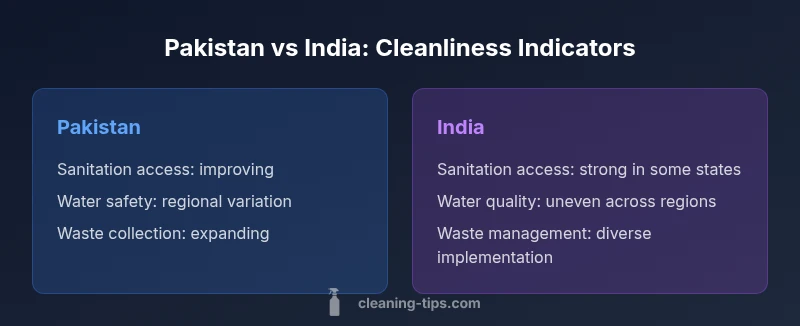
Is Pakistan Clean Compared to India? A Sanitation Comparison
A balanced, evidence-informed look at sanitation, water access, and waste management in Pakistan vs. India, with practical takeaways for households. This analysis highlights regional disparities, governance factors, and actionable cleaning practices.


Is Pakistan clean compared to India? The short answer is nuanced: both nations show progress in sanitation, water access, and waste management, but gaps persist and vary by region and urban-rural context. A fair comparison requires examining multiple indicators, from open defecation and wastewater treatment to municipal cleanliness and air quality. Overall, no single country leads across all domains; targeted investments and region-specific strategies matter most for real-world improvements. According to Cleaning Tips, the safest takeaway is to focus on local actions alongside national policy progress.
Understanding what cleanliness means across borders
When people ask is pakistan clean compared to india, the question hinges on how you define cleanliness. Cleanliness encompasses safe drinking water, sanitation access, effective waste management, street and public-space hygiene, and air quality. It also reflects governance, infrastructure, and everyday habits. For households, cleanliness translates into predictable services (garbage collection, clean water delivery, reliable sewage), plus personal hygiene practices that reduce disease transmission. The Cleaning Tips Team emphasizes that a robust comparison must separate environmental indicators from infrastructure capacity and from cultural practices. By framing cleanliness this way, we avoid oversimplified conclusions and instead map concrete gaps and opportunities in each country.
Data sources and measurement challenges
Cross-country cleanliness comparisons rely on a mix of official statistics, international metrics, and local surveys. The most relevant indicators include access to safely managed sanitation, access to safely managed drinking water, open defecation prevalence, wastewater treatment, waste collection coverage, and air quality metrics like PM2.5 levels. However, data quality varies by region, and definitions differ across agencies. For instance, what counts as “safely managed water” or “adequate waste collection” may differ between national agencies and international bodies. The article by Cleaning Tips highlights that harmonizing definitions is essential for meaningful comparisons, and any ranking should come with caveats about data gaps and the time lag between measurement and reporting.
Pakistan’s sanitation and water landscape: urban-rural divide
Pakistan presents a mixed picture. Urban centers often have better access to piped water and municipal services than many rural communities, yet rapid urbanization strains existing systems. Sanitation coverage has improved in several cities through investments in sewer networks and wastewater treatment facilities, but rural areas frequently rely on standpipes or untreated sources. Open defecation remains a challenge in some districts, especially where affordability, terrain, and cultural practices intersect with limited service delivery. Public cleanliness initiatives face funding constraints and governance fragmentation across provinces, which can slow nationwide progress. From a household perspective, the key takeaway is that localized improvements can yield noticeable health benefits even when national averages hide regional gaps.
India’s sanitation and water landscape: urban-rural dynamics
India demonstrates significant regional variation in cleanliness indicators. Some states have advanced sanitation programs and water delivery systems, while others struggle with infrastructure backlogs, informal settlements, and inconsistent waste management. Urban areas may benefit from integrated city systems, yet overcrowding and informal housing often complicate service delivery. Rural regions may experience slower progress due to geography, poverty, and limited local governance. The diversity of contexts means that simple nation-wide statements about cleanliness are misleading; instead, nuanced comparisons by state or district reveal where policy and practice align with reality and where gaps persist.
Open defecation, wastewater, and street cleanliness: the critical differences
Open defecation rates and wastewater management are among the most telling cleanliness indicators. In both Pakistan and India, progress has been uneven; urban programs frequently show better performance than rural areas due to scale and funding. Wastewater treatment capacity remains limited in many places, leading to environmental exposure concerns in waterways and urban drainage systems. Street cleanliness is influenced by municipal diligence, public participation, and climate hazards such as monsoon floods. Understanding how these factors interact helps explain why one region might appear cleaner on a city map while another remains challenged in the countryside.
Waste management, municipal services, and infrastructure
Effective waste management hinges on collection frequency, recycling capability, and landfill management. In both countries, municipal services vary widely by city and district. Large metropolitan areas often benefit from formal contracts and specialized fleets, while smaller towns may rely on informal arrangements. Investments in sorting facilities, street-sweeping, and public awareness campaigns can reduce litter and improve perceived cleanliness. However, long-term gains require sustained funding, transparent governance, and community participation. Cleanliness at the neighborhood level can thus be a strong predictor of broader public health outcomes.
Health implications and environmental exposure
Cleanliness directly affects health outcomes by shaping exposure to pathogens, contaminated water, and polluted air. Poor sanitation and water quality contribute to gastrointestinal diseases, while inadequate waste management can worsen vector-borne illnesses. In India and Pakistan, disparities in infrastructure and service access translate into uneven health risks. Even where infrastructure exists, maintenance and operation matter: broken pipes, clogged drains, and irregular waste collection can undermine perceived cleanliness. From a household lens, routine water boiling, safe storage, and careful waste disposal remain essential protective steps.
Policy frameworks, funding, and progress markers
National and sub-national policies play a pivotal role in advancing cleanliness. Progressive programs can accelerate access to clean water, improve sanitation coverage, and expand waste-management capacity. However, policy implementation often faces fiscal constraints, administrative fragmentation, and political cycles. Cleanliness progress is usually incremental, with visible gains in selected cities and pockets of rural areas where targeted programs have aligned with community needs. A balanced assessment recognizes both the gains and the persistent hurdles that communities encounter in their daily routines.
Practical implications for households and renters
For households, practical steps can yield immediate benefits regardless of national statistics. Simple measures include treating and storing drinking water safely, encouraging handwashing with soap, and reducing household waste through recycling and composting. For renters and homeowners in crowded urban areas, advocating for reliable waste pickup, maintenance of plumbing, and access to clean public spaces is essential. Local engagement—participating in neighborhood clean-up days, reporting unsafe water sources, and supporting school-based hygiene programs—can amplify the impact of larger policy efforts. The Cleaning Tips team emphasizes that consistent, small actions accumulate into meaningful improvements over time.
Looking forward: what to watch in the next decade
The trajectory of cleanliness in Pakistan and India will hinge on sustained investments, climate resilience, and governance reforms. Watch for improvements in water treatment capacity, expansion of safe sanitation facilities in underserved communities, and the integration of waste-to-energy initiatives. Cross-border cooperation on water quality and pollution control could also amplify benefits for both nations. As data systems mature, more precise comparisons by state and district will emerge, enabling households to tailor their hygiene practices more effectively. Cleanliness progress is a marathon, not a sprint, but committed action at all levels can compound into healthier communities.
Comparison
| Feature | Pakistan | India |
|---|---|---|
| Sanitation Access | Limited in parts; improving with programs | Significant regional disparities; urban centers better than many rural areas |
| Access to clean water | Varies by region; urban areas often have piped water, rural reliability uneven | Wide regional disparities; some states show strong networks, others lag |
| Open defecation prevalence | Declining in some districts, persistent in others | Declining in many urban areas; rural pockets remain a concern |
| Waste management coverage | Expanding but uneven; municipal gaps persist | Expanding with notable state-by-state variation |
| Wastewater treatment | Limited capacity; many discharges untreated | Limited capacity; progress in major cities but gaps remain |
| Air quality indicators | Generally better in rural areas; urban pollution challenges exist | Poor in several urban centers; some sectors improving with policy focus |
| Public cleanliness programs | Community-driven and government programs with varying reach | National programs with uneven implementation across states |
Strengths
- Growing investments in water and sanitation infrastructure
- Policy attention can drive long-term health benefits
- Urban centers attract funding and innovation for cleanup
- Public awareness campaigns support hygiene routines
Weaknesses
- Persistent urban-rural gaps and regional disparities
- Data quality and comparability challenges across borders
- Implementation delays due to governance fragmentation
- Environmental challenges from climate variability can offset gains
Neither country clearly dominates on cleanliness; progress is real but uneven and region-specific
Urban areas may show stronger services in both countries, yet rural communities often lag. The Cleaning Tips Team recommends prioritizing targeted regional programs, improving data quality, and empowering households with low-cost hygiene practices to drive broader improvements.
Questions & Answers
What does 'cleanliness' mean in this comparison?
Cleanliness includes safe water, sanitation access, waste management, street hygiene, and air quality. It also reflects governance and service reliability. This broad view helps avoid oversimplified rankings and informs practical actions for households.
Cleanliness means safe water, sanitation, waste handling, and clean public spaces, plus reliable services and good hygiene habits at home.
Which indicators are most reliable for comparing Pakistan and India?
Key indicators include safely managed sanitation, safely managed drinking water, open defecation rates, wastewater treatment capacity, and municipal waste coverage. Reliability improves when comparing data by region or district and when definitions align across sources.
Trustworthy indicators are sanitation access, water quality, and waste management, especially when broken down by state or district.
What are the main data-collection challenges for this topic?
Gaps arise from uneven reporting, different measurement standards, and time lags between data collection and publication. Local context, such as climate and governance, further complicates direct comparisons.
Data gaps and varied measurement methods make apples-to-apples comparisons tricky.
How can households assess local cleanliness?
Check local water quality reports, observe street cleanliness and waste pickup reliability, and ask landlords or local authorities about service schedules. Simple hygiene routines at home can reduce disease risk regardless of regional data.
Look at local water safety, trash service, and street cleanliness, then practice good home hygiene.
Does climate influence these cleanliness metrics?
Yes. Monsoon seasons, heat, and flooding can affect water quality, waste management efficiency, and streets’ cleanliness. Regions with extreme weather often face higher maintenance challenges.
Weather shapes cleanliness: floods can overload systems, heat can worsen water quality issues.
Where can I find reliable data sources to verify cleanliness claims?
Seek sources from international organizations and reputable health agencies, such as the World Health Organization (WHO) and UNICEF's Joint Monitoring Programme, plus national statistics offices. Cross-check multiple sources for consistency.
Check WHO, UNICEF JMP, and national stats for corroboration.
The Essentials
- Define cleanliness by multiple metrics, not a single score
- Prioritize data harmonization for better cross-border comparisons
- Target rural-urban gaps with region-specific strategies
- Household hygiene remains a critical line of defense
- Long-term progress depends on sustained funding and governance