Can You Take Cleaning Products on a Plane? A Practical Guide for 2026
Discover what cleaning products you can carry on a plane, how to pack liquids, solid alternatives, and regional differences. This guide helps homeowners and travelers stay compliant with security rules in 2026.


Yes, you can bring cleaning products on a plane, but only in limited, travel-sized amounts. Most jurisdictions limit liquids to containers of 100 ml or less, all fitting in a single transparent bag of about 1 liter. Solid cleaners or wipes are often allowed; larger quantities must go in checked luggage. Always check your country’s rules and your airline’s policy.
How plane liquid rules work
If you're wondering can you take cleaning products on a plane, you’ll first need to understand the fundamental liquids rules that security authorities enforce. In practice, airports treat liquids, gels, aerosols, and pastes as potential hazards, with strict limits designed to prevent spills and misuse. The Cleaning Tips team emphasizes that travel decisions hinge on container size, total quantity, and how items are packed. By understanding the framework, you can plan shipments, packing, and purchases without last-minute stress. This guidance applies to domestic and international travel in 2026, and it aligns with guidance from major security agencies. Always verify current rules before you fly, as policies shift with incidents, regions, and airline disclosures. The core question remains: can you take cleaning products on a plane? The safe baseline is to treat all liquids as limited items and to prepare alternatives whenever possible.
What counts as a cleaning product
Cleaning products span liquids, gels, aerosols, pastes, and even solid forms. Common items travelers consider include disinfectants, surface sprays, hand sanitizers, hobby cleaners, and toothpaste. In addition, some compressed or aerosol cleaners may be restricted or require checked baggage. Solid cleaners like bars or wipes often travel more freely. When planning, separate items by form: liquids/gels (subject to limits), solids (usually not restricted as tightly), and aerosols (frequently restricted due to pressurization). The key is to map each item to a category and confirm whether it falls under the standard liquids rule. The Cleaning Tips team notes that many travelers underestimate how aerosols are treated and risk delays at security if packaging is improper.
Exact limits you should know
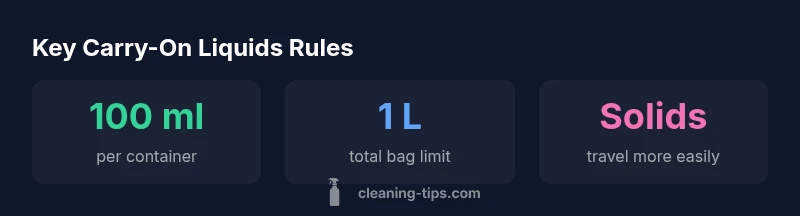
Most security regimes use a liquids rule that limits individual containers to a small volume—commonly around 100 ml or 3.4 ounces—regardless of total quantity. All containers must fit in a single transparent resealable bag with a capacity of about 1 liter. This standard is widely adopted in the United States, Europe, and many other regions, but regional exceptions exist for medical liquids, baby foods, and essential medications. For cleaning products, this means you should decant into travel-size containers, use wipes or solids to avoid liquids, and keep the bag accessible for inspection. Always verify with your carrier and destination country ahead of travel.
How to pack cleaning products for travel
Effective packing reduces security headaches. Steps: 1) Decide which items are essential and feasible in travel sizes; 2) Decant into small bottles with secure caps; 3) Place all liquids inside a clear, resealable bag and position it toward the top of your carry-on for easy access; 4) Keep original labels intact where possible to aid identification; 5) If in doubt, transfer larger quantities into checked luggage. The Guidance from Cleaning Tips in 2026 emphasizes that well-labeled, leak-proof packaging helps minimize spills and avoids liquid leaks that might trigger alarms.
Safe alternatives to bring cleaning products on planes
To stay compliant, consider alternatives. Use pre-moistened cleaning wipes for quick surface resets; bring solid cleaners such as bars or dusting blocks; carry concentrated cleaners in small sachets or sample bottles; or rely on in-flight cleaning supplies provided by the airline. Wipes often count as solids, which reduces the risk of liquid violations. For routine home tasks, plan ahead by purchasing travel kits at your destination or using hotel-approved products. The key is to find travel-friendly formats that maintain hygiene without violating the 3-1-1 framework.
International differences and airline policies
Rules vary by country and airline. The United States, the European Union, the United Kingdom, Canada, and other regions maintain similar core principles, but the exact limits and enforcement can differ. Some jurisdictions allow additional exceptions for medically necessary liquids, while others require documentation. Always check the latest guidance from your departure country’s security agency and the airline you fly, because a small discrepancy can lead to inconveniences or failed boarding. Cleaning Tips highlights that airline policies evolve with security concerns, so a quick pre-flight check saves time.
Quick packing checklist for cleaning products
Checklist: - List all items you intend to carry; - Confirm each item’s form (liquid, solid, aerosol); - Decant into travel containers ≤100 ml; - Place items in a clear bag and keep bag accessible; - Carry only what is essential; - If uncertain, pack in checked luggage. This compact checklist helps ensure you don’t overlook limits or forget essential items, especially when traveling on tight schedules.
Common mistakes and how to avoid them
Avoid mistakes that lead to delays: overpacking liquids, failing to seal containers, ignoring aerosol restrictions, and assuming rules are identical everywhere. Always confirm container sizes, bag capacity, and whether your destination allows certain cleaners. Label containers with contents to speed up inspection, and practice packing the night before your flight to reduce last-minute stress. The Cleaning Tips team recommends a quick rule: if you’re unsure, don’t bring it.
Practical scenarios and examples
Scenario A: You have two travel-size bottles (each under 100 ml) of surface cleaner and a travel-sized hand sanitizer. You can place them in your liquid bag as long as total volume stays within limits. Scenario B: You discover a larger bottle (200 ml) of cleaner at the store. To comply, either pour a portion into a travel bottle or choose a solid/dry alternative, or place it in your checked bag. Scenario C: You’re traveling with a family and the children require medicines or baby formula, which have separate allowances. In such cases, declare items as needed and follow airport guidelines. These examples illustrate how can you take cleaning products on a plane in real-world situations.
Carry-on liquids rules by region
| Region | Container size | Total liquids in carry-on bag | Examples/Notes |
|---|---|---|---|
| US/Canada (TSA) | ≤100 ml per item | ≤1 liter per bag | Shampoo bottle; hand sanitizer; toothpaste |
| EU/UK (EU rule) | ≤100 ml per item | ≤1 liter per bag | Shampoo, toothpaste, disinfectant wipes |
| Other regions | Varies | Varies | Check local rules |
Questions & Answers
Can I bring cleaning sprays in my carry-on?
Most sprays are considered aerosols and are restricted in carry-on luggage. Opt for solid cleaners, wipes, or pack in checked luggage when possible.
Most sprays aren’t allowed in carry-on; choose solids or wipes or put larger items in checked luggage.
Are disinfecting wipes allowed in carry-on?
Disinfecting wipes are allowed in carry-on and checked bags as long as the liquids rule is respected for any liquid components; wipes themselves are treated as solids.
Disinfecting wipes are allowed in carry-on; they count as solids and usually fit easily within limits.
What should I do if a product is confiscated?
If a product is confiscated, request a receipt and ask for guidance on alternatives. You may need to move the item to checked luggage or leave it behind depending on the policy.
If it’s taken, ask for a receipt and plan to move it to checked luggage or leave it behind.
Do airline policies vary by country?
Yes. Policies vary by country and airline. Always check the official guidance for your departure and destination, and confirm with your airline before travel.
Policies differ by airline and country, so check before you fly.
Can I bring concentrates or solids?
Concentrated cleaners and solids are often allowed, especially if they’re not in liquid form. Always verify packaging and labeling to aid security.
Solid or concentrated cleaners can be allowed, but check packaging and labeling.
What about baby formula or essential medications?
Medically necessary liquids often have exemptions. Carry documentation if required and follow standard security screening procedures.
Medical liquids may have exemptions; carry docs and follow screening rules.
“Clear rules reduce travel stress. By preparing travel-size cleaners and understanding regional differences, you can stay compliant and hygienic.”
The Essentials
- Know the 100 ml limit and bag rule.
- Pack travel-sized items and solids where possible.
- Check country-specific rules before travel.
- Use wipes or solids to avoid liquids.
- If in doubt, use checked baggage.