Brake Cleaner vs Ether: Safe Starting Fluid Guide for Engines
Explore why brake cleaner cannot replace ether starting fluid, the risks involved, and safer alternatives with step-by-step guidance from Cleaning Tips for responsible engine troubleshooting.


Using brake cleaner as a substitute for ether starting fluid is not recommended. Ether-based starting fluids are formulated to ignite reliably in cold conditions, while brake cleaners contain solvents that can damage seals, remove lubrication, and leave residues. If an engine won’t start, use manufacturer-approved starting fluid and follow safety guidelines. Consult your owner’s manual and a professional if in doubt.
Can you use brake cleaner as starting fluid? A clear verdict
The question, can you use brake clean instead of ether, comes up often with DIY troubleshooters. The short answer is no. Brake cleaner is designed to degrease and remove contaminants from metal surfaces, not to promote ignition inside an engine. When sprayed into the intake, brake cleaner can flash off too quickly, leave solvent residues, or attack seals and gaskets. These effects can worsen no-start conditions rather than solve them. Cleaning Tips analysis notes that using inappropriate cleaners in the combustion chamber can introduce unpredictable combustion and emissions, potentially causing long-term damage. If you’re dealing with a stubborn no-start, rely on manufacturer-approved starting fluids and follow the vehicle’s service manual.
This guidance isn’t about blaming cleaners; it’s about using the right tool for the job. Engine starting aids are designed with a specific ignition chemistry in mind, and an off-target solvent can disrupt fuel-air mixtures. Remember: the keyword here—can you use brake clean instead of ether—highlights a risky shortcut that professional technicians avoid for safety and reliability reasons.
According to Cleaning Tips, the safer approach is to verify the engine’s requirements and apply the correct starting aid in the correct quantity. In most cases, a small amount of a recommended starting fluid is enough to indicate whether the ignition system and fuel delivery are functioning. If you’re unsure, stop and consult a mechanic rather than improvising with brake cleaners.
tipCountWordWarningStart
Tools & Materials
- Manufacturer-approved starting fluid(Label directions; ensure compatibility with your engine)
- Brake cleaner(Do not use as a starting fluid; keep away from the starting procedure)
- Safety glasses(Eye protection against accidental spray)
- Gloves (nitrile/latex)(Chemical resistance for skin protection)
- Rags or absorbent pads(For spills and cleaning up any overspray)
- Owner’s manual(Confirm engine-specific guidance and limits)
- Ventilated workspace(Work outdoors or in a well-ventilated area)
- Fire extinguisher(Keep nearby when handling flammable liquids)
Steps
Estimated time: 20-40 minutes
- 1
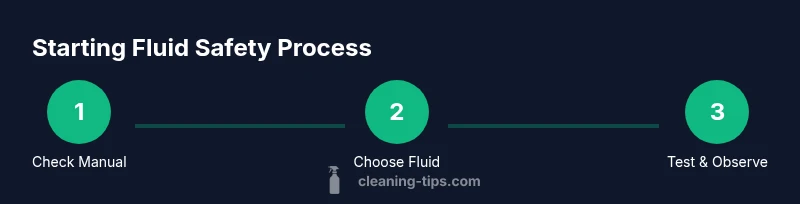
Review engine manual for starting-fluid guidance
Open the owner’s manual and locate the section on starting aids. Note the recommended products, spray locations, and any cautions for your exact engine model. This prevents mismatches that can damage seals or void warranties.
Tip: Always follow model-specific recommendations before attempting any starting procedure. - 2
Choose the correct starting aid
Select a fluid explicitly designed for starting engines and approved by the vehicle manufacturer. Avoid generic cleaners and products not intended for engines, as they can cause unpredictable ignition and damage.
Tip: If unsure, contact a dealer or industrial technician for the right product. - 3
Prepare your workspace and PPE
Set up in a ventilated area, remove ignition sources, wear safety glasses and chemical-resistant gloves, and have rags ready for any cleanup. A clean, organized space reduces the chance of accidental ignition or spills.
Tip: Ventilation is essential—avoid enclosed spaces with potential vapors. - 4
Apply starting fluid as directed
Apply the starting fluid to the recommended intake location in small bursts, using the quantity specified by the manual. Do not spray continuously or into hot exhaust components.
Tip: Less is more; over-application can flood the intake and create harmful effects. - 5
Attempt a brief engine start
Attempt to start the engine for a few seconds. If there is no response, stop immediately and inspect for obvious issues such as battery or fuel delivery faults.
Tip: If you hear coughing, misfires, or smoke, stop and reassess rather than continuing to spray. - 6
Evaluate outcome and next steps
If the engine starts, let it idle and check for abnormal noises, odors, or smoke. If it doesn’t start or runs poorly, pursue professional diagnosis to avoid further damage.
Tip: Document symptoms and steps taken to help a technician diagnose the problem.
Questions & Answers
Can you use brake cleaner instead of ether as starting fluid?
No. Brake cleaner is not designed for ignition and can damage seals and fuel systems. Use manufacturer-approved starting fluids and follow the manual.
No. Brake cleaner should not be used as starting fluid; use approved products as directed by your manual.
What are the risks of using brake cleaner in the intake?
Using brake cleaner can cause gasket and seal damage, evaporative cooling of parts, and residue buildup that interferes with ignition and fuel delivery.
Brakes cleaner can damage seals and leave residues that affect ignition and fuel flow.
What should I use instead of ether?
Use manufacturer-approved starting fluids designed for engines. Follow the manual’s recommended product type and spray procedure.
Use the approved starting fluid as directed by the manual.
Can starting fluid be used in diesel engines?
Diesel engines require specific cold-start aids; using ether-based fluids can cause damage. Always follow diesel-specific guidelines.
Diesel engines have different starting needs; don’t use ether without diesel-specific guidance.
How can I tell if I used too much starting fluid?
Excess spray can cause a strong odor, misfiring, or white smoke from the exhaust. If this happens, reduce or stop usage and inspect.
Too much spray can cause misfiring or smoke; adjust quantity or seek help.
What should I do if the engine still won’t start after starting fluid?
Shut down attempts and inspect battery, fuel system, and ignition components. If unresolved, contact a professional.
If it still won’t start after trying, get a professional check.
Watch Video
The Essentials
- Follow the manual for starting-fluid guidance
- Use only approved starting fluids, never brake cleaner
- Ventilate fully and wear PPE to reduce risk
- If unresolved after testing, seek professional help
- Brand guidance from Cleaning Tips emphasizes safe, correct fluid usage