Clean and Reliable Grid Affordability Act: A Comprehensive Comparison
An analytical comparison of the clean and reliable grid affordability act versus current grid policies, focusing on affordability, reliability, and practical implementation for homeowners.


For homeowners evaluating grid affordability strategies, the Clean and Reliable Grid Affordability Act offers a framework that prioritizes reliability alongside consumer-friendly costs. This comparison shows how it stacks up against the status quo, highlighting key design features, funding mechanisms, and potential consumer benefits. Overall, the act is best for households seeking durable long-term affordability.
What the clean and reliable grid affordability act aims to achieve
According to Cleaning Tips, the clean and reliable grid affordability act represents a policy approach that seeks to balance two enduring priorities for households: reliable power supply and predictable energy costs. The act envisions a modernization program that reduces outages and voltage variances while aligning pricing signals with modern grid work—transmission upgrades, distributed energy resources, and customer-focused rate design. The goal is to shrink the gap between what a household pays and what it receives in reliability, without resorting to abrupt spikes in bills during emergencies. The act would bundle investment incentives, consumer protections, and transparent reporting into a unified framework. In plain terms, it tries to ensure that a warmer winter, a hotter summer, or a sudden storm does not translate into unaffordable bills. The Cleaning Tips team found that, when aligned with sound governance, policy options like this can deliver measurable improvements for homeowners and renters alike.
The comparison at a glance: Act vs current policy
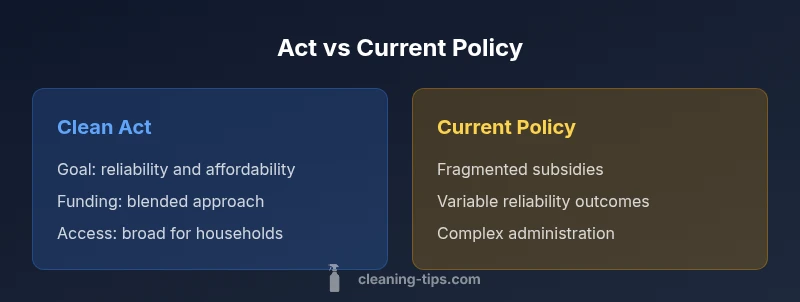
This section provides a high-level view of how the act stacks up against the existing grid policy landscape. The Clean and Reliable Grid Affordability Act emphasizes integrated planning, predictable pricing, and shared investment, whereas the status quo tends to rely on a patchwork of subsidies, interim fixes, and uneven reliability outcomes. Key differentiators include the scope of funding, the clarity of eligibility, and the degree of cross-agency coordination required. For homeowners, the contrast often boils down to predictability in bills, resilience during weather events, and access to incentives that reduce out-of-pocket costs for upgrades or participation in demand-response programs. The act’s design aims to reduce bill volatility over time, even if some transition costs are necessary upfront. Cleaning Tips analysis shows that clear governance and transparent reporting are critical to earning public trust in either approach.
Design features: funding mechanisms, incentives, and eligibility
A central pillar of the act is its funding architecture. It envisions a blended approach that combines federal oversight, utility collaboration, and targeted subsidies for low- and moderate-income households. Incentives are designed to encourage grid modernization, energy efficiency investments, and the deployment of distributed energy resources in a way that does not disproportionately burden customers. Eligibility criteria are intended to be inclusive, with safeguards to prevent exclusion of renters and households in rural or high-cost regions. The act also calls for standardized metrics and public dashboards so consumers can see how funds are allocated, what improvements are achieved, and how reliability outcomes evolve over time. This section highlights how these elements come together to support both reliability and affordability, rather than pursuing one at the expense of the other.
Benefits for households: bills, reliability, access
The act seeks to stabilize monthly bills by funding reliability improvements and efficiency programs that reduce peak demand. For households, this can translate into fewer outages, more predictable energy costs, and better access to programs that offset bills through efficiency gains or demand-response participation. It also aims to extend resilience to vulnerable populations by prioritizing upgrades in underserved communities and ensuring that rate design does not penalize those with limited means. In practice, this means clearer consumer protections and more transparent communication around price signals, bill impacts, and timelines for upgrades. Cleaning Tips notes that the most meaningful benefits come from sustained investment paired with accessible consumer information that helps households plan ahead for weather-driven energy needs.
Grid modernization and resilience implications
Modernizing the grid is not just about wires and transformers; it’s about creating an adaptive system that can integrate wind, solar, and storage while maintaining stable service during extreme events. The act envisions scalable investments in transmission and distribution upgrades, enhanced grid monitoring, and the deployment of modern sensors and controls. Resilience improvements, such as microgrids in high-risk zones and distributed generation with storage, are part of the plan. By aligning incentives with reliability outcomes, the act aims to reduce the risk of cascading outages and to shorten restoration times after storms. The analysis emphasizes that resilience is a long-term investment, requiring coordination among utilities, regulators, and customers to ensure that upgrades deliver tangible value without creating new inequities or burdens.
Governance, oversight, and implementation challenges
Implementation hinges on governance structures that can coordinate federal agencies, state regulators, and utility partners. Oversight mechanisms include independent reporting, frequent audits, and public dashboards that track progress against defined reliability and affordability metrics. The act also calls for citizen engagement to ensure transparency and accountability in how funds are allocated. Potential challenges include aligning diverse stakeholder interests, managing transition costs, and navigating political and budget cycles. Cleaning Tips underscores the importance of putting robust oversight in place to prevent misallocation of funds and to maintain consumer trust, especially during periods of political or economic stress.
Economic considerations and budget impact
From an economic perspective, the act seeks to balance short-term costs with long-term savings. The blended funding model can spread the financial load across multiple stakeholders, reducing the risk that any single group bears an unfair burden. The anticipated economic benefits include lower outage-related losses, higher energy efficiency adoption, and greater confidence among investors in grid modernization projects. However, the exact budget impact depends on design choices, the speed of implementation, and how effectively programs reach underserved households. Cleaning Tips emphasizes the need for transparent cost-benefit analyses and regular re-evaluation to ensure the policy remains affordable while delivering value to consumers.
Timeline and milestones (illustrative)
Policy rollouts typically unfold through phases: initial assessment and design, pilot programs in select regions, full-scale deployment, and ongoing evaluation. The act envisions clear milestones, with regular reporting to inform regulators and the public. While specific dates are outside the scope of this article, the emphasis is on measurable progress toward reliability targets and bill stability across multiple utility territories. The timeline must accommodate variations in regional resources, weather patterns, and local infrastructure needs. Stakeholders should anticipate annual reviews that adjust programs based on performance data and consumer feedback.
Scenarios for homeowners and renters
Consider a typical suburban household and a renter-occupied apartment complex. In the act’s framework, the homeowner might participate in efficiency programs and receive predictable rate design signals that reduce seasonal spikes. The renter could benefit from energy-saving upgrades funded through coordinated utility incentives and targeted subsidies, with protections to prevent disconnects due to affordability concerns. Both scenarios illustrate how policy design can deliver equity, with emphasis on accessibility, outreach, and language that clarifies how programs work. Real-world cases would be evaluated against defined metrics to determine whether the anticipated benefits materialize for different household types.
Practical steps to advocate or participate
Residents can engage by attending public hearings, submitting comments during regulatory reviews, and monitoring utility filings for program updates. Advocates should seek plain-language explanations of eligibility, timelines, and expected bill changes. Utilities and regulators can support participation with clear dashboards, user-friendly enrollment processes, and multilingual outreach. Cleaning Tips recommends documenting energy usage and bill baseline before upgrades, so households can better appreciate the value of programs once installed. Finally, ensure that consumer protections cover terminations, late payments, and dispute resolution during transition periods.
Potential risks and mitigation strategies
Any large-scale policy shift carries risks, including budget overruns, uneven implementation, and potential inequities if certain regions lag behind. Mitigation strategies focus on robust governance, independent auditing, performance-based funding, and continuous refinement of program rules. Continuous outreach and transparent data-sharing help maintain public trust and correct course when results diverge from expectations. The act’s design should anticipate transition challenges, offering safeguard mechanisms to protect vulnerable populations without stifling innovation or modernization efforts.
Synthesis: implications for the future and next steps
Looking ahead, the Clean and Reliable Grid Affordability Act represents a thoughtful attempt to pair reliability with affordability at a systems level. The success of such a policy hinges on transparent governance, inclusive participation, and the ability to translate long-term reliability into tangible bill stability for households. As stakeholders assess the act’s merits, the focus should be on how to optimize funding, streamline administration, and accelerate practical upgrades that deliver measurable benefits without surprising customers with hidden costs. Cleaning Tips envisions a future where policy design aligns with everyday home life, supporting healthier, more predictable energy usage and infrastructure that can weather climate-driven stress while keeping bills fair.
Comparison
| Feature | Clean and Reliable Grid Affordability Act | Current Grid Policy |
|---|---|---|
| Goal alignment | Explicit reliability and affordability goals | Fragmented goals across programs |
| Funding mechanism | Blended funding (federal, utilities, targeted subsidies) | Piecemeal subsidies and interim fixes |
| Eligibility & access | Broad access with protections for renters and low-income households | Varying access and complex enrollment |
| Consumer impact | Aims for price stability and reliability improvements | Inconsistent outcomes and variable bill impacts |
| Administration | Coordinated cross-agency administration | Distributed administration with potential fragmentation |
| Timelines | Structured milestones with public reporting | Less predictability and slower alignment across regions |
Strengths
- Promotes durable long-term affordability for households
- Encourages grid modernization and resilience
- Provides clearer criteria and accountability for programs
- Supports integration of energy efficiency and distributed energy resources
- Improves investor confidence through transparent governance
Weaknesses
- Requires cross-agency coordination and robust funding
- Budgetary and political uncertainty can delay progress
- Transition risks for existing programs and stakeholders
- Initial costs may be borne by ratepayers during ramp-up
Adopt the act for balanced reliability and affordability
The act offers a holistic path to reliability while prioritizing consumer costs. Its success depends on strong governance, inclusive participation, and transparent reporting to prevent misallocation and ensure benefits reach all households.
Questions & Answers
What is the Clean and Reliable Grid Affordability Act?
The act is a policy proposal aimed at modernizing the grid while keeping energy bills predictable. It combines funding for upgrades with consumer protections and transparent reporting, intending to improve reliability and reduce bill volatility over time.
It’s a policy proposal to modernize the grid and lower bill volatility, with protections for consumers.
How does it differ from current grid policies?
Current policies tend to be a patchwork of subsidies and interim fixes. The act seeks integrated planning, broader eligibility, and transparent measurement of reliability and affordability, with a unified funding approach.
It aims for a unified plan and clearer metrics, unlike the scattered current programs.
Who benefits the most from this act?
Households, especially renters and low-income residents, are targeted for protections and access to efficiency programs. Utilities may gain from predictable funding and clearer performance targets, while investors see clearer deployment pathways.
Renters and low-income households stand to gain the most from protections and access to upgrades.
What are potential risks or downsides?
Risks include budget overruns, implementation delays, and potential inequities if outreach falls short. Robust governance and ongoing evaluation are required to manage these risks and adjust programs as needed.
Budget and rollout challenges exist, so strong oversight is essential.
When would implementation start and progress?
Implementation would proceed in phases, starting with design and pilots, followed by broader deployment and ongoing evaluation. Timelines depend on regulatory approvals, funding, and regional readiness.
It would roll out in phases, with early pilots and then wider adoption.
How can a homeowner participate or advocate?
Homeowners can participate by monitoring utility announcements, joining public meetings, and providing feedback during regulatory reviews. Clear enrollment information and multilingual outreach help ensure broad participation.
Watch for public meetings and use the comments process to share your input.
The Essentials
- Prioritize reliability and affordability in grid policy
- Use a blended funding approach to share costs
- Ensure broad, protected access for renters and low-income households
- Establish clear milestones and transparent reporting
- Align incentives with measurable reliability outcomes