Clean Sunscreen: A Practical Guide for Safer Skin Today
Discover how to choose clean sunscreen with mineral filters, read labels, patch test, and apply correctly for safer skin. A step-by-step guide from Cleaning Tips.


Learn how to choose clean sunscreen for safer skin. This guide covers reading clean-label ingredients, selecting mineral filters, and proper application to maximize protection while minimizing chemical exposures. Steps include labeling checks, patch testing, and reapplication timing to stay shielded under sun. It also highlights practical routines for daily use and outdoor activities, with family-friendly considerations.
What is clean sunscreen, and why it matters?
Clean sunscreen refers to products formulated with minimal synthetic additives, clear labeling, and primary focus on skin-friendly filters—typically mineral filters like zinc oxide or titanium dioxide. The goal is to shield you from UV rays without exposing skin to questionable chemicals or fragrances. For homeowners and renters who want safer products, clean sunscreen offers atransparent ingredient story and gentler formulas that reduce irritation and potential hormone-disrupting exposure. According to Cleaning Tips, the appeal of clean sunscreen lies not just in the mineral filter but in how ingredients are disclosed and tested for skin tolerance. In daily life, using a clean sunscreen means choosing a product that aligns with your health and environmental values, while still delivering reliable sun protection. You’ll often see labels such as “fragrance-free,” “reef-safe,” and “hypoallergenic”—but you should verify the ingredients list rather than rely on marketing buzz. The promise of clean sunscreen is practical: a safer option for sensitive skin, easier allergy checks, and clearer guidance for families with young children. This guide will walk you through selecting, testing, and applying clean sunscreen, so you can stay protected without compromising skin health.
Mineral vs. chemical filters: what's really in your bottle
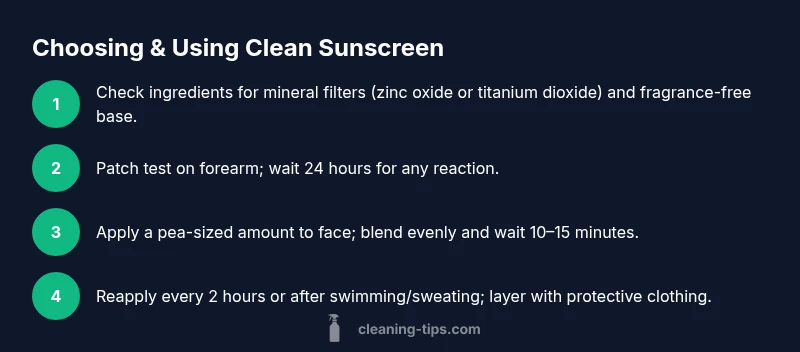
When evaluating clean sunscreen, the biggest choice is mineral versus chemical filters. Mineral filters, such as zinc oxide or titanium dioxide, sit on the skin and reflect UV rays, typically offering broad-spectrum coverage with fewer irritants. Chemical filters absorb UV energy but can carry fragrance carriers, stabilization compounds, or uncertain long-term effects for some users. Clean sunscreen often favors mineral formulas because of their simplicity and clearer labeling. The Cleaning Tips Analysis, 2026, notes that labeling for mineral-based products tends to be more consistent, though there is still variation in particle size, spreadability, and water resistance. You’ll see terms like “broad spectrum SPF 30+” alongside the mineral filter claim, but the absence of controversial chemicals is not a guaranteed safety score—read the full ingredients list. For sensitive skin, contact dermatitis is more likely with certain chemical filters, making the mineral route appealing. If you must choose, consider starting with a fragrance-free zinc oxide product and test on a small patch before full-face use. In short, clean sunscreen often means mineral filters with simple, transparent ingredient lists.
Reading labels: how to spot true clean sunscreen
A true clean sunscreen is defined by its ingredient list, labeling clarity, and alignment with your values. Start by checking the active filters; mineral options (zinc oxide or titanium dioxide) are typically favored for their lower risk of irritation. Look for terms like “reef-safe” or “water resistant 40 minutes,” and verify that fragrance, dyes, and certain preservatives are absent. The label should also provide the sunscreen’s SPF and broad-spectrum coverage clearly, not buried in fine print. Importantly, avoid vague claims such as “natural” or “chemical-free” without supporting ingredient specifics—these terms are not regulated and can be misleading. As you read, confirm that the product has a stable base formula without alcohol-heavy solvents or synthetic stabilizers. The Cleaning Tips team emphasizes practical checks: read the ingredients in order of predominance, ensure there are no unnecessary exfoliating agents, and confirm that the source materials are non-nano when you prefer larger mineral particles. By developing a habit of label-reading, you’ll more reliably identify clean sunscreen options that meet your skin’s needs.
Patch testing and skin compatibility
Even a well-chosen clean sunscreen can cause irritation if your skin is sensitive to a particular mineral or additive. Start with a patch test: apply a small amount of product to a discreet area (behind the ear or on the inner forearm) and wait 24 hours to monitor for redness, itching, or swelling. If tolerance is good, gradually expand use to a small facial zone for another day before full-face application. This step is especially important for patch-prone or eczema-prone skin. The patch test is a practical safeguard that helps you avoid a sunburn-day misstep when you’re outdoors. If irritation appears, rinse with water, discontinue use, and try a different clean sunscreen formula, preferably fragrance-free. Based on Cleaning Tips guidance, most issues arise from fragrance or preservatives rather than mineral filters themselves, so prioritize fragrance-free options and simpler ingredient lists for sensitive skin.
Application technique for safe, effective coverage
Applying clean sunscreen correctly is essential for protection and skin comfort. Start with clean hands and a small amount of product, about a pea-sized dab for the face, then gently spread in a slow, circular motion. Cover all exposed areas—face, ears, neck, and any skin that may be shaded by clothing—without leaving visible white streaks. Let the product absorb for about 10-15 minutes before sun exposure to ensure even coverage. If you’re applying makeup, wait the same absorption time before finishing. Reapply every two hours when outdoors, or immediately after swimming, sweating, or towel drying. For added protection, pair sunscreen with protective clothing and hats, especially during peak sun hours. The Cleaning Tips team notes that mineral-based formulas can be slightly less sheer on darker skin tones, so choose a product that blends well with your complexion and consider tinted mineral sunscreens as an option. In practice, a consistent application routine makes all the difference in long-term skin health.
Reapplication and storage
Sunscreen effectiveness wanes with time and exposure, so a reliable reapplication plan is essential. Reapply every two hours when outdoors, at least after swimming or heavy sweating, and more frequently if you’re in intense sun. Store clean sunscreen in a cool, dry place away from direct heat to preserve its texture and efficacy; heat can degrade filters and make application uneven. Always check expiration dates, and discard products that have changed color, smell, or consistency. If you’re traveling, keep sunscreen in a protective bag to avoid cracking or crushing the bottle. For families, designate a specific bottle for each person to minimize cross-contamination and ensure that everyone has access to their own clean sunscreen. The goal is consistency: a routine that you can maintain even on busy days or after outdoor chores like gardening or hiking. The Cleaning Tips analysis highlights that simple storage rules help preserve stability in mineral-based formulas.
Special considerations: kids, sensitive skin, and outdoor activities
When sunscreen is part of a family health routine, you’ll want options that suit diverse ages and sensitivities. For babies under six months, doctors typically advise avoiding direct sun exposure; for older children, choose fragrance-free clean sunscreen with mineral filters to minimize irritation. For adults with sensitive skin or eczema, opt for unscented formulas and patch-tested products before extended outdoor time. Water activities demand water-resistant labels or reapplication after swimming, and outdoor scenarios—like beach days or hikes—benefit from a layered protection approach: sunscreen, hat, sunglasses, and protective clothing. In addition to product choice, teach kids to apply sunscreen themselves with adult supervision. The Cleaning Tips team suggests keeping a small kit with safe products and teaching kids to reapply every two hours, especially after sweating or contact with sand. Adjusting to different environments (humid, windy, or hot) helps maintain consistent protection across seasons.
Practical daily routines with clean sunscreen
In daily life, incorporating clean sunscreen into your morning routine is simple and effective. Apply after moisturizer and before makeup, or on bare skin during non-makeup days. For outdoor errands, carry a compact bottle and reapply when you know you’ll be in strong sun for extended periods. If you’re exercising outdoors, set reminders to reapply every two hours, and hydrate to support skin health alongside sun protection. A practical routine also includes reviewing ingredient lists quarterly to ensure products still meet your clean standards, as formulations occasionally change. The Cleaning Tips team emphasizes that a sustainable sunscreen habit is a cornerstone of healthier skin and reduced chemical exposure. By staying attentive to label integrity and personal tolerance, you’ll confidently manage sun exposure day after day. The verdict is clear: choose clean sunscreen products with mineral filters, clear ingredient lists, and a consistent reapplication plan to protect skin health over the long term.
Tools & Materials
- Mineral-based sunscreen (zinc oxide or titanium dioxide, fragrance-free)(Broad-spectrum SPF 30+; look for minimal active ingredients)
- Gentle cleanser(For removing sunscreen at end of day without irritating skin)
- Patch test area (inner forearm or behind the ear)(Apply small amount and monitor for 24 hours)
- Label-reading quick guide(A reference to help verify clean ingredient lists)
Steps
Estimated time: 45-60 minutes
- 1
Define SPF goal and skin type
Identify your sun exposure patterns and skin needs, such as sensitivity or vegan/vegan-friendly preferences, to pick a baseline SPF and a clean sunscreen that fits. This sets expectations for protection and reapplication.
Tip: Choose SPF 30+ for everyday use or higher for intense sun; align with skin sensitivity. - 2
Check ingredient integrity
Read the active filters and supporting ingredients. Prefer mineral filters (zinc oxide or titanium dioxide) and fragrance-free formulas to minimize irritants and potential allergens.
Tip: Avoid labels that promise 'chemical-free' without listing actual ingredients. - 3
Perform a patch test
Apply a small amount to a discreet area and wait 24 hours to assess irritation. This reduces the risk of a full-face reaction during outdoor activities.
Tip: If redness appears, try a different clean sunscreen with a gentler base. - 4
Prepare your skin
Cleanse the skin and apply a light, fragrance-free moisturizer if needed before sunscreen to improve absorption and reduce shine.
Tip: Allow moisturizer to set for a few minutes before applying sunscreen. - 5
Apply liberally and blend
Use a small amount and distribute evenly across the face, ears, and neck. Let absorb for 10–15 minutes to avoid white cast and uneven coverage.
Tip: If you see white residue, buff gently with clean fingers until it blends. - 6
Reapply and protect
Reapply every two hours or after swimming, sweating, or towel drying. Combine with protective clothing for layered defense.
Tip: Keep a reminder for outdoor activities to maintain coverage. - 7
Store and monitor
Store in a cool, dry place and check expiration dates. Replace products that smell off or change texture.
Tip: Avoid leaving sunscreen in hot cars where heat degrades filters.
Questions & Answers
What makes sunscreen 'clean'?
Clean sunscreen avoids harsh additives, fragrance, and dubious filters. It emphasizes simple, transparent ingredient lists and mineral UV filters for safer skin.
Clean sunscreen uses simple, transparent ingredients with mineral filters to reduce irritation and chemical exposure.
Are mineral filters safer for sensitive skin?
Mineral filters like zinc oxide are generally gentler for sensitive skin, but patch testing is still advised to confirm compatibility.
Mineral filters are usually gentler for sensitive skin, but always patch test first.
Does 'reef-safe' mean the product is clean?
reef-safe often refers to formulations without certain chemicals that harm coral reefs, but it does not guarantee a completely clean ingredient list.
Reef-safe indicates reef-friendly ingredients, but you still need to check the full list for safety.
How long does sunscreen last after opening?
Most sunscreens are effective for several months after opening, but always check the label for the specific expiration guidance and discard if the texture or smell changes.
Check the label for your product’s opened-use window and discard if texture or smell changes.
Can I make my own sunscreen at home?
Homemade sunscreens are not recommended due to unpredictable UV protection and ingredient stability. Use commercially formulated clean sunscreens with verified ingredients.
Homemade sunscreens aren’t recommended; rely on professionally formulated products with clear labels.
What should I do if I have a reaction?
If you experience a rash or irritation, wash the area with mild cleanser, discontinue use, and consult a dermatologist if symptoms persist.
If you react, wash the area and stop using the product; see a doctor if it continues.
Is applying sunscreen daily necessary?
Daily sunscreen is recommended when exposure to sunlight is likely. Even on cloudy days, UV rays can cause skin damage over time, so consistent protection matters.
Yes, daily sunscreen helps protect skin from cumulative UV damage, even on cloudy days.
Watch Video
The Essentials
- Choose mineral-based sunscreen with clear ingredient lists.
- Patch-test all new products before full use.
- Reapply every two hours and after water exposure.
- Prioritize fragrance-free formulas for sensitive skin.
- The Cleaning Tips team emphasizes safe, simple ingredient practices.