Clean vs Dirty Oil: A Comprehensive Comparison
Explore clean vs dirty oil: how contaminants affect lubrication, wear, and efficiency, plus practical steps to keep oil clean in engines, appliances, and tools for longer life.


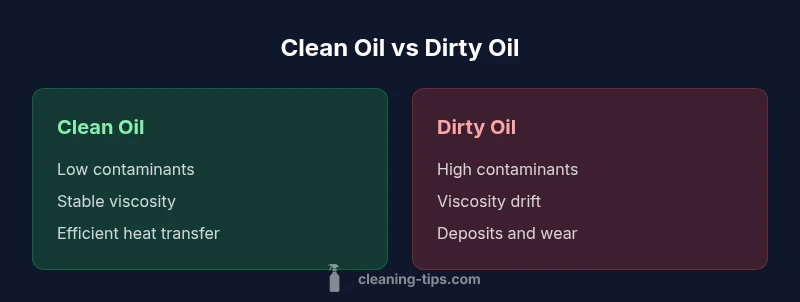
In the context of lubrication, clean oil outperforms dirty oil on efficiency, wear protection, and maintenance needs. This comparison highlights how contaminants shorten oil life, clog filters, and accelerate engine wear, while clean oil delivers steadier viscosity, better heat transfer, and longer intervals between changes. The choice matters for longevity and cost of ownership.
clean vs dirty oil: definitions and scope
According to Cleaning Tips, clean vs dirty oil isn't just a matter of color or odor; it's about whether the oil can form and maintain a protective lubricating film under operating conditions. Clean oil contains minimal particulates, water, and fuel dilution, while dirty oil carries contaminants that degrade viscosity, thicken the film, and accelerate wear. The Cleaning Tips team found that even small amounts of oxidation byproducts or moisture can alter lubrication performance, especially in high-temperature environments. In practice, different industries interpret cleanliness differently: automotive engines expect ultra-pure lubricants; hydraulic and industrial systems tolerate higher contaminant levels but still require regular monitoring. Understanding these distinctions helps homeowners and technicians decide when to drain, filter, or replace oil. In the context of home and small shop equipment, clean oil also reduces deposit formation in pumps, valves, and seals, preserving efficiency and reducing maintenance time.
Why oil cleanliness matters across systems
Oil cleanliness directly affects lubrication performance across engines, gearboxes, and hydraulic circuits. Clean oil reduces abrasive wear, minimizes varnish and sludge formation, and maintains a stable film even when temperatures spike. Dirty oil invites soot, water, fuel dilution, and oxidation byproducts that increase viscosity irregularities and create deposits that disrupt clearances. The consequence is reduced efficiency, louder operation, and more frequent maintenance. Cleaning Tips analysis shows that systems with better oil cleanliness exhibit smoother startup, lower friction, and less unexpected downtime. For homeowners, this translates to longer life for lawn equipment, snow blowers, and vehicle engines, while businesses benefit from less unscheduled downtime and lower total repair costs.
Contaminants and how they affect lubrication
Contaminants come in many forms: solid particulates, water, fuel dilution, and oxidized byproducts. Particles act like tiny sandpaper, scoring bearing surfaces and clogging narrow passages. Water degrades lubrication by promoting emulsions and corrosion, especially in metals with imperfect seals. Fuel dilution dilutes oil's viscosity, reducing film strength and increasing wear under load. Oxidation products form varnish and sludge that hamper heat transfer and trap further contaminants. Clean oil withstands these challenges better because it retains viscosity, supports a consistent lubricating film, and allows filters to capture new contaminants efficiently. The interplay between contaminants and oil chemistry dictates service life, maintenance intervals, and ultimately asset reliability.
How cleanliness is measured and rated
Oil cleanliness is not judged by color alone; it is assessed by particle count, water content, and total acid number, among other indicators. In professional labs, standards define acceptable limits for each system, while field tests rely on dipstick cues and on-condition indicators with caution. Filtration efficiency, filter change intervals, and oil change schedules all influence cleanliness outcomes. For home users, following manufacturer guidance and using the correct filter and grade of oil matters more than chasing a perfect laboratory reading. Remember that cleanliness is a dynamic state: new, clean oil can degrade rapidly if a system has leaks, bypasses, or inefficient filtration. The goal is to maintain a stable, low-contaminant environment that prevents accelerated wear.
Real-world implications: engines, HVAC, and gearboxes
In automotive engines, clean oil preserves bearing surfaces, reduces wear, and supports consistent oil pressure, particularly during cold starts. In household HVAC systems, hydraulic fluids and lubricants rely on cleanliness to ensure valve operation and pump efficiency. In gearboxes and industrial gear trains, contaminants can trap heat and alter viscosity, leading to reduced torque transmission and faster component wear. Each system has its own cleanliness target, but the underlying principle is universal: lower contaminant load equals better film strength, smoother operation, and longer service life. The Cleaning Tips team notes that maintaining cleanliness pays off most in high-load or high-temperature environments where the margin for lubrication errors is small.
Practical steps to keep oil clean in homes and vehicles
- Use the correct oil grade and follow the manufacturer’s change intervals.
- Install and maintain high-quality filters; replace them as recommended.
- Keep storage containers sealed and away from moisture and dust.
- Drain and replace oil at the end of its life or when filters are clogged; avoid mixing old and new oil.
- Check for leaks and fix seals promptly to prevent air and water ingress.
- If using multi-grade oils, ensure the chosen viscosity suits climate and load conditions.
- For older equipment, consider flushes or service as per guidance from a professional. Ongoing monitoring with simple indicators like oil color is unreliable; rely on change intervals and filtration performance.
Synthetic vs mineral oils: cleanliness implications
Synthetic oils often resist oxidation better, tolerate high-temperature operation, and maintain their viscosity range more consistently than mineral oils. This stability helps preserve a protective film in challenging conditions and reduces deposit formation. However, synthetic oils can still accumulate contaminants if filtration is inadequate or if the system leaks. In some cases, an OEM may recommend blending or a specific oil family to optimize cleanliness and performance. The decision should balance cost, maintenance capacity, and the system's cleanliness targets. The Cleaning Tips team emphasizes that cleanliness is not the sole determinant; compatibility and oil chemistry must align with machine tolerances and operating cycles.
Maintenance planning: intervals, filters, and storage
A robust maintenance plan accounts for oil cleanliness, filter efficiency, and storage discipline. Establish clear intervals for oil and filter changes based on manufacturer specs, duty cycle, and observed contamination rates. Use high-quality filters with appropriate micron ratings and replace seals when necessary to prevent ingress. Store oil in clean, sealed containers away from heat, sunlight, and moisture, and label batches to avoid cross-contamination. Conduct periodic checks of seals, gaskets, and drain plugs to minimize sneaky leaks. Finally, document changes and any contamination events to improve future maintenance decisions. The goal is to sustain a low-contaminant environment that supports reliable lubrication.
Clean vs dirty oil in everyday scenarios: kitchen oils and automotive applications
In kitchens, the cleanliness concept differs; used cooking oil degrades due to oxidation, polymerization, and contamination, eventually forming undesirable byproducts. While not interchangeable with lubricating oils, the principle remains that improper storage and repeated reuse lead to quality loss. In automotive and machinery contexts, keeping oil clean means preventing sludge, varnish, and emulsion formation. By treating kitchen oil as a separate domain and respecting oil grades and system requirements, homeowners can reduce cross-contamination risks and extend the life of their equipment. The overarching message is simple: cleaner oil protects assets, lowers maintenance costs, and improves performance across applications.
Comparison
| Feature | Clean oil | Dirty oil |
|---|---|---|
| Contaminant load | Low contaminants | High contaminants |
| Viscosity stability | High stability | Prone to viscosity change |
| Heat transfer efficiency | Better heat transfer | Impaired heat transfer |
| Filter burden | Lower filter burden | Higher filter burden |
| Engine wear risk | Lower wear risk | Higher wear risk |
| Oil life span | Longer oil life | Shorter oil life |
| Maintenance cost | Lower maintenance cost | Higher maintenance cost |
Strengths
- Improved engine longevity and reliability
- Better fuel efficiency and performance
- Lower risk of unexpected downtime
- Potentially longer intervals between oil changes
Weaknesses
- Higher upfront cost for quality oils or filters
- Requires disciplined maintenance and monitoring
Clean oil generally wins for longevity and efficiency; clean vs dirty oil
Choose clean oil to maximize film strength and reduce wear. Dirty oil increases downtime and repair risk; prioritize filtration, proper change intervals, and storage discipline.
Questions & Answers
What defines clean oil?
Clean oil is low in particulates, water, and contaminants, and it maintains viscosity under operating conditions. It forms a stable lubricating film, minimizes wear, and supports reliable performance. Color alone is not a reliable cleanliness indicator.
Clean oil is low in contaminants and keeps its thickness under use, supporting steady lubrication and less wear.
Can dirty oil be cleaned or reused?
In most systems, once oil is heavily contaminated or oxidized, cleaning it is not practical or reliable. Filtering may extend life mildly, but a full oil change is usually recommended to restore optimal film strength and protection.
Generally, dirty oil should be replaced rather than cleaned, to ensure reliable lubrication.
How can I test oil cleanliness at home?
Home tests are limited. Visual checks are unreliable. For accurate results, rely on manufacturer-recommended intervals, filter performance, and, when possible, professional oil analyses or diagnostic indicators provided by equipment manuals.
Use the system's recommended change intervals and filter status; consider professional oil analysis for precise cleanliness data.
How often should oil be changed to maintain cleanliness?
Change intervals depend on the equipment, oil type, and operating conditions. Generally, follow the manufacturer's guidance and adjust based on observed contamination or performance changes rather than color alone.
Stick to the recommended schedule and adjust if you notice unusual wear or performance changes.
What contaminants are most harmful to lubricants?
Key contaminants include water, fuel dilution, particulates, and oxidation byproducts. Each can degrade film strength, increase wear, and hinder heat transfer, so controlling ingress and maintaining filtration is crucial.
Water, fuel, dirt, and oxidation byproducts are the main enemies of oil cleanliness.
The Essentials
- Prioritize oil cleanliness to protect assets
- Follow manufacturer change intervals with quality filters
- Don’t rely on color as cleanliness proof
- Store oils properly to prevent contamination
- Document changes to improve maintenance decisions