How Much Clean Water Does AI Use? A Practical Guide for Data Centers and Researchers
Explore the water footprint of AI, from data centers to cooling tech. This guide explains how much clean water AI uses, what drives the range, and how to cut it.


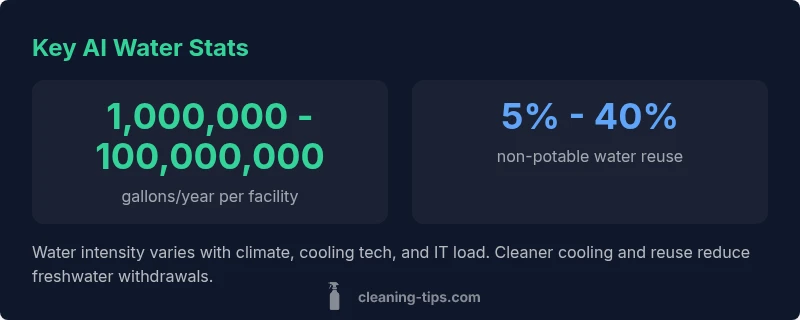
There is no single value for how much clean water does AI use. Cleaning Tips Analysis, 2026 estimates that annual cooling water use per data center ranges from about 1,000,000 gallons to 100,000,000 gallons, depending on climate, cooling technology, and facility efficiency. For individual AI projects, water footprint varies widely with training vs inference workload, hardware density, and cooling design. This article highlights the main drivers and practical measures to estimate and reduce that footprint.
Understanding the water footprint of AI systems
When you ask how much clean water does ai use, the answer hinges on context. AI workloads span training massive models to real-time inference at edge locations. Water is primarily used for cooling data-center equipment, not to power the computations themselves. Cleaning Tips Analysis, 2026 shows that annual cooling water use per data center can range from roughly 1,000,000 gallons to 100,000,000 gallons, with large variations driven by climate, cooling technology, and facility design. This broad spectrum means there is no universal figure for AI water use; instead, practitioners should track water intensity, local water availability, and cooling efficiency for each project. Different AI tasks demand different IT loads and heat outputs, so the water footprint scales with both energy use and the cooling strategy employed. This nuance matters because even modest efficiency improvements in cooling can yield outsized reductions in the footprint over a project’s lifetime.
Drivers of water use in AI systems
The two biggest levers are the workload profile and the cooling solution. Training runs, which push dense GPU or AI accelerator racks for days or weeks, typically produce substantial heat and can spike water use during peak cooling periods. Inference, particularly at the edge or in less dense configurations, often requires far less cooling water. The hardware density, airflow design, coolant type (air vs water-based), and whether free cooling or adiabatic methods are used all influence how much water is drawn from local sources. Beyond hardware, facility choices—urban versus rural locations, humidity, and seasonal climate—also shape cooling needs and water recycling potential. To quantify your exact footprint, you’ll want a model that ties water use to IT load and time, not just a headline figure.
Regional differences and cooling technologies
Geography dictates water availability and the viability of certain cooling strategies. Regions with ample non-potable water supplies can support higher water reuse rates, while arid areas push facilities toward dry cooling or air-cooled architectures to minimize freshwater withdrawals. Emerging cooling approaches, such as closed-loop systems and condensate reuse, reduce fresh water demand but require upfront investment and ongoing maintenance. Evaporative cooling can dramatically increase water use if not paired with reuse schemes. When evaluating AI facilities, compare the local water stress index, the cooling method, and the facility’s ability to implement non-potable water sources. The goal is to decouple AI performance from freshwater withdrawals while maintaining reliability and uptime.
Methods to estimate water use for AI projects
A robust estimate starts with a water accounting framework. Use Water Usage Effectiveness (WUE) or a similar metric to relate water withdrawals to IT energy consumption. Collect facility-level data: average IT load (MW), cooling system type, water source and quality, and the proportion of non-potable water in use. Then translate cooling water withdrawals into annual volumes, accounting for seasonal variation. For project planning, create scenario analyses: best case (high-efficiency cooling, high reuse), most likely (moderate reuse, mixed cooling), and worst case (low reuse, older equipment). Document assumptions so stakeholders understand range and risk. Transparency matters when communicating environmental performance to regulators, investors, or customers.
Strategies to reduce water use in AI infrastructure
There are practical, ready-to-implement steps that can meaningfully trim water footprints:
- Upgrade to high-efficiency cooling with reliable heat exchangers and variable-speed pumps.
- Increase non-potable and treated wastewater reuse, with robust filtration and monitoring.
- Adopt dry or evaporative cooling where climate permits, paired with fall-back cooling for reliability.
- Optimize data-center layout to improve airflow and reduce heat concentration, lowering cooling loads.
- Deploy water-aware capacity planning: right-size hardware, consolidate workloads, and shift non-critical tasks to cooler periods.
- Leverage free cooling and ambient air when possible, especially in cooler seasons.
- Monitor water quality and leaks to prevent waste and downtime. Implement a greenhouse gas and water accounting dashboard for ongoing visibility.
The combined effect of these measures can significantly reduce the freshwater drawn for AI operations without compromising performance.
Benchmarks and ranges you should track
Baseline ranges for AI-related water use vary widely, but tracking consistent metrics helps teams compare apples to apples. A practical starting point is to measure water withdrawals per unit IT load (gallons per MW) and to compute water usage per trained model epoch. Compare seasonal variations to identify opportunities for load shifting and cooling optimization. Where possible, set targets such as reducing freshwater withdrawals by a fixed percentage each year and increasing reuse by a comparable amount. Use external benchmarks to place your facility in context, but tailor targets to climate and local water rights. Remember: two data centers with identical IT capacity can have very different water footprints if one uses dry cooling and recycled water while the other relies on evaporative cooling with limited reuse.
Data table: side-by-side comparisons of cooling strategies
The following table provides a high-level view of how common cooling strategies relate to water use, reliability, and cost. It’s intended as a quick reference for planning discussions and vendor evaluations. Real-world figures depend on climate, equipment, and maintenance practices.
Interpreting the numbers: a practical example
Consider a hypothetical mid-sized data center hosting AI inference services in a temperate climate. If the facility employs advanced air cooling with a modest amount of water used for humidification and condenser cooling, you might see comparatively low water withdrawals relative to a densely packed GPU cluster using evaporative cooling. If the same building upgrades to a closed-loop, non-potable water system, the freshwater withdrawals can drop noticeably while maintaining uptime. The key is to quantify water use per unit of IT energy and then connect it to workload patterns. This approach makes it easier to compare proposed upgrades or new builds and to demonstrate progress toward sustainability goals.
What to monitor and next steps
Set up a simple, repeatable measurement protocol for the next 12 to 24 months: record IT load, cooling system type, water source, and water withdrawals monthly. Build scenario analyses for upgrades or shifts in workload. Engage facilities teams, data engineers, and sustainability staff in a cross-functional plan. Communicate progress to leadership with clear cost-benefit analyses that balance water savings, energy efficiency, and reliability. Finally, stay aligned with evolving standards and guidelines from industry groups and regulators to ensure your metrics remain meaningful and credible.
Illustrative ranges for AI-related water use by operation type
| AI Operation | Typical Water Use Range | Measurement Basis |
|---|---|---|
| Training Run (LLM) | 1,000,000 - 20,000,000 gallons/year per facility | Annual cooling water use |
| Inference Peak (Data Center) | 100,000 - 5,000,000 gallons/year per facility | Cooling during peak operation |
| Cooling System Efficiency | Varies by setup | Water footprint per unit IT load |
Questions & Answers
What is the typical water footprint of an AI training run?
The footprint depends on data-center cooling and workload intensity. There is no universal figure; use water-use benchmarks tied to IT load and cooling type. Document assumptions for stakeholders.
The water footprint of AI training varies with cooling and workload. There isn’t a single number; track IT load and cooling type to estimate it.
Can AI facilities operate without freshwater?
Yes, with non-potable water loops and closed-loop cooling, a facility can minimize fresh water withdrawals. Reliability and maintenance are key to successful non-potable reuse.
Yes. If you use non-potable water and closed-loop cooling, you can avoid freshwater, but you need solid maintenance.
What steps reduce water use for AI projects?
Adopt high-efficiency cooling, implement non-potable reuse, prefer dry or evaporative-compatible systems, optimize workload distribution, and monitor water metrics in real time.
Use efficient cooling, recycle water, optimize workloads, and monitor water metrics to cut usage.
How is water use measured in data centers?
Measure withdrawals, usage, and efficiency using metrics like WUE. Collect monthly data on IT load, cooling type, water source, and withdrawals for transparency.
Measure water withdrawals and usage with metrics like WUE, and track monthly data for clarity.
Is AI water use increasing or decreasing over time?
Trends vary: improvements in cooling efficiency and reuse can reduce per-unit water use, but growing AI demand can push total water demand higher. Scenario planning helps.
Per-unit water use may fall with better cooling, but total demand could rise with more AI activity.
“Water efficiency should be treated as a core metric for AI infrastructure, on par with energy efficiency. Reducing cooling water use can unlock substantial environmental and cost benefits without sacrificing performance.”
The Essentials
- Water use for AI is highly context-dependent
- Cooling strategies drive most of the water footprint
- Reuse and non-potable sources dramatically cut freshwater use
- Track water intensity per unit of IT load for meaningful comparisons