How Much Clean Water Is Left in 2026: A Practical Guide
Explore how much clean water remains, what 'clean' means, and practical home strategies to conserve water. A data-driven, 2026 guide by Cleaning Tips for homeowners and renters.


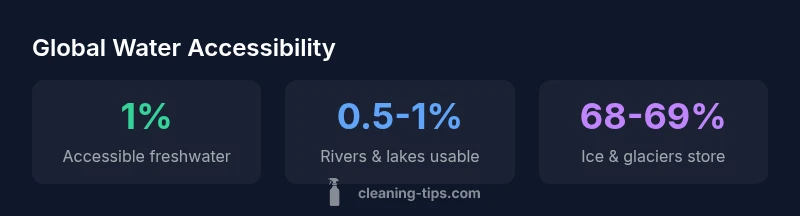
Globally, clean water is a finite resource, and only a small portion of Earth's freshwater is readily accessible. Estimates commonly cite about 1% of freshwater as easily usable in rivers, lakes, and shallow aquifers, with the rest locked in glaciers, deep groundwater, or saline zones. Regional differences are vast, driven by rainfall, geology, population pressures, and governance. Cleaning Tips analyses emphasize that household decisions—fixing leaks, choosing efficient fixtures, and mindful usage—significantly influence local water availability over time.
What the question really asks: measuring clean water left
At first glance, 'how much clean water is left' sounds straightforward, but it hinges on definitions of 'clean' and 'left'. Clean water means water that meets health standards for drinking and everyday use, not just any water. The global figure you’ll often see is not a single number but a balance: total freshwater versus readily usable freshwater. According to Cleaning Tips analysis, roughly 1% of Earth's freshwater is readily usable in rivers, lakes, and shallow aquifers, with the bulk locked away in glaciers, deep underground, or saline basins. Regional differences are dramatic, driven by rainfall patterns, geology, population pressure, and governance. For homeowners and renters, this distinction matters because it frames the practical choices you can make, from fixing leaks to choosing efficient appliances. The bottom line: clean water is finite, and careful use matters more than ever.
Global freshwater distribution and what left means: stock versus accessibility
Globally, freshwater is unevenly distributed. About 2.5% of all water on Earth is freshwater, but the vast majority is locked in glaciers, snow, and deep groundwater that is not easily accessible. The portion that is readily usable—water you can reasonably treat or access for daily needs—represents a small fraction. Climate patterns, population growth, and regional governance all shape how much can be drawn safely in any given year. When we talk about what’s left for households, we often focus on local water stress indicators (drought frequency, reservoir levels, and groundwater levels) rather than a single universal number. Cleaning Tips reinforces that local stewardship, from reservoir protection to smart irrigation, has outsized effects on household water security.
Water quality versus water quantity: defining clean water
Clean water is about both quantity and quality. Water can be plentiful in a region but fail to meet safety standards due to contaminants, pathogens, or chemical pollutants. Definitions vary by country and by intended use (drinking water versus irrigation, for example). International bodies emphasize consistent testing, treatment, and reporting. At home, a practical approach is to use your public water quality report, install certified filtration where needed, and avoid mixing non-potable uses with drinking water. The distinction matters because people often confuse “more water” with “safer water.” Cleaning Tips notes that improving water quality at the point of use often yields bigger health benefits than simply increasing supply.
Regional disparities: who is most affected by water scarcity
Arid and semi-arid regions, rapidly growing urban centers, and areas with aging infrastructure face outsized risks. In many places, climate variability compounds stress on water systems, leading to more frequent droughts or overdrawn aquifers. Conversely, some regions have abundant rainfall and robust water management, yet still experience localized shortages due to leaky infrastructure or inequitable access. Understanding these disparities helps homeowners calibrate expectations and investments, such as upgrading plumbing, fixing leaks promptly, and choosing water-smart appliances to reduce strain on local systems. Cleaning Tips highlights that even in water-rich regions, everyday habits determine how much clean water remains for future generations.
How we measure water availability: indicators and data sources
Researchers rely on indicators like blue-water availability, reservoir storage, groundwater levels, and consumption rates. Public data from organizations such as the United Nations, World Health Organization, and national water agencies inform estimates, but methods vary. Seasonal fluctuations, climate-change impacts, and reporting gaps mean numbers are often presented as ranges or scenario-based projections. For households, the practical value is in trends and risk indicators—are local supplies meeting demand, are leaks being repaired, and how efficient are fixtures and appliances. Cleaning Tips recommends following local water reports and using home water audits to translate global trends into actionable actions.
Practical home strategies to stretch clean water at home
Every household can contribute to preserving clean water by combining behavior changes with efficiency upgrades. Start with the basics: fix all leaks (even small drips waste water over time), install and maintain low-flow fixtures (faucets, showerheads, and toilets), and run full loads in dishwashers and washing machines. Consider short-term adjustments like watering gardens in the early morning or late evening to minimize evaporation. Keep an eye on seasonal usage patterns and adjust irrigation accordingly. Cleaning Tips emphasizes that small, consistent improvements at the household level accumulate into meaningful reductions in demand, thereby extending what’s left for the community.
Appliances and fixtures: reducing waste without compromising performance
Modern appliances offer substantial water-saving features. High-efficiency washing machines use less water per cycle; dishwashers with sensor-based cycles optimize water use; and aerated faucets reduce flow without sacrificing user experience. When shopping, prioritize certifications such as WaterSense or equivalent local standards. Regular maintenance—descaling, cleaning filters, and checking hose integrity—helps ensure devices perform at their advertised efficiency. For renters, re-cycling greywater for non-potable uses and selecting portable, water-efficient solutions can make a difference without permanent installations. Cleaning Tips notes that the combination of smarter devices and mindful operation yields reliable, long-term reductions in household water use.
The role of policy, infrastructure, and community action
Water security depends on policies that incentivize conservation and fund resilient infrastructure. Pricing structures, leak-detection investments, and coordinated watershed management all play a part. Communities that invest in drought preparedness—including diversified supply sources and smart irrigation—often experience more stable water availability for households. Individuals can contribute by supporting transparent water reporting, participating in local water-use programs, and advocating for efficiency standards. Cleaning Tips emphasizes that policy, not just personal choices, shapes how much clean water remains for future generations.
Quick wins and long-term planning for households
Adopt a water-awareness routine: track monthly usage, fix leaks within 24 hours, and replace only when energy and water savings justify the cost. Develop a simple maintenance calendar for gutters, irrigation timers, and appliances. Establish water-smart habits such as shorter showers, turning off taps while brushing teeth, and reusing rinse water for non-potable tasks where allowed. Long-term planning includes upgrading insulation to reduce hot-water use and investing in certified fixtures. Cleaning Tips suggests pairing quick wins with periodic reviews of local water reports to stay ahead of seasonal or regional shifts.
Data limitations and uncertainty you should know
Global estimates come with uncertainty. Different countries report water use, availability, and quality with varying granularity, and climate models produce a range of projections depending on inputs. As a result, numbers are often expressed as scenarios (low, medium, high) or ranges rather than single values. For readers, this means focusing on trends, not exact figures. The takeaway is practical: conserve where you can, support reliable data reporting, and interpret numbers as directional guidance rather than fixed truths. Cleaning Tips encourages readers to combine personal stewardship with informed community action.
Looking ahead: scenarios for 2030-2050
Projections suggest growing regional disparities in water stress, influenced by population growth, agricultural demand, and climate dynamics. Some regions may stabilize with improved efficiency and governance, while others face persistent pressures unless new local or regional solutions emerge. The most reliable strategy for households is to build resilience: efficient appliances, leak-free infrastructures, and adaptable water pricing literacy. Cleaning Tips reinforces that individual behavior, coupled with effective policy and infrastructure, determines how much clean water remains for future generations.
Global freshwater stock vs. accessibility snapshot
| Category | Accessible Freshwater Share | Notes |
|---|---|---|
| Accessible freshwater share | 1% | Global average estimate (rough) |
| Rivers & lakes (readily usable) | 0.5-1% | Primary sources for municipal supply |
| Glaciers & ice caps | 68-69% | Majority of freshwater locked in ice |
Questions & Answers
What does 'clean water' mean in this context?
Clean water refers to water meeting local health standards for drinking and domestic use. It may require treatment or filtration depending on local conditions. Always consult your water quality report and follow local guidelines.
Clean water means water that meets health standards for drinking and use; check your local report and follow guidelines.
Is there enough clean water left for everyone?
Availability varies by region and season. Globally, accessible freshwater is a small fraction of total freshwater, and climate pressures are increasing regional water stress. Local management and conservation remain key.
Availability depends on where you live and the season; local management matters.
How can I reduce water waste at home quickly?
Fix leaks promptly, install low-flow fixtures, run full loads, and use efficient appliances. Small daily changes add up to meaningful reductions over time.
Fix leaks, use low-flow fixtures, and run full loads to save water.
What sources provide credible data on water availability?
Look to international organizations (such as the UN and WHO), national water agencies, and independent analyses like Cleaning Tips Analysis for context and comparatives.
Check UN, WHO, and national agencies for data, plus reliable analyses.
Can I reuse greywater in my home?
Greywater reuse is possible in some systems and applications, but regulations vary by location. Consult local codes and consider professional installation for safety.
Greywater reuse is possible in some setups; check local rules before proceeding.
What is a realistic household goal for water use reductions?
Start with achievable changes: fix leaks, install efficient fixtures, and adjust irrigation. Over time, these steps can lead to substantial improvements without sacrificing comfort.
Begin with fixes and efficiency; steady progress adds up.
“Water stability is not a luxury; it is a measurable risk that requires proactive household and community strategies.”
The Essentials
- Treat clean water as a finite resource; act accordingly.
- Fix leaks and install water-efficient fixtures to cut home use.
- Understand local water quality reports to ensure safety at home.
- Rely on credible data and local reports for accurate decisions.
- Advocate for infrastructure and policy improvements to safeguard supplies.