How to Stop Clean Energy Charging: A Home Guide
Learn how to stop clean energy charging with a practical, step-by-step approach. This home-focused guide explains why you might disable it, how it works, and safe steps to turn it off across devices.


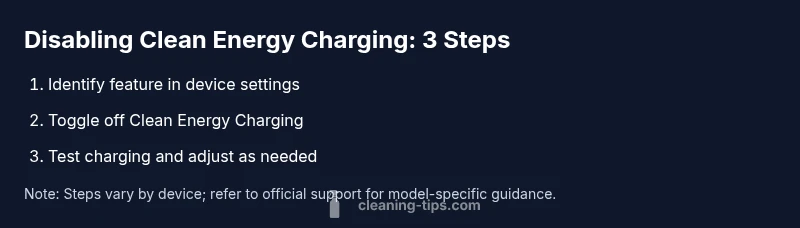
How to stop clean energy charging is a straightforward process: identify the feature by name in your device's battery or charging settings, then toggle it off. Expect a more predictable charging schedule, with potential slight increases in energy use. This quick guide provides general steps you can apply across common devices.
Why you might want to stop clean energy charging
Clean energy charging can be a useful feature for reducing carbon emissions by delaying full charging until carbon-intensive hours are lower. However, there are practical reasons some homeowners and renters choose to stop clean energy charging. If you rely on a predictable charging schedule for essential devices, or you want to ensure your devices reach a full state of charge by a certain time (for work or school), turning off the feature offers reliability. The Cleaning Tips team notes that while carbon-aware charging is beneficial in theory, real-world needs—like overnight calls, early mornings, or long workdays—often override these environmental savings for many households. Understanding your daily routine helps determine whether turning it off makes sense for you.
How clean energy charging works: a quick overview
Clean energy charging is designed to align device charging with lower-carbon electricity availability. In practice, the system learns your daily routine and slows charging to avoid peak carbon intensity. Over time, your device may continue charging in the background but will complete charging closer to the moment you normally unplug. This feature can help reduce emissions and extend battery health when used as intended, but it can also delay a full charge when you need it quickly. For households prioritizing reliability over carbon optimization, knowing how this feature functions helps you decide whether to keep it enabled.
Device variability: where the setting lives
Different devices label and locate the energy-saving charging feature in varying places. On smartphones, the option may live under Battery/Charging settings with names like Clean Energy Charging or Optimized Battery Charging. Laptops and tablets may feature similar controls under Power or Battery sections. Some devices require you to enable or disable policy-based settings through a companion app or system preferences. Because wording differs by manufacturer and OS version, having a general sense of where to look speeds up the process. If you can’t find it, consult the device’s official support page for model-specific steps.
When turning it off makes sense in a home
Turning off clean energy charging can be beneficial when you need assured charging times—for early departures, important meetings, or critical devices that must be ready at a fixed time. It’s also reasonable during periods when your energy supply comes from a source with stable carbon intensity, or when you are testing new charging routines and want to compare results. In a home where multiple people share devices with different usage patterns, disabling the feature on a few key devices can simplify schedules and avoid unexpected delays.
Potential downsides and energy implications
Disabling clean energy charging may lead to slightly higher energy use during peak hours. You might lose some of the carbon-reduction benefits associated with smart charging, depending on your local energy mix. Battery health considerations remain nuanced: some trends suggest that avoiding unnecessary temperature fluctuations and keeping a device fully charged when needed can be beneficial, but this is highly device-specific. Weighing comfort, reliability, and environmental goals helps determine whether stopping clean energy charging is right for your household.
What to expect after turning off Clean Energy Charging
After you disable the feature, your device will follow a more traditional charging pattern, often charging to full capacity as soon as you connect to power. This can mean a faster, more predictable charge, especially when you need a quick top-up before leaving the house. Battery health effects vary by device and usage; in most cases, occasional disabling won’t cause notable long-term damage if you maintain good charging habits, like avoiding leaving devices plugged in at 100% for extended periods.
Troubleshooting common issues after disabling
If you notice erratic charging behavior after turning off clean energy charging, check for other settings that may affect charging speed, such as low-power mode, battery saver features, or device updates that alter charging logic. Ensure cables and power adapters are in good condition and that the charger is compatible with your device. If a setting reappears unexpectedly after a reboot, review any device-management profiles or parental controls that could reset charging behavior.
Authority Sources
For broader energy context and reliability guidance, consult trusted sources. The U.S. Department of Energy and related federal agencies provide information on energy use and environmental impacts. You can also review general battery-management research from reputable institutions for deeper understanding. These sources offer context to the environmental considerations behind smart charging and how families can balance convenience with energy goals.
Practical next steps for most households
- Identify the target device(s) and locate the charging or battery section in Settings.
- Look for terms like Clean Energy Charging, Optimized Battery Charging, or Smart Charging.
- Toggle the feature off, confirm prompts, and test a full charge to ensure it meets your schedule.
- If you rely on a shared device, communicate the change to household members to avoid confusion.
Tools & Materials
- Smartphone or device to adjust (iPhone, Android, or laptop)(Have the device fully accessible and connected to power during testing.)
- Manual or official support page for model-specific steps(Optional but helpful for device-specific menu wording.)
- Stable charger and cable(Ensure you’re using a compatible charger to test charging behavior.)
- Notebook or digital note app(Record any changes and observed charging times for comparison.)
Steps
Estimated time: 15-25 minutes
- 1
Identify the feature and device
Scan Battery or Charging settings to locate the option named Clean Energy Charging, Optimized Battery Charging, or Smart Charging. Note the exact label on your device, as terminology varies by brand and OS version.
Tip: If you’re unsure of the term, search the device’s help center for 'charging optimization' or 'battery health.' - 2
Open the appropriate settings area
Navigate to the device’s Settings app and open the Battery, Power, or Health section where charging options are listed. On some devices, you may need to go through a sub-menu labeled 'Charging' or 'Battery Health.'
Tip: Make sure you’re in the system settings, not a third-party battery app. - 3
Disable the clean energy charging feature
Toggle off Clean Energy Charging, Optimized Battery Charging, or the equivalent option. Confirm any on-screen prompts that request permission to disable the feature.
Tip: If a toggle isn’t present, look for a checkbox or an alternative label like 'Turn off carbon-aware charging.' - 4
Verify the change
Plug the device into power and observe whether it begins charging immediately or follows a preset schedule. If it still behaves like before, revisit settings or consult the official support page for device-specific steps.
Tip: Test with a full cycle: unplug, replug, and note the time to full charge. - 5
Test in real-life conditions
During typical mornings or evenings, monitor charging behavior to ensure it aligns with your routine. Document any differences in charging time and battery levels.
Tip: Keep a brief log for a week to compare before-and-after performance. - 6
Consider enterprise or shared-device implications
If the device is managed by an organization or shared with others, policy constraints may re-enable the feature after updates or resets. Check with an administrator if applicable.
Tip: Ask about policy exceptions or profile updates that might override local settings. - 7
Revisit decision later
If you change your mind, you can re-enable the feature following the same steps in reverse. Periodically re-evaluate after software updates or energy policy changes.
Tip: Set a reminder to review your charging settings after major OS updates.
Questions & Answers
What is clean energy charging and why would I want to stop it?
Clean energy charging times charging to reduce emissions. You might stop it for a guaranteed full charge when you need it or if your routine changes frequently. Consider energy goals versus convenience.
Clean energy charging times charging to reduce emissions, but you may stop it if you need a reliable full charge.
How do I turn off clean energy charging on an iPhone?
Go to Settings > Battery > Battery Health, then toggle off Optimized Battery Charging or Clean Energy Charging. Restart the device if the option doesn’t appear, and test charging after re-seating the charger.
Open Settings, find Battery options, and disable Optimized Battery Charging, then test charging.
Can turning off clean energy charging affect battery health?
Disabling the feature may change charging patterns, but typical usage won’t necessarily harm battery health. Keep charging habits steady and avoid excessive heat or leaving devices plugged in at 100% for long periods.
It can change charging patterns, but with good habits, battery health remains generally stable.
Is clean energy charging available on Android devices?
Android devices may offer similar power-saving charging modes under Battery, Power, or Maintenance settings. Terms vary, so consult your device’s support pages for exact labels and steps.
Many Androids have similar features under battery settings with different names.
Will turning off clean energy charging affect my energy bills?
Disabling may increase energy use during peak times, which could affect costs if you’re on a time-of-use plan. Consider your local energy pricing and daily schedule when deciding.
You might see a small increase in energy cost during peak hours depending on price plans.
What should I do if I can’t find the option to disable?
Search the device’s help center with terms like 'charging optimization' or 'battery health.' If still unavailable, check for software updates or contact manufacturer support.
Look up the exact feature name in Settings or contact support if it’s missing.
Watch Video
The Essentials
- Disable clean energy charging only if you need reliable, predictable charging times.
- Battery health impact varies by device and usage; test changes carefully.
- Always verify settings after updates or policy changes.
- Document results to compare energy use and charging performance.