Deep Clean vs Regular Clean: A Clear Comparison
Explore how deep cleaning differs from regular cleaning, when to choose each, and practical steps to plan a thorough deep clean for a healthier home. Learn with insights from Cleaning Tips.


What is a deep clean vs regular clean? A deep clean goes beyond routine tidying to remove hidden grime, mold, and built-up residues in less-visible areas. Regular cleaning handles daily upkeep and high-traffic surfaces. The choice hinges on your health goals, time, and whether you’ve had renovations, pets, or allergies that demand deeper sanitation.
what is a deep clean vs regular clean
What is a deep clean vs regular clean? In practical terms, a deep clean targets areas often neglected during routine cleans—behind appliances, inside ovens, grout lines, vents, baseboards, and high shelves. It also emphasizes more aggressive removal of dust, mold spores, and embedded grime from surfaces and textures like tile grout and natural stone. For many households, the deep clean represents a seasonal reset, whereas regular cleaning maintains daily cleanliness and prevents grime from taking hold. The Cleaning Tips team emphasizes that the distinction rests on depth, frequency, and the intention behind the work. By framing cleaning as a spectrum rather than a single task, homeowners can tailor a plan that fits health needs and living realities. What matters most is acknowledging that deep cleaning complements regular upkeep, not replaces it. As Cleaning Tips Analysis, 2026 suggests, a well-timed deep clean can dramatically improve indoor air quality and perceived freshness.
When to consider a deep clean
A deep clean is particularly valuable after events that introduce heavy grime or allergens—renovations, wildfire smoke exposure, pet-related shedding, or a long period without thorough cleaning. If family members suffer from allergies, asthma, or a recent moisture issue that could foster mold, a deep clean becomes more than a luxury; it is a health precaution. In many homes, the deep clean is scheduled quarterly or semi-annually, depending on usage and concerns. The Cleaning Tips team notes that seasonal shifts—fall and spring—often motivate homeowners to pair deep cleaning with maintenance tasks like filter changes and vent cleaning. After renovations or new furnishings, a deep clean helps eliminate dust and odors that regular cleaning may miss.
What regular cleaning covers
A regular cleaning focuses on high-visibility areas and routine maintenance: dusting, vacuuming, mopping floors, wiping down countertops, sanitizing bathrooms, and removing everyday grime from commonly used surfaces. Tasks are typically performed on a weekly or biweekly cycle, with touch-ups for spills or high-traffic zones between visits. Regular cleaning prioritizes efficiency, consistency, and the predictable rhythms of family life. It’s designed to keep a home presentable and comfortable, rather than to chase every hidden corner where grime hides. Cleaning Tips recommends pairing a regular schedule with a quarterly deep clean to preserve hygiene and extend the life of household surfaces.
Key differences in scope, time, and cost
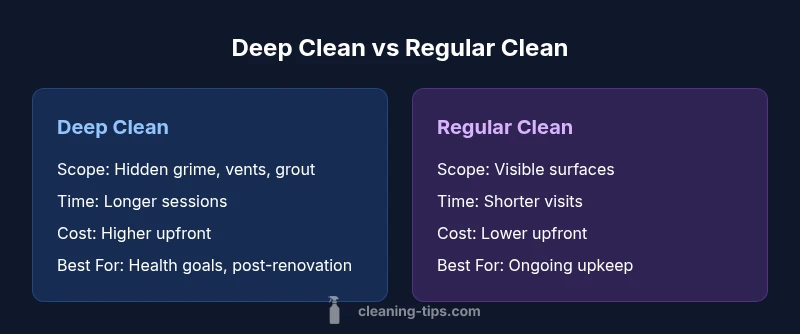
The most visible differentiator is scope—deep cleans address hidden grime and structural nooks, while regular cleans tackle surfaces you can see. Time commitments differ: deep cleans often require longer blocks or multiple sessions, especially in larger homes or spaces with ovens, grout, or vents needing attention. Cost implications follow suit; deep cleans are typically more expensive due to labor intensity and specialized tasks. However, many households find the enhanced hygiene, allergen reduction, and immediate sense of renewal justify the investment. It’s also common to customize a deep clean by prioritizing rooms or tasks, enabling a hybrid approach that balances results with budget.
Step-by-step planning for a deep clean
- Create a prioritized checklist by room, starting with the kitchen, bathrooms, and areas with visible moisture or mold risk. 2) Gather cleaning tools: long-handled brushes, steam cleaners, microfiber cloths, a mold-safe cleaner, and appropriate protective gear. 3) Schedule time blocks that fit your energy level and household rhythm, factoring in breaks and potential help from a friend or professional. 4) Develop a safety plan for sensitive surfaces and electronics, and ensure good ventilation. 5) Use a two-pass approach: a surface-level pass to dislodge grime, followed by a deep-clean pass for grout, vents, and hidden pockets. 6) Validate results with a health lens: check air quality, odors, and residual moisture in problem areas. 7) Schedule maintenance tasks to sustain the gains from the deep clean. The process is easier when you break it into phases and track progress with photos and a shared checklist.
Tools, products, and best practices
Choosing the right tools matters as much as the technique. For deep cleaning,
- Invest in a steam cleaner for tiles, grout, and sealed surfaces where moisture helps lift grime.
- Use microfiber cloths and pads to trap dust rather than push it around.
- Consider a mold-safe, fragrance-free cleaner for kitchens and bathrooms, and avoid abrasive compounds on delicate surfaces.
- Vacuum with a HEPA filter to capture fine particles; follow with damp mopping for hard floors.
- Environmental awareness matters: opt for low-toxicity products and proper ventilation during use.
In practice, a deep clean benefits from a clean-as-you-go approach after the initial reset. The Cleaning Tips team suggests making note of tricky zones—behind the refrigerator and under the sink—and developing a routine that targets them on a rotating basis. This keeps grime from re-accumulating and reduces the total effort required for subsequent cleanings.
Real-world scenarios and schedules
Consider a two-bedroom apartment with a busy kitchen and two bathrooms. A one-day deep clean focusing on the kitchen, bathrooms, and baseboards, plus a second day for behind-appliances and vents, can be a practical strategy. For larger homes, a staged plan over several days may be more feasible, especially when coordinating with family members. A common hybrid approach is to perform a quarterly deep clean for hard-to-reach areas, while maintaining weekly regular cleanings for surfaces and floors. This hybrid plan is often the most efficient and sustainable for busy households. Cleaning Tips’s experience shows that homeowners who adopt staged deep cleans report higher satisfaction and fewer recurring issues with odors and moisture build-up.
Myths and misconceptions about deep cleaning
Myth: Deep cleaning is just a more thorough scrub. Reality: It’s a systematic process targeting hidden grime and potential health hazards, often including behind appliances, grout, and vents. Myth: You must hire professionals for a deep clean. Reality: Many steps can be done by diligent homeowners, but heavy mold, asbestos concerns, or electrical risks warrant professional oversight. Myth: A single deep clean eliminates ongoing maintenance needs. Reality: Deep cleaning supports ongoing upkeep, but a regular schedule remains essential. The best outcomes come from a plan that combines both approaches, with clear scope, budget, and timing. Cleaning Tips emphasizes a practical mindset: plan, execute, and reassess based on results and evolving home health needs.
directAnswerOFFTOPIC
Comparison
| Feature | Deep Clean | Regular Clean |
|---|---|---|
| Scope | Extensive, including hidden areas and built-up grime | Routine cleaning of visible surfaces and high-traffic areas |
| Time Required | Half to full day or multiple sessions | 1-3 hours per visit, depending on space |
| Cost Range | $200-$600 depending on home size and services | $80-$250 for typical routine cleaning |
| Frequency Recommended | Every 3-12 months for deep refresh or after events, renovations | Weekly or biweekly for ongoing upkeep |
| Common Tasks | Oven interiors, behind appliances, grout, vents, high shelves, baseboards | Dusting, vacuuming, mopping, bathroom sanitizing |
| Impact on Health/Hygiene | Removes deeply embedded grime and allergens, improves indoor air quality | Maintains general cleanliness but may miss hidden hotspots |
| Best For | Homes with heavy grime, allergies, post-renovation, or long-neglected spaces | People seeking regular upkeep and cost control |
Strengths
- Deeper sanitation and allergen removal
- Improves long-term hygiene and perceived cleanliness
- Addresses hidden grime and hard-to-reach areas
- Can be staged to fit budget and schedule
Weaknesses
- Higher upfront cost compared to regular cleaning
- Requires more planning and time commitment
- Possible disruption to household routines during cleaning window
- May require specialized cleaners or equipment for certain areas
Deep cleaning is the stronger hygiene investment for most homes, especially where health, post-renovation cleaning, or long-neglected spaces are concerns.
If you prioritize thorough sanitation and allergen reduction, choose a deep clean. For ongoing upkeep and cost control, regular cleanings fit best; a hybrid plan often offers the best balance of results and practicality. The Cleaning Tips team stands by a phased approach to maximize health benefits while respecting your schedule.
Questions & Answers
What is the main difference between a deep clean and a regular clean?
The deep clean targets hidden grime and health-related issues, typically involving hard-to-reach areas. Regular cleaning handles routine maintenance in visible spaces. In practice, deep cleans are less frequent and more intensive, while regular cleans are more frequent and surface-level.
Deep cleaning digs into hidden grime and health risks, while regular cleaning keeps everyday spaces tidy. Think of deep cleaning as a seasonal reset and regular cleaning as day-to-day upkeep.
How often should I schedule a deep clean?
Most households benefit from a deep clean every 3-6 months, depending on lifestyle, pets, and renovation history. After events like remodeling or moisture issues, a sooner deep clean may be warranted. Cleaning Tips recommends pairing seasonal deep cleans with regular weekly maintenance.
A good rule of thumb is every 3 to 6 months, more often if you have pets or renovations.
Can I perform a deep clean myself, or should I hire pros?
Many deep-clean tasks can be DIY if you’re comfortable with strenuous work and proper safety. However, mold concerns, electrical behind appliances, or structural grime may require professional help. Assess the scope and safety risks before deciding.
You can do many steps yourself, but call a professional for mold, electrical, or structural issues.
What tasks are typically not included in a regular cleaning?
Regular cleaning often skips hidden nooks, behind appliances, deep grout cleaning, mold remediation, and vent cleanup. Deep cleaning tackles these tasks to improve air quality and reduce allergens.
Regular cleans miss hidden spots like behind appliances; deep cleaning addresses those gaps.
Is a deep clean worth it for allergy sufferers?
Yes, a deep clean can significantly reduce allergens and dust reservoirs that trigger symptoms. It’s most beneficial when paired with ongoing upkeep and proper filtration.
Absolutely—deep cleaning can make a real difference for allergy relief when combined with regular maintenance.
How should I prepare my home for a deep clean?
Clear clutter in the areas to be cleaned, secure valuables, and note any sensitive surfaces. Communicate any health concerns or mold issues to the cleaning team, and ensure good ventilation during cleaning.
Clear the rooms, note concerns, and let the cleaners do their job with proper airflow.
The Essentials
- Plan a deep clean after renovations or health concerns
- Pair deep cleaning with regular upkeep for best results
- Budget for longer sessions or staged work
- Use a hybrid schedule to balance cost and hygiene
- Prioritize hidden areas (behind appliances, vents, grout) for maximum impact