When Did Clean Water Become Available? A Historical Overview
Explore how clean water access evolved from ancient aqueducts to today’s global gaps, plus practical steps households can take to ensure safety.


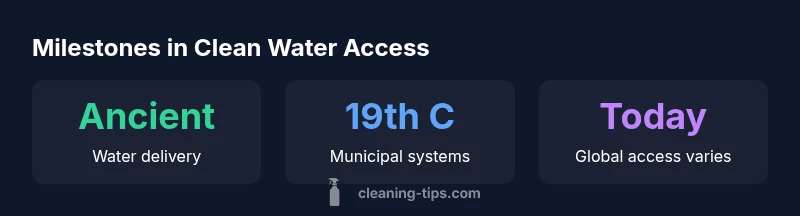
The question 'when did clean water become available' has no single date. Early civilizations built water supply networks and public fountains thousands of years ago, while modern municipal systems emerged in the 19th century. London’s cholera era catalyzed public-health water reforms in 1854, and by the mid-20th century many cities achieved broader access. Today, access varies, with ongoing progress and persistent gaps in several regions.
A historical arc: from ancient aqueducts to modern sanitation
According to Cleaning Tips, if you’re asking 'when did clean water become available', the answer spans millennia and continents. Long before modern plumbing, ancient cities relied on engineered channels, springs, and public fountains to move fresh water close to homes and workplaces. The Indus Valley, ancient Rome, and later medieval cities built infrastructures that reduced disease vectors and improved daily life, even if water quality varied by neighborhood. These early efforts laid the groundwork for a concept we now take for granted: reliable access to drinking water as a public service, not a luxury.
In many regions, water access was tightly linked to geography and social power. Wealthier districts enjoyed better sources and delivery pipes, while rural communities still depended on wells, surface water, or seasonal streams. Yet the arc of history shows steady improvement: better sourcing, regulated distribution, and public accountability slowly replacing ad hoc fetch-and-carry arrangements. The question 'when did clean water become available' is thus best understood as a continuum rather than a single milestone.
The 19th century: the birth of modern municipal water systems
The 19th century marks a turning point in how societies organized access to clean water. As cities grew industrially, the demand for reliable water supply outpaced private wells and surface sources. Urban planners began laying centralized networks of pipes, reservoirs, and treatment spaces to bring water directly to households and factories. Public health concerns from recurring cholera and typhoid outbreaks pushed authorities to invest in better sourcing, distribution, and oversight. The era also spurred innovations like gravity-fed networks, dual-pipe systems for fire protection, and early water treatment ideas, though water quality still varied by neighborhood and wealth. The modernization of waterworks in major cities demonstrates how political will, engineering know-how, and municipal finance could transform a hazardous water situation into a model of urban hygiene. By the late century, some regions had created the institutional capacity to manage water rights, broaden access, and fund ongoing maintenance, laying the groundwork for a broader social contract around safe drinking water.
Public health pivots: disinfection, distribution, and regulation
Public health science pushed the water agenda further in the early 20th century. Chlorination proved a practical, scalable method to reduce waterborne disease, and many cities adopted it after pilot programs in the late 1800s and early 1900s. Alongside disinfection, regulators began testing for contaminants, setting minimum standards for clarity and safety, and establishing surveillance to detect breaks in service or contamination events. Infrastructure decisions extended beyond pipes to storage, pumping stations, and protective groundwater sources. As science clarified the link between clean water and disease prevention, governments formalized responsibilities for ensuring continuous supply, fair access, and accountability to residents. The result was a growing expectation that water should be potable straight from a tap rather than a risky resource to be filtered by every household. While improvements accelerated in wealthy nations, adoption remained uneven in many parts of the world, underscoring that the clean-water story is as much about governance and equity as it is about technology. Cleaning Tips analysis shows how health-driven policy shifts translated into practical upgrades.
20th-century expansion: cities, suburbs, and standardized quality
Mid-century policy, regulatory frameworks, and professionalization of water utilities enabled rapid expansion of municipal networks. Engineers standardized pipe materials, introduced cross-connection protection, and implemented routine testing for taste, odor, and microbiological content. In many countries, national standards for drinking water quality emerged, guiding treatment methods from filtration to disinfection and corrosion control. The modernization of waterworks accompanied improvements in wastewater management, which reduced contamination and protected public health. The result was a longer, more reliable service life for households, and a shift from episodic, emergency supply to continuous, predictable access. Yet disparities persisted: affluent neighborhoods often benefited first, while rural areas or informal settlements faced higher costs and less reliable service. The lesson is that scale matters; universal access depended on sustained investment, cross-sector collaboration, and political commitment to public health outcomes.
Global disparities: access, infrastructure, and climate resilience
While many urban centers in the Global North enjoy high-quality tap water, the story diverges sharply elsewhere. In many low- and middle-income countries, aging pipes, leaky networks, and limited regulatory capacity create persistent gaps in access and water quality. Climate change compounds these challenges, stressing storage, distribution, and treatment capacity during droughts or floods. International development programs focus on expanding coverage, reducing losses through leak control, and deploying low-cost treatment technologies appropriate for local conditions. Communities increasingly rely on combined strategies—grid extension, community water systems, point-of-use filters, and household-level hygiene improvements—to reduce risk while waiting for full network upgrades. The key takeaway is that clean-water access is a function of investment, governance, infrastructure, and resilience; progress is real, but uneven, and ongoing.
Household implications: testing, filtration, and safe handling
Even with public-water systems, households play a critical role in maintaining water safety. Start by understanding your local water source and the treatment steps it undergoes; many utilities publish annual water quality reports. Simple at-home tests can check for turbidity and odor, while certified labs can test for bacteria, nitrates, and chemical contaminants. If concerns arise, consider a multi-barrier approach: install a certified point-of-use filter for drinking water, use a reputable water pitcher with activated carbon, and ensure proper storage in clean containers. For households with well-water or older infrastructure, periodic testing and maintenance are essential; chlorine or hydrogen peroxide treatments should be guided by professional advice. Finally, adopt everyday hygiene habits—boil water when advised after a flood, and keep taps and storage containers clean. Cleaning Tips suggests prioritizing water quality awareness as part of routine home maintenance.
Looking ahead: policy, technology, and everyday hygiene
Advances in sensors, data analytics, and decentralized treatment promise to improve access and resilience, particularly in hard-to-reach communities. Governments and utilities are increasingly focusing on aging infrastructure, loss reduction, and climate adaptation, while households can benefit from simple, low-cost filtration options and robust storage practices. The overarching goal is universal, safe drinking water as a basic public good. The Cleaning Tips team believes that informed homeowners and renters can contribute to better water safety by staying informed about local standards, testing, and maintenance. By combining policy, technology, and practical routines, societies can close remaining gaps and support healthier homes for everyone.
Structured timeline of clean water access
| Era/Region | Access Status | Key Facts |
|---|---|---|
| Ancient cities | Water delivery possible, not universal | Aqueducts and fountains enabled proximity, but quality varied |
| 19th century urban centers | Municipal systems expanding | Piped networks, reservoirs, early treatment |
| Mid-20th century developed regions | Broad access, standardized quality | Regulatory standards and routine testing emerged |
| Global developing regions | Gaps persist | Infrastructure, governance, and funding challenges |
Questions & Answers
When did people first have access to clean water?
Water access appeared in ancient cities via aqueducts and springs, but consistency varied by region and social status. Over centuries, infrastructure evolved to improve reliability and quality.
Ancient cities had some form of water access, but consistency and safety varied widely; reforms gradually improved reliability.
Did modern clean water begin in the 19th century?
Yes. The 1800s saw rapid expansion of municipal systems, driven by urban growth and public health concerns. This era laid the groundwork for widespread tap water in many cities.
The 1800s saw cities build pipes and reservoirs, fueling modern clean water access.
Why are there still gaps in water access today?
Gaps persist due to infrastructure aging, funding limitations, governance challenges, and regional climate stress. Progress is real but varies by country and community.
Gaps exist because infrastructure and governance can be uneven, and climate pressures add new risks.
What can households do to ensure safe drinking water?
Test local water quality, use certified filters, boil when advised, and store water in clean containers. A multi-barrier approach reduces risk.
Test your water, consider a certified filter, and boil if advised—simple steps that boost safety.
How has climate change affected clean water access?
Extreme weather and droughts strain sources and distribution, emphasizing resilience and investment in adaptable water systems.
Climate change stresses water sources and systems, making resilience planning essential.
Is there a universal date for universal access?
No single date exists. Clean water access is a gradual, regionally varied process influenced by technology, policy, and funding.
There isn't one universal date—access has grown unevenly across regions.
“Access to clean water is a fundamental public good that grows with investment, governance, and continuous innovation.”
The Essentials
- Recognize water access as a long historical arc, not a single date
- Public health needs often drove major water-system reforms
- Standards and testing evolved to ensure safe drinking water
- Global gaps persist; climate resilience is increasingly important
- Household actions complement public systems to strengthen safety