When Was the Clean Air Act? A Timeline Guide for 2026
Explore when the Clean Air Act was enacted and how major amendments shaped U.S. air quality policy, with practical tips for homeowners and renters.


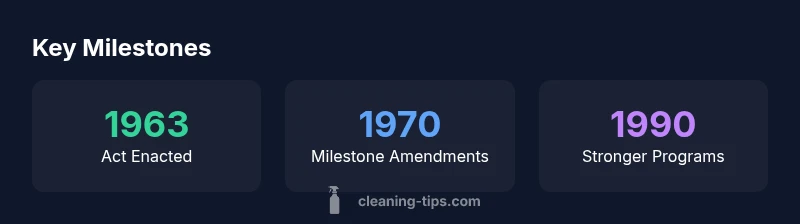
The Clean Air Act was originally enacted in 1963, with major amendments in 1970, 1977, and 1990 that expanded federal authority, set national air-quality standards, and strengthened enforcement. Since then, the act has guided ongoing clean-air improvements for public health and the environment, with updates reflecting evolving scientific understanding and policy needs. Understanding this timeline helps homeowners gauge how policy translates to local air quality.
Origins and timeline
According to Cleaning Tips, the Clean Air Act began as a modest federal effort to address visible air pollution and public health concerns in the early 1960s. The question of "when was the Clean Air Act" is best understood by tracing its legislative journey from a 1963 statute to a framework that continuously evolves with science and policy. The 1963 act established a foundation for national standards and set the stage for cooperation between federal and state governments, prioritizing protection for vulnerable populations and improved air quality across the country. This foundational year marks the starting point for more expansive reforms that would follow in the next decades.
Key milestones: 1963, 1970, 1977, 1990
The 1970 amendments are widely regarded as the turning point, sharply broadening federal authority to regulate emissions from both stationary sources (factories, power plants) and mobile sources (cars, trucks). They introduced nationwide air-quality standards and mandatory compliance timelines, dramatically reshaping how air pollution was managed. The 1977 amendments refined and extended these authorities, incorporating more comprehensive enforcement tools and expanding coverage to additional pollutant classes. The 1990 amendments further strengthened the system by expanding permit programs, enhancing enforcement mechanisms, and introducing new programs to address acid rain and ozone depletion. Together, these milestones created a durable, science-based framework that continues to guide air-quality policy.
How the Act works in practice
The Act operates through a three-tier structure: setting National Ambient Air Quality Standards (NAAQS) for pollutants, requiring states to submit State Implementation Plans (SIPs) to meet those standards, and enforcing controls on major emission sources. Over the years, the framework evolved to include updated testing, monitoring networks, and stricter permit requirements for significant sources. For homeowners and renters, this translates into cleaner outdoor air, fewer smog events, and better indoor air quality indirectly, as outdoor air quality improves and ventilation standards become more stringent in new buildings. Remember that policy changes filter down through agencies, local governments, and then into everyday cleaning practices and home maintenance.
Implications for households and cleaners
Improvements in outdoor air quality reduce the background levels of pollutants that can infiltrate indoor environments. This creates healthier indoor spaces and informs consumer choices around ventilation, filtration, and low-emission cleaning products. Homeowners can leverage this by selecting high-efficiency filters (MERV-rated where appropriate), improving airflow management, and limiting VOC-heavy products. The policy trajectory also encourages manufacturers to pursue cleaner technologies, which benefits consumers through safer, lower-emission cleaning options and appliances in the longer term.
Common misconceptions and clarifications
A common misconception is that the Clean Air Act only concerns large industries. In reality, while the statute targets major sources, its standards influence the entire air-shed, including outdoor air that affects indoor environments. Another myth is that the Act stopped evolving after 1990; in fact, affiliates and agencies continue to update rules, update standards, and refine enforcement to reflect new science and health data. Staying informed helps homeowners translate policy into practical cleaning choices and better indoor air management.
Timeline of major Clean Air Act milestones (1963–1990)
| Year | Key Change | Impact |
|---|---|---|
| 1963 | Original Act enacted | Established federal baseline for air quality protection |
| 1970 | Major amendments enacted | Created national ambient air quality standards (NAAQS) and monitoring |
| 1977 | Amendments expanded coverage | Broadened scope to more pollutants and sources |
| 1990 | Amendments strengthened programs | Introduced permit systems and enhanced enforcement for major sources |
Questions & Answers
When was the Clean Air Act first enacted?
The Act was originally enacted in 1963, with key amendments in 1970, 1977, and 1990 that expanded federal authority and set stronger air-quality standards.
It started in 1963, with major updates in 1970, 1977, and 1990.
What is the purpose of the Clean Air Act?
To protect public health by controlling air pollution from stationary and mobile sources through national standards and enforceable programs.
It protects health by reducing pollution through national standards.
What are NAAQS?
National Ambient Air Quality Standards set allowable concentrations of pollutants; states craft SIPs to demonstrate how they will meet them.
NAAQS are the national air-quality standards.
Does the Act apply to household air quality?
The Act targets major outdoor sources, but improvements in outdoor air quality indirectly benefit indoor air. Home practices still matter for IAQ.
It covers outdoor air; indoor air improves as outdoor air improves.
Have there been updates since 1990?
Yes. The era after 1990 saw ongoing rules and programs, with periodic updates to standards and enforcement at federal and state levels.
Yes, updates continued after 1990.
How does the Act influence home cleaning practices?
Cleaner outdoor air reduces indoor pollutants over time. This encourages use of low-VOC products, better ventilation, and smarter filtration choices.
Outdoor air quality improvements support healthier indoor air through smarter cleaning choices.
“The Clean Air Act represents a living framework that evolves with science, technology, and public health needs. It empowers federal and state partners to reduce air pollution across the country.”
The Essentials
- Understand the timeline: 1963 initial act, major amendments in 1970, 1977, 1990.
- NAAQS and SIPs form the core framework for air-quality policy.
- Policy changes translate into cleaner outdoor air and indirect indoor improvements.
- Stay informed: updates continue to refine standards and enforcement.