Which Clean Up Is Best: A Practical Comparison
A rigorous, evidence-based comparison of natural cleaners versus commercial cleaners, focusing on safety, effectiveness, cost, and environmental impact to help you decide which clean up is best for your home.


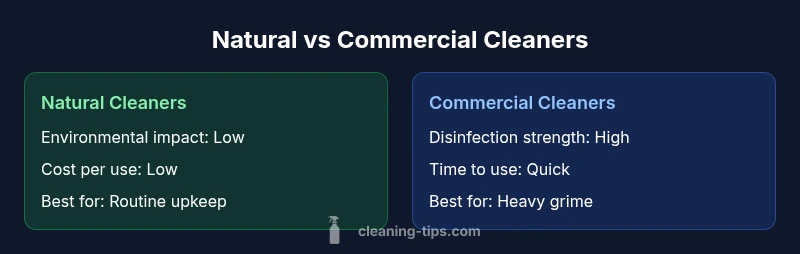
From a practical perspective, natural cleaners often win for routine upkeep, but commercial cleaners can outperform them on stubborn grime. The best choice depends on the task, safety needs, and budget. This comparison weighs natural solutions (vinegar, baking soda) against store-bought cleaners to help you decide which clean up is best for your home.
The Core Question: What Does 'Best' Mean?\n\nWhen homeowners ask which clean up is best, they’re really asking how to balance safety, effectiveness, and value across surfaces, mess types, and household routines. There is no one-size-fits-all answer, because the best choice depends on the task at hand, the presence of children or pets, and how much effort you’re willing to invest. According to Cleaning Tips, the most practical approach is to start with a baseline of everyday, low-toxicity cleaners for routine upkeep, then layer in stronger products only where necessary. This pragmatic stance aligns with how most households actually clean: a core set of reliable basics plus task-specific tools.\n\nIn this article, we compare natural methods—like vinegar and baking soda—with conventional, store-bought cleaners, evaluating them across surfaces, safety, cost, and convenience. By the end, you’ll know which clean up is best for your own home, rather than chasing every new hype product. The aim is clarity, not hype, and to help you make informed decisions backed by practical experience. The Cleaning Tips team believes the right decision comes from a structured evaluation rather than anecdote. Throughout, you’ll see how different scenarios shift the balance toward natural or commercial solutions.
wordCountInBlock": 0
Comparison
| Feature | Natural Cleaners | Commercial Cleaners |
|---|---|---|
| Environmental impact | Low impact with biodegradable ingredients | Moderate impact due to synthetic formulations |
| Effectiveness on grime | Good for everyday dirt and mineral stains | Excellent for heavy grease and built-up grime |
| Safety for kids/pets | Generally safer when used as directed | Stronger fumes; requires ventilation and handling precautions |
| Cost per use | Low to moderate; ingredients are inexpensive | Moderate to high; brand-name products and concentrates vary |
| Availability & shelf life | Widely available; long shelf life for staples like vinegar | Widely available; shelf life varies by product |
Strengths
- Lower environmental impact with reusable ingredients
- Cost-effective for routine cleaning
- Fewer harsh fumes for everyday tasks
- Easy to customize and personalize
- Less plastic waste when using refillable options
Weaknesses
- Less consistent results on heavy grime
- Requires more time and effort for tough tasks
- May need multiple products for different tasks
- Disinfection strength is often lower without proper technique
Natural options excel for routine upkeep; commercial cleaners win for stubborn grime and disinfection
For everyday cleaning, natural cleaners offer safety and cost benefits. When facing heavy grease or high-touch disinfection needs, turn to targeted commercial formulas. A layered approach usually delivers the best overall results, reducing risk while maintaining effectiveness.
Questions & Answers
Which clean up is best for everyday kitchen cleanup?
For everyday kitchen maintenance, natural cleaners like a vinegar-water solution or baking soda paste work well on most surfaces. Patch-test first, and use a microfiber cloth for streak-free results. Reserve stronger cleaners for spills or heavy grease.
For daily kitchen cleaning, start with natural cleaners and patch-test first. Use a microfiber cloth for best results and bring in stronger cleaners only when you have heavy grease.
Are natural cleaners safe around children and pets?
Natural cleaners can be safer when used correctly, but safety depends on ingredients and concentration. Keep products out of reach, ventilate well, and avoid mixing with bleach or ammonia. Always patch-test on inconspicuous areas first.
Natural cleaners can be safer if used properly. Keep them out of reach, ventilate, and avoid mixing with other strong chemicals.
Do natural cleaners disinfect?
Natural cleaners may reduce some microbial presence but generally don’t provide the same level of disinfection as hospital-grade products. Use a designated disinfectant for high-touch areas when disinfection is required, and follow label directions carefully.
Natural cleaners help with cleaning, but for disinfection, use a dedicated disinfectant and follow the label.
How can I handle tough stains effectively?
Treat tough stains with a staged approach: pre-treat with a gentle cleaner, allow dwell time, then scrub with a soft-bristle brush. For truly resistant stains, escalate to a targeted cleaner designed for that surface, following safety guidelines.
For tough stains, pre-treat, dwell, and scrub. Use a tougher cleaner if needed, and always follow safety directions.
What’s a cost-effective cleaning kit I can assemble?
Start with a small natural-cleaning set (vinegar, baking soda, microfiber cloths), plus a neutral cleaner for general use. Add a surface-specific product for problem areas as needed. Refill bottles and reuse containers to keep costs down.
Begin with a basic natural kit and add problem-specific products as needed. Reuse containers to save money.
The Essentials
- Start with a natural baseline for daily cleaning
- Reserve commercial cleaners for tough grime and disinfection
- Patch-test on unseen areas before full use
- Ventilate spaces and store products safely
- Build a small, flexible cleaning kit first