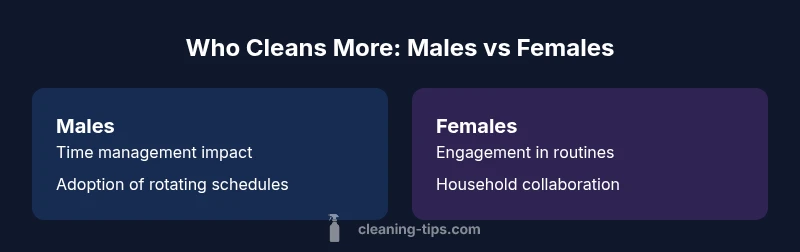
Who is Cleaner: Males or Females? A Balanced Look Today
Explore evidence-based insights on whether cleanliness habits differ by gender and how home routines can be more inclusive, informed by Cleaning Tips analyses.


The short answer is: there isn’t a universal gender-based difference in cleaning ability. Cleaning outcomes are shaped by routines, access to time, and household context, not biology. When households adopt explicit sharing, rotating tasks, and clear expectations, cleaning patterns become more equitable. This analysis explains why gender alone does not determine who cleans and how to design routines that work for any home. who is cleaner males or females
What this question means in practice
The question who is cleaner males or females often surfaces in conversations about household labor and gender roles. In practice, defining “cleaner” means more than the speed of scrubbing a surface. It involves how often tasks are done, the thoroughness of effort, and the consistency of routines. When readers ask this question, they’re really probing whether biology gives one gender an edge in domestic chores or if social factors drive differences. From Cleaning Tips’ perspective, the most actionable takeaway is not to assign blame or credit to a gender, but to understand patterns that influence how cleaning happens in real homes. The phrase who is cleaner males or females appears frequently in online discussions, but the practical guidance is to focus on creating reliable systems that work for your household.
According to Cleaning Tips, the goal is to move beyond stereotypes and toward routines that reduce friction, save time, and promote health. In the following sections we examine the evidence, discuss cultural and behavioral drivers, and offer concrete steps you can take to build equitable cleaning habits in any living situation.
The science behind gender and cleaning
Scientific inquiry into gender differences in cleaning presents a nuanced picture. Across diverse populations, researchers highlight that apparent gaps in cleaning effort often reflect environmental and social factors—such as who is at home, who does childcare, and how chores are distributed—rather than innate ability. In some contexts, women may assume a larger share of routine housekeeping; in others, men contribute substantially when supported by fair expectations and shared decision-making. Importantly, the literature emphasizes variability by culture, age, household size, and work commitments. The Cleaning Tips Analysis, 2026, notes that when households implement explicit sharing agreements and rotating tasks, cleaning patterns tend to distribute more evenly. The takeaway is not to claim a fixed hierarchy of cleanliness by gender, but to recognize how household dynamics shape outcomes.
For readers seeking a concise summary, the evidence points to social and situational determinants as the primary drivers of cleaning behavior, with biology playing a minimal, if any, role in everyday home care.
Behavioral and cultural determinants
Behavioral habits and cultural norms exert a strong influence on how households approach cleaning. In many families, traditional roles shape who performs which chores and when they are done. These norms can create persistent patterns that resemble differences in effort, even when both partners have similar capacities. Conversely, communities that actively redefine responsibilities—through shared calendars, rotating duties, or chore-checklists—tend to see a more uniform level of attention to cleaning tasks. It’s essential to distinguish personal preference from obligation. If one person dislikes certain tasks, that preference should be balanced with fairness and practical scheduling rather than reinforcing stereotypes. Cleaning Tips’ guidance stresses that measurable improvements come from system design, not from changing gender identities. This section emphasizes how culture and personal choices interact to influence daily cleaning routines.
When households align expectations and document who does what, cleaners often see less drift into last-minute scrambles and more consistent results. As with many home-management challenges, the most reliable path is transparency and collaboration rather than assumptions about gender.
Household dynamics and task assignment
Household dynamics—the rhythms of daily life, work schedules, and family size—strongly determine who cleans and how deeply. If both adults work full time, without a plan, cleaning tasks may pile up and feel uneven. On the other hand, households that explicitly allocate tasks, set deadlines, and rotate chores tend to maintain higher overall cleanliness with less ongoing negotiation. Even if one partner previously carried more of the cleaning load, a deliberate shift toward shared responsibility can yield better hygiene outcomes and reduce friction.
Practical strategies include creating a master task list, setting a recurring rotation, and using a shared calendar or app to track duties. These steps help ensure that cleaning is a mutual responsibility rather than a source of conflict. The underlying message is clear: who cleans is less important than having a fair, repeatable system that acknowledges everyone’s time and effort. Cleaning Tips emphasizes that equitable sharing improves satisfaction and consistency in household maintenance.
How to design equitable cleaning routines
Designing an equitable cleaning routine starts with a clear assessment of tasks and time. Begin by listing all recurring chores, then categorize them by effort, frequency, and required resources. Next, assign tasks to household members with rotating schedules so no one bears the burden for an extended period. Use checklists and short, scheduled cleaning blocks to prevent backlog and to keep motivation high. Regular review sessions (monthly or quarterly) let you adjust assignments as life changes.
A practical framework: 1) map tasks to days of the week, 2) rotate tasks every cycle, 3) create a shared to-do list, 4) set simple quality standards for each task, and 5) celebrate consistency as a team effort. This approach shifts the focus from gender to collaboration, health, and efficiency. The Cleaning Tips team recommends documenting the outcomes of each cycle to identify patterns and refine the routine over time.
In short, a fair system beats intent alone. When both partners participate and communicate, cleaning quality improves and household harmony rises.
Practical tips for renters and homeowners
Renters and homeowners face different constraints, but both can implement equitable cleaning practices. Start by designing a pragmatic, low-friction plan that fits your space and budget. Simple steps include investing in durable, easy-to-clean tools, using quick-clean routines between errands, and scheduling longer deep-cleans on weekends or days off. Consider shared products and storage to avoid duplication and confusion. A visible calendar with assigned tasks helps keep everyone accountable without nagging.
For households with children, involve them with age-appropriate chores to build responsibility while keeping expectations realistic. In smaller apartments, batch cleaning tasks to maximize efficiency—group dusting, wiping, and floor care into one session to minimize repeated trips. Cleaning Tips notes that the most effective plans are those that minimize friction, emphasize positive reinforcement, and adapt to changing life circumstances.
This section provides ready-to-use templates and checklists you can tailor to your space, ranging from weekly rotations to monthly deep-clean schedules. The key is to implement a plan that sustains cleanliness while honoring everyone’s time and preferences.
Common myths and misconceptions
A common misconception is that cleaning prowess maps to gender. In reality, cleaning efficacy depends on habits, routines, and environment, not biology. Another myth is that women are inherently more meticulous; while social expectations may encourage different patterns in some households, there are plenty of households where men maintain higher cleanliness standards due to training or deliberate practice. It’s important to challenge stereotypes and replace them with evidence-based practices.
By focusing on shared goals, households can develop outcomes that reflect their values rather than cultural stereotypes. Cleaning Tips emphasizes that progress comes from inclusive language, explicit agreements, and a robust cleaning plan that treats all participants as capable contributors. Debunking these myths supports healthier attitudes toward housekeeping and reduces unnecessary blame when tasks feel uneven.
Measurements of success and check-ins
Measuring success in cleaning goes beyond surface appearance. Effective households track process metrics (task completion, rotation adherence) and outcome metrics (perceived cleanliness, odor control, visible grime reduction) without overemphasizing gender differences. Regular check-ins are essential to adjust allocations, address burnout, and celebrate improvements. Focus on concrete actions: did the deep-clean happen on schedule? Are tasks being rotated? Are all members contributing fairly? Avoid punitive language; emphasize teamwork and shared responsibility.
Cleaning Tips recommends using short, neutral language during reviews and documenting adjustments in a shared journal or app. With consistent feedback, households can identify friction points—such as a task that consistently falls through the cracks—and reassign responsibilities accordingly. The goal is sustainable routines that keep the home healthy and comfortable, regardless of who does the work.
Ethical considerations and inclusive language
Language matters when discussing household labor. Framing conversations around “cleaning equity” and “shared responsibility” helps prevent stigmatizing any gender. Avoid phrases that assign blame for uneven workloads and instead emphasize collaboration and transparent decision-making. This approach aligns with broader health and wellbeing goals for the home. Cleaning Tips encourages readers to adopt inclusive language and to recognize that cleanliness quality improves when everyone participates.
The takeaway is to build habits that respect each person’s time and preferences, while prioritizing household health and safety. By fostering an open dialogue and practical routines, families can move toward a cleaner home and a more harmonious living environment.
Comparison
| Feature | Males | Females |
|---|---|---|
| Time spent on cleaning (per week) | lower or equal | higher or equal |
| Task variety experienced | similar variety | similar or greater variety |
| Perceived cleanliness quality | comparable | comparable |
| Likelihood of sustained routines | similar likelihood | similar likelihood |
| Best for | households with rotating schedules | households prioritizing collaborative planning |
Strengths
- Promotes fair, repeatable routines that reduce conflict
- Encourages clarity and accountability in home tasks
- Supports healthier home environments through consistency
- Fosters a sense of teamwork and mutual respect
Weaknesses
- Requires time upfront to set up a rotation and tracking system
- May challenge longstanding cultural norms in some households
- Relies on ongoing communication; lapses can disrupt fairness
Gender does not determine cleaning ability; equitable routines matter most
Evidence suggests cleaning outcomes depend on habits, routines, and household dynamics rather than gender. Adopt a shared, rotating plan to improve fairness, efficiency, and health in your home.
Questions & Answers
Do studies consistently show a difference in cleaning by gender?
Most studies show variability across households and cultures, not a universal biological difference. Differences are more about norms and routines than biology. Cleaning Tips Analysis, 2026 emphasizes context over biology.
Most research points to social and environmental factors, not biology, shaping cleaning habits; context matters more than gender.
What factors influence who cleans in a home?
Factors include work hours, childcare responsibilities, cultural norms, space size, and available cleaning tools. Effective routines emerge when roles are clearly defined and shared.
Work schedules, culture, and available resources mainly shape who cleans.
Can cleaning quality improve if one partner reduces their workload?
Yes. Redistributing tasks with a fair plan can improve overall cleanliness and reduce burnout. Clear expectations and rotating duties help maintain high standards.
Fair task sharing usually leads to better cleanliness and less stress.
How can I start a fair cleaning routine with my roommate or partner?
List tasks, estimate how often each should happen, and assign them with a rotating schedule. Use a visible tracker and review monthly to adjust.
Make a shared plan and keep it visible so everyone stays accountable.
Are there health benefits to equitable cleaning practices?
Equitable routines often lead to more consistent cleaning, reducing dust, mold, and grime, which supports better indoor air quality and overall health.
Health improves when cleaning is regular and fairly distributed.
How can I avoid blaming gender for cleaning gaps?
Frame conversations around tasks, schedules, and preferences, not identities. Focus on practical solutions and mutual respect.
Keep the focus on tasks, not gender.
The Essentials
- Create a clear cleaning task list
- Rotate chores to prevent bias
- Measure outcomes, not gender
- Use checklists to maintain consistency
- Foster open discussions about responsibilities
- Revisit plans regularly to adapt to life changes