Will Cleaning Vinegar Kill Ants? A Practical Guide
Learn if cleaning vinegar can kill ants, how it works, and when to use it. Cleaning Tips analyzes effectiveness, safety, and best sanitation practices for integrated pest prevention.


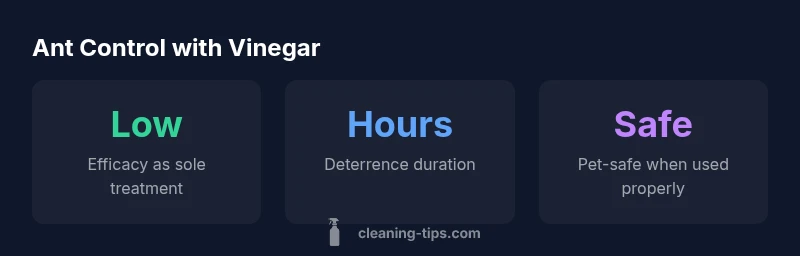
The short answer is that cleaning vinegar is not a reliable standalone ant killer. It may deter or kill exposed workers, but it rarely eliminates an entire colony. For most homes, vinegar should be used as a supplementary measure within a broader, sanitation-focused pest-prevention plan rather than a sole solution.
How cleaning vinegar works and why it might deter ants
Cleaning vinegar typically contains about 5% acetic acid, which can disrupt the scent trails ants rely on and irritate exposed insects. When sprayed directly on ants, it may kill some individuals by contact, but colonies extend beyond the treated area, and for most species the queen and nest workers remain unharmed. Importantly, many ants communicate through pheromone trails that other workers follow; vinegar's strong odor can temporarily mask these trails, causing temporary confusion rather than eradication. So, will cleaning vinegar kill ants? In practice, the answer is nuanced: it can remove a handful of workers and reduce immediate agitation near a spill, but it does not address the colony's source of infestation. For homeowners, this means vinegar should not be relied upon as a sole control method. A more effective approach combines sanitation, exclusion (sealing entry points), and targeted baiting to attract foraging ants away from nests. In the context of an integrated pest management (IPM) plan, cleaning vinegar plays the role of a cleaning agent and a temporary deterrent, not a permanent solution.
Why effectiveness is situational (ant species, nest size, entry points)
Ants are not a uniform threat; different species have different nesting habits and foraging ranges. A small indoor carpenter ant trace might respond differently to vinegar than a large outdoor colony of pavement ants. Even within a species, nest size and proximity to entry points dramatically influence outcomes. Vinegar can disrupt a wandering forager's path or deter ants from a treated doorway, but it does not reach the nest inside walls or soil. Because colonies can contain thousands of individuals and a queen that survives the spill, relying on vinegar alone often leaves the infestation intact. This variability underscores the need for an integrated approach, combining sanitation, exclusion, and baiting to target the colony rather than just the immediate trail.
Practical at-home tests you can run safely
If you want to assess vinegar’s effect in your home, start with a small, inconspicuous area. Dilute cleaning vinegar with water (a typical household ratio is 1:1) and spray a narrow line along suspected trails or entry points. Observe whether ants alter their paths or reduce foraging in the treated zone over 24–48 hours. Do not insist on a single test; repeat in different locations and after cleaning to verify results. Remember to document whether the queen or nest has been affected—an outdoor colony is unlikely to be eradicated by surface spraying alone. Safety comes first: keep vinegar away from soft finishes and metal surfaces that might be damaged by acidity, and ensure the area is ventilated. If ants continue to invade, this simple test likely confirms that a broader IPM plan is warranted.
How to use vinegar safely as part of a broader plan
Vinegar should be one tool among many in an IPM strategy. Start with sanitation: wipe down surfaces, seal crumbs, store food tightly, and fix moisture issues that attract ants. Next, create physical barriers by sealing cracks and gaps around doors, windows, and foundations. Use vinegar as a temporary deterrent near entry points or to clean trails after observation, but avoid heavy reliance. Consider baiting strategies that exploit ants’ foraging behavior by placing sugar- or protein-based baits away from pets and children. Finally, monitor activity over several weeks. If colonies persist, moving to professional assistance or stronger, targeted baits may be necessary. Vinegar’s role is supportive and situational rather than curative.
Alternatives to vinegar for ant control
There are several alternatives that address the colony, not just the stray workers. In IPM, baits that attract foragers and transport poison to the nest are often more effective than surface sprays. Diatomaceous earth and diatomaceous silt can disrupt exoskeletons on contact when applied to known foraging routes, though it requires repeated applications. For indoor use, gel baits formulated for ants provide sustained appeal. Keep pets and children away from bait stations, follow label directions, and target entry points. If you’re dealing with a persistent infestation, non-chemical methods such as exclusion and moisture control remain essential, and chemical treatments should be applied with care and, if needed, professional guidance.
Common myths vs. reality
A common myth is that a single spray will instantly erase an ant problem. In reality, ants are social insects, and eradicating a colony requires addressing the nest. Another myth is that mixing vinegar with essential oils creates a stronger repellent; essential oils can vary in effectiveness and may irritate sensitive individuals or pets. The reality is that vinegar is best viewed as a temporary cleaning aid and deterrent, not a stand-alone solution. Finally, some claim that vinegar can replace baits; this is not supported by evidence for colony-wide control. In summary, expect mixed results and rely on a comprehensive strategy rather than a single approach.
Step-by-step actions if you choose to try vinegar
- Identify trails and entry points. 2) Clean surfaces with a vinegar-water solution to remove residues and neutralize scents. 3) Seal gaps using caulk or hardware cloth. 4) Place child- and pet-safe bait stations away from areas treated with vinegar. 5) Monitor activity for 2–3 weeks and adapt your plan as needed. 6) If ants persist, escalate to integrated pest management or professional help.
Comparison of common ant-control methods
| Method | Ant-kill ability | Safety | Cost | Notes |
|---|---|---|---|---|
| Vinegar (cleaning) | Low to moderate | Moderate (avoid ingestion) | Low to moderate | Best as a supplement, not a standalone solution |
| Baiting with insecticidal bait | High (colony impact) | High safety with proper placement | Moderate | Targets the nest via foragers |
| Diatomaceous earth | Low to moderate (physical barrier) | Low toxicity for humans; beware inhalation | Low | Effective as a deterrent when dry and applied to trails |
| Professional pest control | High (structured IPM) | High safety with professional application | High | Recommended for persistent or large infestations |
Questions & Answers
Can cleaning vinegar kill ants instantly?
No. Cleaning vinegar may kill some exposed ants on contact, but it does not eradicate an entire colony. Persistence and colony-targeted strategies are needed.
No—it's unlikely to eliminate a whole colony; use it as a supplementary cleaning step along with other control methods.
Is vinegar safe to use around pets and children?
When used in moderation and kept away from ingestion locations, vinegar is relatively safe. Avoid concentrated uses near food prep areas and always ventilate.
Generally safe if you keep it away from food and pets, and ventilate well.
What should I use instead of vinegar for ants?
Consider integrated pest management: sanitation, sealing entry points, and bait stations or gels designed for ants. For stubborn cases, professional help may be warranted.
Try sanitation, baiting, and sealing; call a pro if it keeps coming back.
Can vinegar be combined with essential oils for better results?
Some people mix vinegar with essential oils, but evidence on improved effectiveness is limited and oils may irritate sensitive individuals or pets. Use caution.
Mixing isn't proven to help; use caution around pets and kids.
“Vinegar can support cleaning and short-term deterrence, but integrated pest management is the reliable path to eliminating ants.”
The Essentials
- Ants require colony-targeted control, not just surface sprays.
- Vinegar is best as a supplemental cleaning/deterrent, not a cure.
- Sanitation, exclusion, and baiting form the core IPM strategy.
- Avoid overreliance on any single method, especially indoors or around pets.
- Consult professional help for persistent infestations.