Can Clean Boss Be Used on Granite? Practical Guidance for Granite Care
Explore whether Clean Boss is safe for granite countertops, how to read labels, and the best testing steps. This Cleaning Tips guide covers granite-friendly cleaning, common risks, and maintenance to keep stone surfaces pristine in your home.


Can Clean Boss be used on granite? Only if the product label explicitly states granite-safe and pH-neutral. Avoid formulas with acids or abrasives, which can etch or dull granite. Always perform a patch test on a hidden area and follow the manufacturer's directions for best results.
Granite care basics
Granite countertops add lasting beauty to kitchens and baths, but they require careful cleaning to preserve their seal and polish. Because granite is a natural stone, harsh chemicals or abrasive scrubs can wear down the surface over time. The Cleaning Tips team emphasizes using cleaners that are labeled safe for granite and, ideally, pH-neutral. If your product, such as Clean Boss, does not explicitly state granite-safety, treat it as a general cleaner rather than a granite-safe option. According to Cleaning Tips, the safest approach is to use a product that specifically targets stone surfaces and to avoid cross-usage with non-stone cleaners. This distinction matters for homeowners who want to maintain the long-term integrity of sealed granite counters.
Can Clean Boss be used on granite? Labeling and ingredients to check
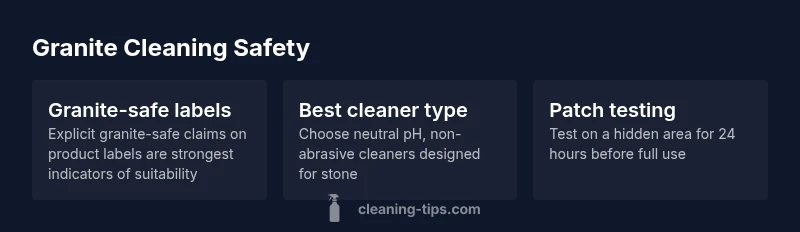
When deciding whether Clean Boss can be used on granite, start with the label. Look for explicit granite-safe claims and a neutral or near-neutral pH. Avoid any formula that lists acids (like vinegar or citrus), ammonia, bleach, or abrasive particles. If the label is ambiguous, contact the manufacturer or choose a cleaner specifically marketed for granite or stone surfaces. The presence of a granite-specific claim is the strongest indicator of suitability. If you are unsure, opt for a dedicated granite cleaner and save Clean Boss for other surfaces.
Patch testing and application steps
To minimize risk, perform a patch test:
- Pick an inconspicuous spot on your countertop.
- Apply a small amount of Clean Boss (or any cleaner) to a 2×2 inch area.
- Wait 24 hours and inspect for changes in color, gloss, or texture.
- If no changes appear, you can proceed with a full-area cleaner application, following the product’s directions.
- Rinse thoroughly with a damp microfiber cloth after cleaning. Patch tests are particularly important for glossy or heavily sealed surfaces.
What to avoid with granite cleaners
Granite is sensitive to acidic and abrasive formulas. Avoid products with acids (vinegar, citrus), ammonia, bleach, or abrasive scrubbers. Do not use scouring pads or powders that can scratch the surface. Never mix cleaners with unknown ingredients, and never leave cleaner on the surface for extended periods. Quick, thorough rinsing and drying are essential to prevent streaks and mineral deposits.
Alternatives and how to compare cleaners
If you’re unsure about Clean Boss, compare it to granite-specific cleaners or high-quality, pH-neutral stone cleaners. Check for explicit stone-safe labeling, minimal odor, and no harsh chemicals. Compare ingredients side-by-side and consider performing an additional patch test in a separate area. Stone care guides from Cleaning Tips consistently favor products clearly labeled for granite or stone surfaces, especially for daily cleaning tasks.
Ongoing granite maintenance tips
Consistency matters for granite care. Wipe up spills immediately to prevent staining, use coasters and cutting boards to avoid scratches, and reseal according to the manufacturer's schedule if the granite is sealed. For tough stains, opt for a dedicated stain-remover designed for stone surfaces rather than a generic cleaner. Regular maintenance helps preserve the counter’s luster and protects the seal over time.
Granite cleaner safety comparison
| Product Type | Granite Safety | Notes |
|---|---|---|
| Clean Boss (assessed) | Label-dependent/unknown | Check label; patch-test recommended |
| Granite-safe Cleaner | Yes if labeled granite-safe | Designed for stone surfaces |
| Harsh Cleaners | Not recommended | Avoid acids/abrasives on granite |
Questions & Answers
Is Clean Boss safe for granite countertops?
Only if the label explicitly states granite-safe and non-acidic. If unsure, avoid use and opt for a proven granite cleaner. Always patch-test first.
Only if the label says granite-safe and non-acidic. Patch-test first.
What should I do if the label claims granite-safety?
Confirm the ingredients are non-acidic and non-abrasive, and perform a patch test. If any dulling or staining occurs, discontinue use.
Verify ingredients and patch-test; stop if you see dulling.
Can I use vinegar on granite?
Vinegar and other acids can etch granite; avoid them and choose a pH-neutral cleaner labeled safe for granite.
Avoid vinegar on granite; use a granite-safe cleaner.
How long should I patch test before cleaning the whole surface?
Patch tests should be left for 24 hours in a hidden area to monitor for color or texture changes.
Patch-test for 24 hours.
What signs indicate a cleaner is not suitable for granite?
Etching, dulling, or color changes after application indicate an unsuitable cleaner; discontinue and rinse thoroughly.
Look for etching or dulling after use.
Do I need to reseal granite after using cleaners like Clean Boss?
Sealing is routine for many granites; follow manufacturer guidance and check if cleaners affect sealant. Re-seal as recommended.
Follow the sealant guidance after cleaning.
“Granite countertops require cleaners that won’t etch or dull the surface; always verify label claims and perform patch tests.”
The Essentials
- Test a small area first before full cleaning
- Always read the label for granite-safety claims
- Prefer pH-neutral, non-abrasive cleaners on granite
- Avoid acids and harsh abrasives on granite surfaces
- Patch-test for 24 hours to confirm safety