How to Make Clean Laundry Detergent at Home: A Practical DIY Guide
Discover a simple, effective way to make clean laundry detergent at home with safe ingredients. This guide covers ingredients, cost ranges, and eco options for busy households seeking practical cleaning tips.


Goal: Make a simple, effective laundry detergent at home with readily available ingredients and minimal cost. You’ll need a grated soap base or bar soap, washing soda, and a measuring cup; optional boosters include baking soda for odor control and a touch of fragrance. This guide shows a basic recipe plus safe substitutions.
Why make your own laundry detergent
According to Cleaning Tips, DIY laundry solutions offer a practical path to simpler, greener cleaning routines. By controlling every ingredient, you reduce plastic packaging, avoid unnecessary fragrances, and tailor formulas to family needs. Home-made detergent tends to be cheaper per load when you compare raw material costs to store-bought bottles. Beyond savings, many households appreciate the transparency of ingredients and the ability to adjust strength for different fabrics and soil levels. This section outlines why a DIY approach can fit into a busy home lifecycle and align with eco-conscious goals.
For most families, the most compelling benefits are cost savings, reduced packaging waste, and improved control over the ingredients that touch fabrics and skin. Plain, unscented formulations can be safer for sensitive individuals, while fragrance can be added selectively. If you have hard water, you’ll also gain from water-softening components that help detergents work more effectively.
Key ingredients and why they work
A clear, effective DIY detergent relies on a few core components. Grated soap or a soap base supplies the primary cleaning action and helps to suspend soils. Washing soda (sodium carbonate) acts as a water softener and enhances grease removal, while baking soda can boost deodorizing effects and alkalinity. Optional boosters like borax can improve stain lifting and fabric softness, though some households prefer to omit it due to sensitivity concerns. Fragrance, if desired, is best added via a small amount of essential oil after the dry mix.
Choosing the right soap matters: fragrance-free soaps reduce skin irritations and are gentler on fabrics. If you start with a scented soap, you can still blend in fragrance-free alternatives to tailor scent intensity. The key is to keep proportions balanced so the mixture dissolves evenly in water and does not leave residue on clothes.
Simple base recipe and variations
A simple base starts with equal parts of three dry components: grated soap, washing soda, and baking soda. For a practical batch, begin with one cup of grated soap, one cup of washing soda, and one cup of baking soda. Mix thoroughly and store in an airtight container. For liquid detergent, dissolve a portion of the dry mix in hot water to create a gel-like consistency that’s easy to measure for each load. If you prefer a powder with a stronger cleaning punch, increase the washing soda slightly while keeping the soap amount constant.
Variations: to reduce clumping, sift the dry mix before storing; for fragrance, add a few drops of essential oil after the mix cools. If you have sensitive skin, target fragrance-free versions and test on a small load first to confirm no irritation.
Adjusting for water hardness and fabric types
Hard water reduces surfactant efficiency. If you have consistently hard water, consider a slightly higher washing soda ratio or pre-dissolving the detergent in warm water before adding it to the washing machine. For delicate fabrics, use a smaller dose and avoid strong scents that can irritate sensitive skin. For heavily soiled loads, pre-treat with a small amount of the dry mix or a pre-soak with lukewarm water and a touch of the base formula. Always check garment care labels and run a small test wash on new or delicate fabrics.
In all cases, dissolve the powdered detergent completely before loading clothes to ensure even distribution and minimize residue. If your machine is older or prone to buildup, consider running an occasional hot-water maintenance cycle with an empty load using a rinse aid that is compatible with DIY detergents.
Storage, batch notes, and safety tips
Store the detergent in a cool, dry place away from moisture and direct sunlight. An airtight jar or tub keeps the powder from clumping and preserves potency. Label each batch with the date and ingredients so you can track shelf life and plan future batches. Safety comes first: wear gloves when handling concentrated powders, keep containers out of reach of children and pets, and avoid inhaling fine powders during mixing. If you have allergies, start with fragrance-free options and introduce scent slowly if desired.
Batch sizing is flexible; small households may enjoy 1- to 2-cup batches, while larger families can scale up to 4- to 6-cup runs. Remember that different loads may require different amounts, so start with the lower end and adjust after assessing results.
Testing, troubleshooting, and eco considerations
Always test a new detergent batch on a small load before using it across a full wash cycle. If you notice residue, adjust the amount you use or increase the water temperature slightly to promote dissolution. If a batch bunches or clumps, run a quick sifter and mix longer. To reduce waste, store your detergent in a reusable container and consider purchasing bulk washing soda or soap in larger quantities. Eco-conscious choices also extend to buying fragrance-free options and using locally sourced ingredients when possible. Regularly reassess your formulas to ensure they still meet your fabric care needs.
Tools & Materials
- Washing soda (sodium carbonate)(Use 1 cup per batch; handle with care)
- Grated bar soap or soap base(E.g., castile soap; grate for best dissolution)
- Baking soda(Optional booster for deodorizing and softness)
- Borax (optional)(Use only if safe for your family; check sensitivities)
- Essential oil for scent (optional)(Limited to a few drops per batch if desired)
- Grater or shredding tool(To create fine soap flakes)
- Measuring cups/spoons(For accuracy in batch size)
- Airtight storage container(Keeps detergent dry and helps with shelf life)
Steps
Estimated time: 15-25 minutes active
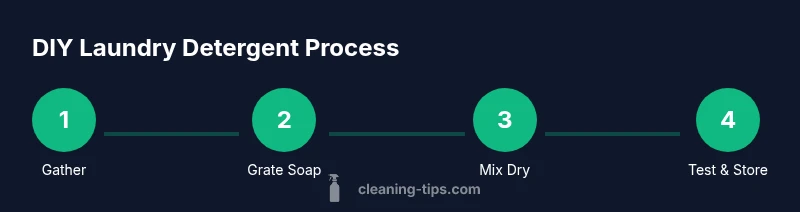
- 1
Gather ingredients and tools
Collect all items before you start so you can measure accurately and avoid interruptions. Having everything ready reduces the risk of skipping essential components.
Tip: Lay items on a clean, dry surface within easy reach. - 2
Grate the soap
Finely grate the soap into fluffy, uniform flakes to improve dissolution in water and ensure a smooth mix with other dry ingredients.
Tip: Use a mask or work in a well-ventilated area if using scented soaps. - 3
Mix the dry ingredients
In a large bowl, combine washing soda, baking soda, and any optional boosters. Stir thoroughly to create an even, clump-free mixture.
Tip: Sift powders to avoid clumps and ensure even distribution. - 4
Add fragrance (optional) and store
If using essential oils, add a few drops to the dry mix after blending, then transfer to an airtight container.
Tip: Keep fragrance to a minimum for sensitive households and avoid contact with eyes. - 5
Use and test
For a standard load, start with 1-2 tablespoons of the dry mix. Test on a small load to gauge cleaning performance and fabric response.
Tip: Adjust quantity for large or heavily soiled loads; dissolve in warm water if needed.
Questions & Answers
Is homemade laundry detergent as effective as store-bought?
Homemade detergent can be effective for regular washing when the formula is well balanced and properly stored. It may not perform identically on heavy stains or specialty fabrics.
Yes, with the right balance and proper loading, it cleans effectively for everyday laundry.
Can I use homemade detergent in high-efficiency washers?
Yes, as long as the detergent is low-suds and used in moderation. Avoid powders that clump; consider liquid or low-suds formulations.
Yes, just use a low-suds option and avoid excess powder.
How long does homemade detergent last?
Store in a cool, dry place in an airtight container. It remains effective for several months if kept dry and free from moisture.
Keep it dry and sealed; it lasts several months.
Are there safety concerns with homemade detergent?
Concentrated powders can irritate skin or eyes. Wear gloves when handling and keep away from children and pets. Always label batches.
Be careful with powders and keep away from kids and pets.
Can I customize scent or add fabric softeners?
Yes, you can add a few drops of essential oil for fragrance. For fabric softeners, use a separate product designed for that purpose.
You can add fragrance with essential oils if desired.
Watch Video
The Essentials
- Make detergent with common, safe ingredients.
- Follow a simple base ratio and adjust for loads.
- Store in a sealed container to maintain dryness.
- Always test on a small load first.