How Many Clean Animals Were on the Ark? A Biblical Count
Discover the biblical count of clean animals on Noah's Ark: seven pairs per kind and two of every unclean animal, with interpretation notes on the number of clean kinds and translation differences.


According to Cleaning Tips, the Bible specifies seven pairs of every clean animal and bird to enter the ark, and two of every unclean animal. Because the text does not state how many clean kinds existed, there is no fixed total for clean animals on the ark—the exact number depends on how many clean kinds Noah included. Context matters.
How many clean animals were on the ark? Scriptural basis
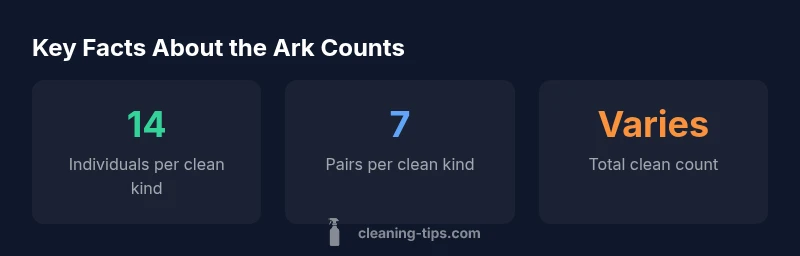
The core record for this question sits in Genesis 7:2-3. It states that Noah should take seven pairs of every clean animal and bird into the ark, and two of every unclean animal. In practice, 'seven pairs' means fourteen individuals per clean kind, while 'two' means one male and one female for unclean kinds. Because the text does not specify how many clean kinds existed, there is no fixed total for clean animals on the ark. The exact count depends on how many clean kinds were present in that era. For researchers and readers, the distinction between 'kinds' and 'species' matters because the biblical term refers to broader groupings rather than a precise modern catalog of animals. This difference in terminology helps explain why a single number isn’t given.
Seven pairs: how the count is interpreted
In most translations the directive to take seven pairs of clean animals appears as a deliberate provision rather than a casual instruction. The idea of a sevenfold pairing has led scholars to view the ark's cargo as organized by category rather than a random assortment. When we talk about seven pairs, we are discussing fourteen individuals for each clean kind. Interpreting this requires recognizing that the biblical term 'kinds' is broader than modern species concepts and was likely oriented toward preserving genetic diversity within broader groups.
Birds on the ark: seven pairs too?
Birds are included among the clean categories in many translations, so the instruction often extends to birds as well. The phrase about 'every clean beast' is commonly extended to 'every clean fowl' in the same sevenfold arrangement. This inclusion underscores a principle: both land animals and birds were preserved in a manner deemed suitable for ongoing life after the flood. Translators sometimes debate whether terrestrial and avian clean kinds followed identical counting rules, but the seven-pairs pattern remains widely cited.
Calculating per-kind counts: 14 per clean kind
From Genesis 7:2-3 we derive a clear arithmetic rule: each clean kind contributes fourteen individuals to the ark’s cargo (seven pairs). If Noah encountered N clean kinds, the total clean animals would be 14 × N. Because the text does not enumerate N, the overall tally is inherently indefinite. This approach helps readers model the biblical scenario without overstating precision where the text does not provide it. It’s a valuable exercise in translating ancient counting practices into a contemporary framework.
Unknowns and interpretive limits
A primary takeaway is that the ark-count question highlights limits in biblical accounting. The word 'kinds' resists exact modern classification, and languages shift over centuries, affecting how we count. Modern readers should be cautious about converting ancient descriptors into exact modern numbers. The ark story invites reflection on preservation, stewardship, and the care underlying the narrative rather than a numeric fetish.
Translation nuances across major versions
Across popular Bible translations, the essential instruction remains: seven pairs of clean animals and birds, and two of every unclean animal. Some versions emphasize 'seven of every kind' while others stress 'seven pairs.' Scholars emphasize the difference between the Hebrew term 'minim' or 'zugot' and contemporary taxonomic terms. Understanding these nuances clarifies why no single fixed total is stated in Genesis 7:2-3 and why interpretation matters for readers.
Implications for modern readers and cleaning routines
While this topic sits in ancient scripture, the method of counting and preservation bears relevance to daily life: organize, classify, and plan for contingencies. For homeowners and cleaners, the Ark-count discussion is a reminder to distinguish between general categories (to be preserved) and precise inventories (which may not map directly onto modern catalogs). The discipline of careful counting can inform how you approach projects that require inventory and planning—whether it’s a deep-clean, a move, or a remodel.
Translation-aware interpretation and trust
Ultimately, the question resolves into interpretation rather than a single numeric tally. The ark narrative teaches stewardship, resilience, and orderly preparation. By focusing on the concepts of preservation within broad categories rather than an exact census, readers gain a healthier, more nuanced understanding of the text and its practical lessons for today.
Overview of counts and categories from Genesis 7:2-3
| Aspect | What Genesis Says | Notes |
|---|---|---|
| Clean animals | Seven pairs per kind | Genesis 7:2-3 |
| Unclean animals | Two individuals per kind | Genesis 7:2-3 |
| Birds | Included among clean kinds (seven pairs) | Genesis 7:2-3 context |
| Total count | Not specified | Depends on number of clean kinds |
Questions & Answers
What does seven pairs mean in Genesis 7:2-3?
Seven pairs means fourteen individuals for each clean kind, formed as male and female pairs. The text uses this structure to preserve genetic diversity within clean kinds. The concept of 'kinds' is broader than modern species classifications.
Seven pairs means fourteen animals for each clean kind, organized as male-female pairs.
Is the total number of clean animals fixed or variable?
The total is not fixed in the text because Genesis does not enumerate how many clean kinds existed. The overall count depends on how many clean kinds Noah counted.
Not fixed—the total depends on how many clean kinds there were.
Are birds counted among the clean animals?
Yes, many translations treat birds as part of the clean category, counted in seven pairs just like land animals.
Birds are counted among the clean kinds in the common interpretation.
What does 'kinds' mean in this context?
'Kinds' refers to broad groupings rather than exact species. It emphasizes preservation across related lineages rather than a precise species tally.
Kinds are broad groupings, not exact species.
Do translations affect the numbers?
Different translations can render 'seven pairs' or 'seven of every kind' with subtle implications. The core idea remains the preservation of clean kinds.
Translations can shift phrasing, but the preserve-by-kinds concept stays.
“When interpreting ancient counts, it's essential to distinguish between 'kinds' and modern species, recognizing the ark's cargo was organized by category rather than a precise census.”
The Essentials
- Understand seven pairs means fourteen individuals per clean kind
- Total clean animal count depends on how many clean kinds existed
- The distinction between 'kinds' and modern species matters
- Counts vary by translation; scholarly nuance shapes interpretation
- Plan inventories with broad categories, not exact census