How Many Cleaning Companies in the US: A Market Overview
Explore how many cleaning companies operate in the US, the definitions that shape counts, data sources, and practical steps to estimate market size for homeowners and pros.


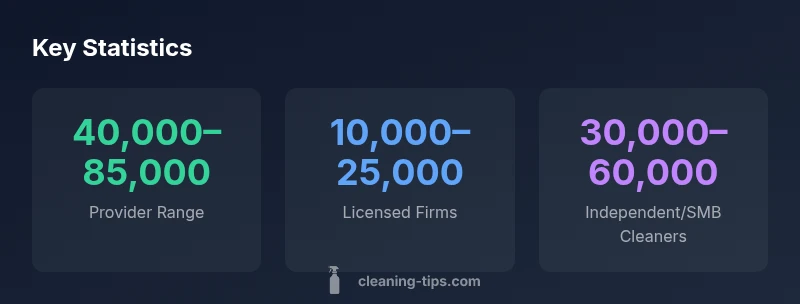
There is no single official count of how many cleaning companies operate in the US. Estimates vary because definitions differ—licensed firms, franchises, and independent cleaners all contribute to the market. According to Cleaning Tips analysis, the market includes thousands of entities when you count licensed businesses, franchised brands, and independent operators, but an exact number depends on data sources and inclusion criteria.
Market landscape: how many cleaning companies operate in the US
Estimating how many cleaning companies operate in the US is a nuanced exercise. There is no single federal or state tally that cleanly enumerates every provider, especially when you count licensed firms, franchises, and independent cleaners. The phrase how many cleaning companies in the us typically prompts debates about definitions—and the Cleaning Tips team has found that numbers shift dramatically with different criteria. For homeowners and service professionals, the practical takeaway is that the market comprises tens of thousands of entities when you include all licensed operations, franchise networks, and solo operators. This breadth matters for pricing, service options, and local competition. The big picture is that the market is large, fragmented, and evolving as regulations and consumer expectations change. This complexity is exactly why clear definitions matter for any estimate. Cleaning Tips analysis, 2026 emphasizes that context matters as much as the raw count.
Defining the counting problem: licensed vs franchised vs independent
To get a meaningful count, it helps to separate provider types:
- Licensed firms: Companies registered with state authorities, often with business licenses, insurance, and employee records.
- Franchise brands: National or regional networks with many franchisees under a single brand umbrella.
- Independent cleaners: Solo operators or small teams that may not be affiliated with a formal franchise or corporate entity.
These categories overlap in practice—some licensed firms operate franchises, while many independent cleaners register as small businesses. When you combine all three, the potential universe expands beyond the count of any single category. This is a core reason for wide variation in published estimates and a reminder that the “how many” question requires explicit definition before you compare numbers. For homeowners, the practical effect is that there are many options at different scales and price points, from neighborhood independents to national franchise networks. The Cleaning Tips team recommends documenting which categories you include in any count to avoid apples-to-oranges comparisons.
Data sources and reliability: where numbers come from
Reliable counting relies on triangulating multiple data sources, each with strengths and blind spots. Common sources include:
- State business registries and professional licenses (for licensed firms).
- Franchise disclosures and brand directories (for franchise networks).
- Industry directories, chamber of commerce records, and professional associations.
- Economic censuses and NAICS-based reports (for market sizing).
Each source has limitations: state registries may miss informal operators; franchise lists may overlook non-branded independent cleaners; and self-employment data can undercount individuals working as sole proprietors. The net effect is that estimates will vary by source and definition. Cleansing the data requires transparency about which categories are included and acknowledgment of potential gaps in coverage. Cleaning Tips analysis, 2026 highlights the importance of documenting assumptions so readers can gauge the reliability of any counts.
Regional distribution and market density
Geographic patterns reflect population density, urbanization, and consumer demand for cleaning services. Major metro areas—coast-to-coast hubs such as New York, Los Angeles, Chicago, Houston, and Dallas—show higher concentrations of both licensed firms and independent cleaners due to larger customer bases and diversified economic activity. However, smaller cities and suburban regions also host substantial numbers of providers, especially independent cleaners who cater to local households. State-by-state variation arises from licensing requirements, labor markets, and local competition. Understanding regional density helps homeowners estimate service availability, typical response times, and price ranges in their area. The bigger takeaway is that access to cleaning services is widespread, but the mix of providers shifts by market size and regulatory environment.
Market dynamics and drivers: what pushes the counts up or down
Several forces shape how many cleaning companies exist at any given time:
- Labor dynamics: shortages or surges in cleaners influence how many firms hire staff or rely on subcontractors.
- Regulatory and licensing changes: stricter requirements can shift counts toward compliant firms and reduce informal operators.
- Technology and marketplaces: platform-based hiring and booking apps expand visibility for independents, increasing apparent counts even if formal registrations stay stable.
- Consumer demand patterns: post-pandemic cleaning norms, emphasis on green and safe cleaning, and service diversification (carpet cleaning, upholstery, specialty floors) broaden the types of providers.
For readers, these drivers mean counts are not static. The market adapts to who can legally operate, who can market services effectively, and who meets evolving consumer expectations. The Cleaning Tips team notes that market size is as much about how you define “provider” as it is about the raw number of firms. This perspective helps explain why the numbers you see from different sources may diverge significantly.
Implications for homeowners and renters
The sheer size and fragmentation of the market translate into practical considerations for buyers of cleaning services. High competition typically yields better pricing and more flexible scheduling, while a longer tail of smaller operators can mean variability in reliability and service breadth. Homeowners should look beyond price and consider:
- Verification of licensing and insurance: ensures protection against liability and worker injuries.
- Clear service scope: what is included, added-value services, and limits.
- Customer reviews and BBB ratings: indicators of consistency and accountability.
- Transparent pricing structures: upfront quotes and absence of surprise fees.
- Service specialization: whether you need basic housekeeping, move-out cleaning, carpet care, or appliance cleaning.
For renters and homeowners alike, awareness of market structure helps in choosing providers that balance value with dependability. It also clarifies why some areas have more options but different price points, depending on the local mix of licensed firms, franchises, and independents.
How to estimate for your needs: a DIY checklist
If you want a localized estimate of how many cleaning providers serve your neighborhood, use this practical checklist:
- Define scope: decide if you’ll count licensed firms, franchises, independents, or all three.
- Identify geographic area: city, county, or metro region; adjust for rural vs urban coverage.
- Gather sources: state registries, franchise directories, local business directories, and chamber of commerce listings.
- Compile and reconcile: remove duplicates (a single entity appearing in multiple lists) and note differences in categorization.
- Consider front-line indicators: number of competing providers, typical response times, and range of services offered.
- Document assumptions: log your definitions and data sources so the estimate is reproducible for future updates.
- Apply context: translate counts into practical expectations for scheduling, pricing, and service availability. Following these steps helps homeowners form an grounded sense of local market size without relying on a single, possibly biased source.
What this means for the Cleaning Tips reader
Understanding the scale of cleaning service providers helps readers compare options and manage expectations. The reality is that you will encounter a broad spectrum of providers—from small, local cleaners to large franchise networks. This diversity underpins competitive pricing, varied service quality, and flexible scheduling. When you plan a cleaning project, use the counting framework to gauge how many options exist in your area, then vet candidates with the criteria outlined above. The ultimate goal is to find a trustworthy provider that meets your needs without overpaying. Cleaning Tips’s approach emphasizes transparent definitions, reliable data sources, and practical steps you can apply in any city.
Looking ahead: trends shaping the counting of cleaning companies
As consumer demands and regulatory landscapes evolve, the way we count cleaning providers will continue to shift. Increased emphasis on licensing, workers’ rights, and insurance could stabilize counts by weeding out non-compliant operators, while digital marketplaces may inflate perceived options by aggregating solo cleaners into a single listing. Ongoing data collection and standardized definitions will be critical for accurate market sizing. For readers and researchers, the takeaway is to track multiple data sources, document assumptions, and revisit estimates periodically to capture market dynamics accurately. The Cleaning Tips team will continue to publish defensible, definition-aware analyses to help homeowners and pros navigate a growing and evolving market.
Estimated breakdown by provider type
| Category | Definition Scope | Notes |
|---|---|---|
| Licensed Firms | Businesses registered and licensed at state level | Data comes from state registries and professional licenses |
| Franchise Brands | National franchises with multiple locations | Brand-level counts may exceed individual franchise units |
Questions & Answers
Why isn't there a single official count of cleaning companies in the US?
Different data sources use varying definitions (licensed firms, franchises, independents) and aggregation methods. This leads to multiple estimates rather than one definitive number.
There isn’t one official count because definitions vary and data sources differ.
How can a homeowner estimate the number of cleaners in their area?
Define scope, gather local registries and franchise directories, then reconcile duplicates and document assumptions. This yields a reasonable local estimate rather than a nationwide figure.
Start with your city and go outward using local listings.
Do franchise-based cleaners comprise a large share of the market?
Franchise networks contribute a notable share, but independent cleaners and smaller firms also make up a large portion of the market. The exact split varies by region and data source.
Franchises are significant but not the only players.
What data sources are best for researching cleaning businesses?
State business registries, franchise directories, industry associations, and NAICS-based reports provide complementary views. Cross-reference to improve accuracy.
Check multiple sources to get a fuller picture.
Can this information help me compare cleaning services?",
Yes. Understanding provider types, coverage, and local density helps you compare options beyond price, including availability, specialization, and reliability.
Use it to shortlist providers that fit your needs.
“Counting cleaning companies in the US isn't straightforward; definitions shape the numbers, and a comprehensive approach blends licensed firms, franchises, and independents.”
The Essentials
- Define your counting scope before estimating.
- Provider counts vary by licensing, franchising, and independence.
- Use multiple data sources for reliable market sizing.
- Verify licensing and insurance when choosing a cleaner.
- Local market density often exceeds national averages.