Cleaner vs Janitor: Key Differences in Roles and Scope
Explore the difference between a cleaner and a janitor with an analytical, data-backed comparison of duties, training, work settings, compensation, and career paths to help homeowners and managers hire smarter.


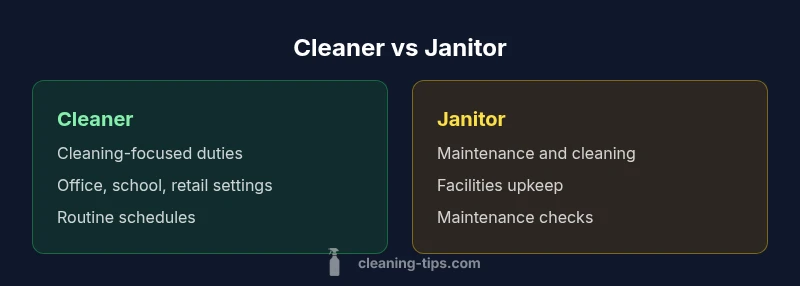
The difference between a cleaner and a janitor mostly comes down to scope. A cleaner typically handles cleaning tasks like surfaces, restrooms, and laundry, while a janitor covers broader facilities maintenance, minor repairs, and supplies management. In workplaces, choosing depends on needs: homeowners usually hire cleaners for routine cleaning, while facilities managers may need janitorial staff for maintenance and incident reporting.
Defining Roles: cleaner vs janitor
In practice, the difference between a cleaner and a janitor is not a universal standard; it reflects how organizations assign responsibility and accountability. According to Cleaning Tips, the most useful way to think about these roles is to map duties to outcomes rather than to job titles alone. In many workplaces, the term cleaner emphasizes routine cleaning tasks in defined areas, with emphasis on hygiene, appearance, and sanitation. The term janitor, by contrast, often signals a broader remit that includes cleaning plus basic maintenance, light repairs, and facilities oversight. In the U.S. and parts of Europe, you’ll see cleaner roles described for offices and schools, while janitorial roles appear in large facilities, shopping centers, and older buildings where ongoing upkeep extends beyond weekly cleaning. The key takeaway is: the differentiation is a practical one tied to scope and accountability, not a rigid taxonomy. The Cleaning Tips team notes that the actual duties depend on the employer, building type, and required service levels. When homeowners or managers hire staff, they should define expectations clearly, so the title matches the tasks.
This introductory framing also highlights why the question often asked is the difference between a cleaner and a janitor. By focusing on duties rather than labels, organizations can avoid confusion and set realistic performance targets. Cleaning Tips analysis emphasizes that a clear, written job description reduces mismatch and improves satisfaction for both staff and clients.
Scope of responsibilities and typical tasks
Cleaner roles traditionally emphasize cleaning outcomes: dust removal, floor care, surface sanitization, restroom maintenance, trash disposal, and laundry duties if required. They often work in defined areas such as offices, schools, or retail spaces, following established cleaning protocols and schedules. Janitors, in contrast, commonly have a broader facilities-maintenance remit. Alongside cleaning, they perform light repairs, report larger maintenance issues, manage supply inventories, monitor safety and compliance, and coordinate with supervisors on building upkeep. This broader scope can also involve basic equipment maintenance, securing workspaces after hours, and assisting with event setup or changeovers. The key distinction: cleaners focus on cleanliness and hygiene outcomes, while janitors blend cleaning with upkeep and problem-solving responsibilities. In real-world settings, some employers merge duties under a single title, which creates ambiguity; the fix is to define expectations clearly in the job description and performance plan. Inside many organizations, a hybrid role arises when facilities demand both cleaning and basic maintenance, requiring careful task delineation to avoid gaps or overlaps.
Training, credentials, and career paths
Training for cleaners often centers on cleaning techniques, product use, and safety protocols, including chemical handling, PPE, and spill response. Many positions rely on on-the-job learning, with optional certifications such as custodial technician credentials or facility sanitation programs offered by community colleges or vocational schools. Janitors typically receive similar cleaning training but may also pursue basic maintenance education—electrical, plumbing, or carpentry fundamentals—depending on the facility’s needs. Some employers reward formal credentials with broader responsibilities or supervisory roles. Cleaning Tips analysis notes that career progression in this space frequently moves from entry-level cleaner or janitor to lead cleaner, supervisor, or facilities coordinator; however, progression varies by industry and organization size. Regardless of title, consistent safety training and adherence to cleaning standards are central to both paths.
Work environments and scheduling differences
Work environments strongly influence the distinction between these roles. Cleaners frequently work in offices, schools, hospitals, and retail spaces with regular daytime or evening shifts aligned to building occupancy. Janitors may operate in similar settings but are more likely to participate in on-call rotations, weekend shifts, or overnight coverage to support continuous facilities operation. In larger facilities, janitors often rotate through specialized posts—custodial supervisor, maintenance assistant, or building attendant—reflecting a tiered structure that blends duties. Scheduling nuance matters: a cleaner might assume a focused, predictable routine, while a janitor may need flexibility to respond to repairs, safety incidents, or after-hours events. For homeowners or small businesses, this translates to choosing someone who can maintain cleanliness consistently, whereas larger properties may require a versatile role capable of handling both maintenance tasks and routine cleaning.
Compensation, recognition, and career outlook
Compensation and recognition frameworks often mirror the scope of duties. In many regions, cleaners are paid for routine cleaning tasks with clear performance benchmarks tied to cleanliness outcomes. Janitors, with their broader scope, may command higher pay bands or benefits where maintenance responsibilities are formally included in the job description, especially in unionized environments or larger facilities. The career outlook hinges on how organizations define roles and invest in training; a well-structured role with defined duties tends to yield better retention, clearer performance metrics, and opportunities for advancement into facilities management or supervisory tracks. Regardless of title, clear expectations, consistent safety practices, and transparent evaluation criteria are essential to attract and retain capable staff.
Practical guidance for homeowners and employers
For homeowners and managers hiring staff, the key is clarity. Start with a precise job description that ties tasks to outcomes rather than relying on generic titles. If you need both cleaning and maintenance, consider a hybrid role with explicit boundaries and escalation paths for repairs. Use standardized checklists for daily cleaning tasks and monthly maintenance inspections to ensure consistency. Provide training on chemical safety, equipment operation, and emergency procedures. Establish reporting lines so staff know when to escalate issues, and create performance metrics tied to cleanliness, safety, and reliability. Regular feedback loops help adjust duties as building needs evolve and reduce role ambiguity for everyone involved.
Difference between a cleaner and a janitor
In practice, the difference between a cleaner and a janitor is a matter of scope and accountability. A cleaner is primarily responsible for cleaning tasks, surface hygiene, and appearance, while a janitor carries a broader facilities-maintenance remit, including minor repairs, supplies management, and safety checks. The two roles may share overlapping duties, but the key decision is to align titles with the expected outcomes, not merely to reflect a traditional label. When in doubt, translate the job into a written scope of work that enumerates daily, weekly, and monthly tasks, along with escalation procedures for repair work or safety concerns. This approach reduces ambiguity, improves job satisfaction, and supports a healthier, safer environment for occupants.
Comparison
| Feature | Cleaner | Janitor |
|---|---|---|
| Definition | Primarily cleaning-focused duties such as dusting, vacuuming, mopping, restroom sanitation, and laundry | Broader facilities maintenance including cleaning plus minor repairs, safety checks, and supply management |
| Primary focus | Cleaning outcomes and hygiene | Facilities upkeep and functional environments |
| Typical work settings | Offices, schools, retail spaces | Industrial facilities, multi-tenant buildings, larger campuses |
| Core tasks | Surface cleaning, sanitizing, trash disposal, laundry | Cleaning plus minor repairs, inventory checks, safety reporting |
| Required training | On-the-job training, safety protocols, chemical handling | On-the-job plus maintenance basics, safety training |
| Career progression | Senior cleaner, lead cleaner, supervisor | Custodial supervisor, facilities coordinator, maintenance technician |
| Scheduling approach | Regular shifts, day/evening options | Rotating shifts, on-call for emergencies |
| Pay and recognition context | Typically role-labeled cleaning; compensation varies by employer | Broader scope; often higher pay or more benefits depending on union and facility |
Strengths
- Clear role definitions aid hiring and budgeting
- Allows tailored training programs aligned with duties
- Supports consistent cleaning standards and safety protocols
- Potential career progression into facilities management
- Easier policy development with distinct roles
Weaknesses
- Role ambiguity persists across organizations
- Pay and advancement can be inconsistent across industries
- Small employers may combine duties, making titles less meaningful
Cleaner roles suit routine cleaning needs; janitor roles fit broader facilities maintenance.
Clear role definitions help hiring and policy development. For facilities with maintenance needs, a broader janitorial scope can improve operations; otherwise, keep titles aligned with tasks to minimize confusion.
Questions & Answers
What is the difference between a cleaner and a janitor?
The difference lies in scope and typical duties; cleaners focus on cleaning tasks, while janitors have broader maintenance responsibilities. Job descriptions should reflect actual duties to avoid confusion.
Cleaner roles focus on cleaning tasks, while janitors cover maintenance; always read the job description for the exact duties.
Are cleaners more common in certain settings?
Cleaners are frequently found in offices, schools, and retail spaces where the priority is routine cleaning. Janitors appear more often in larger facilities with maintenance needs.
Cleaners are common in offices and schools; janitors tend to be in larger facilities with maintenance tasks.
Do cleaners require professional certifications?
Most cleaners do not require formal certifications, though safety and chemical-handling training is common. Some facilities may require specific certifications for sanitation or hazardous material handling.
Most cleaners don’t need formal certifications, but safety training is often required.
Can the roles be combined in one job description?
Yes, many organizations use a hybrid role combining cleaning and maintenance tasks. When this happens, it’s crucial to enumerate duties and escalation processes clearly.
Hybrid roles are common; list exact duties to avoid overlap.
How should I label job postings to avoid confusion?
Label as Cleaner for cleaning-focused duties or Janitor/Facilities Technician when maintenance is included. Include a detailed scope of work in the posting.
Label the job by the actual duties and include a detailed scope.
What questions should I ask during an interview?
Ask about daily tasks, maintenance responsibilities, safety training, and how performance is evaluated. Clarify expectations for after-hours or emergencies to ensure alignment.
Ask about daily tasks, maintenance duties, and safety training to gauge fit.
The Essentials
- Define duties clearly in job postings
- Map titles to tasks to avoid confusion
- Provide consistent safety and maintenance training
- Use a written scope of work to guide hiring decisions
- Plan for career ladders in facilities teams