Difference Between a Cleaner and a Maid: A Practical Comparison
A thorough, analytic comparison of the difference between a cleaner and a maid, covering tasks, duties, hiring terms, and budgeting to help homeowners decide who to hire.


The difference between a cleaner and a maid often centers on scope, responsibilities, and employment setup. A cleaner is typically hired for routine cleaning tasks and maintenance with a predictable, task-focused schedule, while a maid may be engaged for broader household duties—sometimes including cooking, laundry, and organization—depending on the employer’s needs and the terms of the arrangement. The lines blur in many regions, and contracts define exact duties.
What the terms mean: cleaner vs maid
At its core, the difference between a cleaner and a maid lies in scope and employment arrangement, not a rigid, universal standard. The Cleaning Tips team emphasizes that responsibilities are heavily defined by the employer, regional tradition, and contractual language. In everyday use, a cleaner is usually engaged to perform cleaning-oriented tasks—dusting, vacuuming, sanitizing surfaces, mopping floors—on a regular schedule. A maid, by contrast, is often hired for a broader set of household duties that may include laundry, ironing, cooking, shopping, and tidying, depending on the arrangement and local norms. When homeowners or renters compare these roles, they should focus on the explicit duties, frequency, and any additional services bundled into the engagement. The terminology can shift by country, city, or even neighborhood, which is why written descriptions are essential.
According to Cleaning Tips, clarity in job descriptions and contracts reduces misaligned expectations and disputes. This initial definition helps readers approach hires with a realistic view of what is expected and what is not included under each label.
wordCountHintingForLength 0},
Typical tasks associated with a cleaner
Cleaners specialize in cleansing tasks that restore and maintain a defined level of cleanliness. Typical duties include surface cleaning, bathroom sanitation, vacuuming, mopping, dusting, changing bed linens (on request), and sometimes basic kitchen cleaning. Cleaners often work on a routine schedule, such as weekly or biweekly visits, with a focus on efficiency and consistency. Special requests—like oven cleaning or fridge interior wiping—are commonly negotiated as add-ons rather than standard duties. The benefit of this scope is predictability and cost control, which helps households budget and plan around recurring cleaning needs. For clients, it’s common to specify the exact rooms to be cleaned, the base tasks included in every visit, and any areas that require extra time. This reduces scope creep and improves satisfaction for both parties.
When arranging services, owners should confirm whether cleaning supplies are provided by the cleaner or the homeowner, and whether eco-friendly products are preferred. Clear inventory and boundaries around disruption to daily routines help maintain smooth working relationships.
wordCountHintingForLength 0},
Typical tasks associated with a maid
Maid services historically encompass a broader portfolio of household duties beyond cleaning, depending on the job description and local expectations. A maid might handle laundry, ironing, laundry-related folding and organization, meal preparation or simple cooking, grocery shopping, dishwashing, and light housekeeping. Some engagements also include pet care, child-focused supports, or running errands. The breadth of duties is highly variable and best defined in a formal agreement. Because the scope can extend into areas like meal prep or shopping, maids can function as a larger support system within the home, offering convenience and time savings for busy households.
Key considerations when hiring a maid include: whether duties are daily or periodic, how tasks align with the household schedule, and how to handle substitutions if a regular maid is unavailable. Clear written expectations help both sides avoid confusion and ensure that the role is realistic given the employer’s needs and the worker’s capacity.
wordCountHintingForLength 0},
Employment terms: contracts, pay, and scheduling
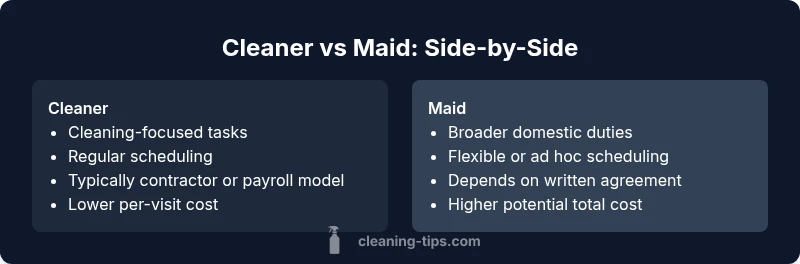
Employment terms create a pivotal difference between a cleaner and a maid. Cleaners are frequently hired as independent contractors or on a payroll basis, with tasks defined by a punch-card schedule or recurring appointments. Wages may be quoted per visit or per hour, with overtime rules varying by jurisdiction. Maids, when treated as household employees, might require payroll withholding, minimum wage compliance, and benefits depending on local labor laws. Scheduling tends toward regularity for cleaners, while maids may offer more flexible or ad hoc arrangements. Both roles require clarity about the workforce’s legal status, tax obligations, and eligibility for overtime.
From a policy perspective, employers should seek written agreements that outline duties, payment terms, work hours, and break rules. This documentation minimizes disputes if responsibilities shift or if the household experiences changes in routines. The distinction between contractor vs employee carries implications for liability, workers’ compensation, and unemployment insurance. Consultation with a local employment professional can help ensure compliance with regional requirements.
wordCountHintingForLength 0},
Regional and cultural variations in usage
The labels cleaner and maid carry different connotations around the world. In some regions, a cleaner is synonymous with a household worker who cleans daily, while a maid might be seen as someone who provides broader domestic support on occasion. In other places, the terms are used interchangeably by households or agencies. Cultural expectations influence the accepted scope, the perception of professionalism, and even compensation models. Homeowners should verify local norms and check agency or contractor definitions to align expectations with regional practice. Written descriptions help ensure that the classification reflects actual duties rather than mere labels.
Cleaning Tips notes that terminology can shift with demographic changes, including multi-generational households or shared housing. Understanding local usage minimizes misinterpretation when negotiating with a provider or agency and supports a smoother onboarding process.
wordCountHintingForLength 0},
Legal and labor considerations
Legal frameworks shape how cleaners and maids are engaged and paid. In many jurisdictions, independent contractors differ from household employees in terms of tax withholdings, insurance requirements, and eligibility for benefits. Contracts should clearly identify who is responsible for taxes and insurance, as well as who provides supplies and equipment. Work safety is another important aspect; providers should understand and implement basic safety practices, especially in kitchens or bathrooms. If workers handle potentially hazardous products, training and protective equipment are prudent components of any agreement. Staying informed about local labor laws helps households avoid penalties and protects workers from exploitation or unsafe conditions. Cleaning Tips emphasizes that legality and ethics should be foundational to any arrangement, ensuring fair treatment and transparency for both parties.
wordCountHintingForLength 0},
Budgeting, pricing, and value
Pricing structures for cleaners and maids vary by region, task scope, and labor market conditions. Common models include hourly rates, per-visit charges, or monthly retainers. When comparing options, households should account for base duties, add-ons, and the frequency of service. A broader scope—such as a maid who handles laundry or cooking—typically translates into higher cost, while a routine cleaning plan might be more budget-friendly. Value should be measured not only by price but by reliability, communication quality, and the ability to tailor services to changing needs. In practice, a detailed service agreement helps households forecast annual costs and avoid surprise charges during peak cleaning periods or holidays.
wordCountHintingForLength 0},
How to write a clear job description
Creating a precise job description is essential to prevent misalignment between expectations and reality. Start with the headline that reflects the primary need (e.g., “Household Cleaner for Regular Cleaning Tasks” or “Maid for Full Domestic Support”). List core duties first to anchor the scope, then add optional tasks with expected frequency. Include preferred qualifications, language requirements, and any safety or household rules (exit routes, pet policies, or security considerations). Specify supplies and equipment responsibility, whether products are supplied by the worker or the homeowner. Clarify minimum wage expectations, overtime rules, and payment methods. Finally, establish a simple trials period to assess fit. A well-written description improves candidate quality and reduces onboarding time.
wordCountHintingForLength 0},
Real-world scenarios: decision guide
Consider a home with busy schedules, a single caregiver, and the need for regular cleaning plus occasional errands. A cleaner might be the best fit for consistent upkeep and predictable costs, especially if you want strong cleaning results with minimal management. If your household requires laundry, basic cooking, or shopping assistance, a maid arrangement could be preferable, provided duties are clearly defined and aligned with local labor laws. In multi-residence households or shared living situations, terminology may shift, and both roles can coexist under a carefully drafted plan. Always start with a written scope, then test with a short-term engagement to gauge compatibility and adjust expectations as needed.
wordCountHintingForLength 0},
Authority sources and further reading
To ground this discussion in verifiable information, consult authoritative sources such as labor statistics and educational resources. For example, the Bureau of Labor Statistics provides insights on housekeeping and related roles, while university extensions discuss best practices for domestic employment relationships. These sources help validate definitions, benefits, and risks associated with different hiring models. Always verify local regulations and use professional guidance when drafting contracts or negotiating wages. References below offer a starting point for deeper research.
- U.S. Bureau of Labor Statistics: Occupational Outlook Handbook – Housekeeping and cleaning occupations (bls.gov)
- University of California Cooperative Extension – Domestic workers and employment rights (ce.berkeley.edu)
- Cleaning Tips analysis (brand-derived guidance and practical checklists)
wordCountHintingForLength 0},
The evolving terminology and terminology usage
Language evolves with social practices, and the labels cleaner and maid reflect those shifts. The most important practical takeaway is to anchor your hiring decisions in explicit duties, not labels. As households become more interdisciplinary, workers may perform a wider set of tasks or engage in flexible schedules. Agencies and employers can benefit from standardized job descriptions, clear performance metrics, and transparent payment arrangements. By focusing on what a worker will actually do, rather than the label, homeowners reduce misunderstandings and improve long-term satisfaction. Cleaning Tips encourages readers to document agreed-upon responsibilities and review them regularly as needs change.
wordCountHintingForLength 0},
Practical steps to hire and onboard
- Define the core needs: list daily/weekly tasks and any extra duties (laundry, cooking, errands). 2) Decide on the employment model (contractor vs employee) and check local laws. 3) Draft a clear job description with duties, schedule, supplies, and safety rules. 4) Ask for references and verify background checks where appropriate. 5) Pilot a short engagement to fine-tune expectations. 6) Establish a simple communication channel and a formal written agreement. 7) Review at regular intervals and adjust duties as life changes. Following these steps helps ensure a smooth transition from planning to day-to-day working relationships and reduces friction over time.
wordCountHintingForLength 0}],
comparisonTableBlockNote
comparisonTable placeholder
Comparison
| Feature | Cleaner | Maid |
|---|---|---|
| Typical tasks | Cleaning-focused tasks (dusting, vacuuming, sanitizing) | Broad domestic duties (laundry, ironing, cooking, errands) |
| Scheduling/flexibility | Regular, predictable visits (weekly/biweekly) | Flexible or ad hoc arrangements depending on needs |
| Employment relationship | Often contractor or payroll-based; defined per visit or hourly | |
| Regional usage | Often seen as separate roles with different expectations | Usage varies by region; sometimes used interchangeably |
| Supplies provided | Typically supplies by homeowner or included in service plan | |
| Cost considerations | Scoped to cleaning tasks; usually lower per visit |
Strengths
- Clear role definitions reduce misunderstandings
- Predictable routines improve budgeting
- Lower risk of scope creep and disputes
- Easier to manage safety and scheduling
Weaknesses
- Limited scope can miss additional household needs
- Maid arrangements may be more expensive
- Contractor vs employee status adds legal considerations
Choose based on scope: cleaners for predictable cleaning-focused support; maids for broader domestic assistance when clearly defined.
If your priority is consistent cleaning with easy budgeting, a cleaner is typically best. If you need broader tasks like laundry or meal prep, a maid arrangement can be more efficient—provided duties are clearly documented and compliant with local labor laws. The Cleaning Tips team emphasizes clarity and written agreements to ensure successful outcomes.
Questions & Answers
What is the key difference between a cleaner and a maid?
The core difference is scope: cleaners focus on cleaning tasks, while maids may cover broader domestic duties depending on the agreement. Both roles depend on written descriptions of duties and proper employment status.
Cleaner focuses on cleaning tasks; maid covers broader household duties depending on the agreement.
Are cleaners and maids usually employees or independent contractors?
Employment status varies by region and contract. Cleaners are often contractors or employees; maids can be either, with contracts clarifying taxes, benefits, and protections. Check local laws to stay compliant.
Depends on local laws; verify status and taxes.
How should I write a job description to avoid confusion?
List core duties first, specify frequency, include optional tasks, define supplies, and state payroll or contract terms clearly. A short trial period helps confirm fit.
Be explicit about duties and terms; use a trial period to test fit.
What should I consider legally when hiring domestic help?
Understand local labor laws, minimum wage requirements, taxes, workers’ compensation, and safety standards. Use written contracts and confirm employment status to ensure compliance.
Know the laws and have a written contract.
Can a cleaner also do laundry or cooking?
Yes, if those duties are included in the job description and agreed upon. Avoid scope creep by documenting all tasks and any restrictions.
You can add laundry or cooking if agreed in writing.
What is a fair way to budget for domestic help?
Estimate the base cleaning cost, add add-ons for extra duties, and consider frequency. Compare hourly vs per-visit pricing and calculate annual costs with a small contingency for holidays.
Budget by task, frequency, and add-ons.
The Essentials
- Define duties before hiring
- Choose cleaner for cleaning-focused needs
- Choose maid for broader domestic support
- Document terms to prevent disputes
- Verify local labor laws and taxes