How to Know If a Song Is Clean on Spotify: A Practical Guide
Learn practical steps to identify clean tracks on Spotify using track labels, version notes, and built-in filters. A family-friendly approach to filtering explicit content across devices.


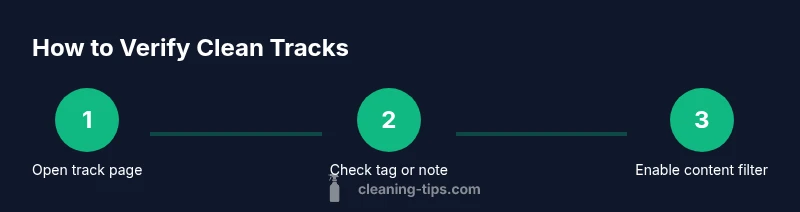
According to Cleaning Tips, to know if a song is clean on spotify you should check the track label (Explicit vs Clean), review the album notes for explicit warnings, and enable Spotify’s content filter to hide explicit tracks if you want a kid-friendly listening experience. These checks reliably identify clean tracks before you press play.
Understanding what 'clean' means on Spotify
When people ask how to know if a song is clean on spotify, the answer hinges on how Spotify labels content and what a listener expects from a release. In practice, 'clean' refers to tracks that do not include explicit lyrics or language, or that have a radio-friendly edit. Spotify primarily marks explicit tracks with an Explicit label, and some artists release 'clean' or 'radio edit' versions that remove or mute strong language. Understanding these distinctions helps you tailor listening for children, guests, or a distraction-free environment. The presence or absence of explicit references, the displayed tag on the track, and the availability of a clean version determine whether a track qualifies as clean on Spotify. The Cleaning Tips team notes that platform labeling is the most reliable signal, but cross-checking with the release notes provides extra assurance.
Check the track label on the track page
To know if a song is clean on Spotify, start with the track page. Look for an Explicit badge or a small 'E' icon next to the track title or near the album art. If you see 'Explicit', the track is not clean by default. Some tracks list 'Clean Version' or 'Radio Edit' in the track or album notes; selecting that version will play the sanitized lyrics. On mobile, the explicit tag is often visible under the track name; on desktop, the badge may appear to the right of the track or within the album sidebar. If you can’t see a tag, proceed to the album notes and check for explicit language notes. These checks address the common question of how to know if a song is clean on Spotify without streaming the track first.
Review album metadata and release notes
Sometimes the content flag applies to the whole album. Inspect the album page for warnings, artist notes, or fan comments indicating explicit content. If an album is flagged as explicit, individual tracks may or may not be clean; some albums feature a Clean Version. Cross-check the track versions listed and scan any release notes for 'clean' or 'radio edit.' The Cleaning Tips guidance suggests verifying across multiple track listings within the same release to confirm consistent labeling, which reduces the risk of unexpected profanity when you play music in shared spaces.
Use Spotify's content controls to filter explicit content
Spotify offers a filter to hide explicit content. In the Settings menu, look for a section like 'Explicit Content' or 'Playback' options and enable the option to 'Hide explicit content' or similar. This feature affects suggestions and playlists across the app, so enabling it helps ensure that you won’t see explicit tracks in Home, Search, or your playlists. If you enable this filter, you still may encounter mixed content if a track lacks a clear explicit flag, so it’s wise to perform a quick double-check before introducing a playlist to family devices. The main idea: use the filter as a safety net to complement track-by-track checks, not as a sole screening method.
Variants: Clean versions, edits, and live performances
Not every release has a clean version; some songs have clean studio edits, while others retain profanity in live performances. A track labeled 'Explicit' may have a clean radio edit version in some regions or on certain playlists. When you search for the track, try adding terms like 'clean', 'radio edit', or 'acoustic' to locate alternate versions. Additionally, some remixes remove explicit language, making them suitable for kids. When evaluating a track, consider whether your goal is to filter language or simply avoid adult themes, and choose the version accordingly.
Practical workflow for families and households
For families, a simple workflow helps maintain a clean listening environment. Create a dedicated 'Kids' playlist and one or more parent-approved playlists, then curate track versions with clear tags. Before adding a song, perform the check: is there an explicit tag? Is there a Clean Version? Does the album note mention explicit language? Then, apply the content filter, and test the track on a guest device to ensure it aligns with your expectations. The result is a reliable approach to knowing how to know if a song is clean on spotify across devices and during shared listening sessions.
Tools & Materials
- Smartphone or computer with Spotify app(Logged in; stable internet connection)
- Stable internet connection(Needed to fetch track metadata and labels)
- Headphones or speakers(Optional for verifying by ear)
Steps
Estimated time: 15-30 minutes
- 1
Open the track page and locate the label
Navigate to the track you’re evaluating and inspect the immediate area around the title and album art for a visible label indicating language content.
Tip: Look for the explicit badge or 'E' icon near the track name. - 2
Check the album page for language notes
Open the album page and scan release notes or artist notes for explicit language warnings or a mention of clean versions.
Tip: A clean version is sometimes listed as 'Clean' or 'Radio Edit' within the track options. - 3
Search for a Clean Version
If the track has multiple versions, use the search or track options to select a 'Clean' or 'Radio Edit' version if available.
Tip: When in doubt, compare the track listing across versions before playing. - 4
Enable explicit content filtering
In Settings, turn on the explicit content filter to reduce exposure to explicit tracks in recommendations and searches.
Tip: This is a safety net; it doesn’t replace fact-checking a track’s language. - 5
Verify on your device
Test playback on the device your household uses to confirm the track meets your comfort level.
Tip: If a track auto-plays with explicit lyrics, reconsider adding it to family playlists. - 6
Create a family-ready workflow
Document a simple process for family members to flag questionable content and prefer clean versions when building playlists.
Tip: Keep a shared note of known safe tracks for quick playlist-building.
Questions & Answers
What does the Explicit label on Spotify indicate?
The Explicit label flags tracks with language or content that may be unsuitable for children. Clean versions may exist separately. Always check the track and album notes for confirmation.
Explicit means language or content may not be suitable for all listeners. Look for a Clean Version if you need something kid-friendly.
Can I hide explicit songs across my account?
Yes. In Spotify settings you can enable a filter to hide explicit content from recommendations and sometimes from searches, though it may not remove every explicit track.
Yes, you can filter explicit content in settings to reduce exposure.
What if there is no explicit tag on a track?
If a track has no explicit tag, check the album notes and related versions to confirm whether the language is clean. If unsure, avoid adding the track to child-friendly playlists.
If there’s no tag, review notes or seek a clean version before playing.
Are live versions always explicit?
Not always. Live performances may include profanity, even if the studio version is clean. Verify version-specific details before playing for kids.
Live versions can differ; verify the specific track version.
Do playlists mark clean tracks?
Playlists may include a mix of versions. Look at individual track metadata in each playlist to confirm clean versions are used.
Track-level checks are safest within playlists.
Is the information the same on mobile and desktop?
Label visibility can vary by platform. Always verify on the device you’ll use most often.
Yes, platform differences exist; verify on your main device.
Watch Video
The Essentials
- Check the explicit tag before playing
- Enable content filters for family listening
- Look for Clean Version or Radio Edit options
- Verify across versions and devices