Is Hang Clean Harder Than Clean? A Side-by-Side Comparison
Explore whether the hang clean is harder than the traditional clean, with biomechanics, programming insights, drills, and practical guidance for lifters at every level.


Is hang clean harder than clean? For many lifters, the hang clean presents a greater technical challenge because you start from the hang position, demanding precise bar speed, hip drive, and catch stability without floor starting power. The full clean adds floor drive that helps momentum, but the hang clean isolates the initial pull and transition, often making it feel tougher to execute cleanly.
Is Hang Clean Harder Than Clean? Framing the Question
Is hang clean harder than clean? This question matters for athletes designing a training plan, because it frames how you allocate technique work versus loading. According to Cleaning Tips, many lifters report that the hang clean is more technically demanding at the same load because you must generate bar speed from a higher starting point and stabilize the catch without the floor drive. This section outlines what makes the two lifts different in principle and what that implies for programming, coaching cues, and progression. The goal is not to declare one lift superior across all goals, but to identify where each lift offers unique value and where beginners should start. For readers aiming to understand the comparative difficulty, this analysis emphasizes practical cues, common sticking points, and how to integrate both lifts into a balanced program. The keyword is woven naturally here: is hang clean harder than clean, and the answer hinges on technique mastery and coaching emphasis.
Core Biomechanical Differences: Hang Clean vs Clean
The hang clean and the traditional clean share a common goal—transfer of energy from hip extension into rapid vertical bar speed. They diverge in starting position, bar path, and the sequence of the pull. In a hang clean, the bar starts from the hang position (often around knee- to hip-height) and the first pull relies heavily on hip extension with minimal knee flexion drive. In a full clean, the lifter pulls from the floor, generating momentum through a triple extension from ankle, knee, and hip. This difference changes which muscle groups control the bar most in the first moments of the pull, how footwork is timed, and how aggressively lifters must coordinate the transition into the vertical pull.
First Pull, Bar Path, and Explosive Drive
From the hang position, the first pull emphasizes hip drive and bar path control rather than floor-initiated momentum. A key cue is to accelerate the bar vertically while keeping the bar close to the body. In contrast, the floor pull of a full clean benefits from eventual knee and hip extension combined with gravity-assisted acceleration. The hang clean places greater emphasis on maintaining a tight midline, keeping the bar close to the thighs during the initial pull, and finishing the first pull with a crisp transition to the second pull. This often explains why some lifters perceive the hang clean as tougher: there is less kinetic help from the floor to start the bar upward.
Catch, Stability, and Lockout: Why the Hang Can Feel Hard
The catch in the hang clean demands precise timing and wrist/forearm strength to rack the bar without relying on a forward knee or ankle drive from the floor. Many lifters report greater challenge in stabilizing the bar during the catch and in recovering to a solid front rack position. Conversely, the full clean benefits from the floor’s momentum and often allows a slightly more forgiving catch under load once the bar is accelerated. Trainers frequently note that mastering the hang catch translates well to improved bar control in other Olympic lifts, even if it feels harder during the proned rack.
Training Implications: Programming Hang Clean and Clean
Programming decisions should reflect your goals. If your aim is to improve starting position, bar path, and catch stability, intersperse hang cleans with periodic full cleans. If peak power or complex coordination under maximal loads is the objective, include heavier full cleans while using hang cleans as a technique refinement tool. A practical approach is to reserve hang cleans for a dedicated technical block, while full cleans appear in the main loading phases. The core idea is to balance the two so that improvements in one lift support gains in the other, rather than treating them as mutually exclusive.
Common Mistakes and Fixes
Hang cleans are notorious for technical errors when lifters rush the transition or let the bar drift away from the body. Common issues include: a floating chest that reduces bar control, early hip extension that truncates the bar path, and poor rack position leading to instability at catch. Fixes include slow-motion video analysis, practicing with slower tempo to reinforce bar close-ensemble paths, and targeted drills that isolate the hang position, first pull, and catch. Tackling these mistakes systematically yields more consistent and higher-quality reps over time.
Drills, Progressions, and Sample Week
A practical progression starts with hang pulls from the hang position, moves to hang cleans with light loads, then introduces paused front squats to reinforce rack position, and finally integrates full cleans. A sample week might include two technique days focusing on hang positions and bar path, followed by one heavier day emphasizing full cleans. Progress gradually, never compromising form for load. Drills like tall cleans, muscle-snatch transitions, and tempo hangs can accelerate skill development without excessive load, aligning with conservative progressions and long-term gains.
Putting It All Together: Best for Goals and Athletes
For athletes prioritizing technique, starting-position improvements, or rehab rehabs, hang cleans offer a precise training stimulus that complements full cleans. For those chasing maximal loading and direct carryover to sport-specific power, full cleans still hold significant value. The smarter path is often a hybrid approach: dedicate blocks to refine the hang position and second pull while preserving full cleans for power development. The truth is that the two lifts serve as a pair, not mere alternatives, with each filling a different gap in a well-rounded lifting program.
Authoritative Sources and Practical Takeaways
In practice, credible training guidance comes from a mix of biomechanical understanding and applied coaching experience. Cleaning Tips emphasizes a methodical approach to integrating hang cleans and full cleans, ensuring technique integrity before heavy loading. For readers seeking external validation, consult peer-reviewed sources and established journals for lift mechanics, velocity, and injury prevention principles. The combined evidence supports using Hang Clean and Clean together to address different phases of the lift, rather than choosing one in isolation.
Comparison
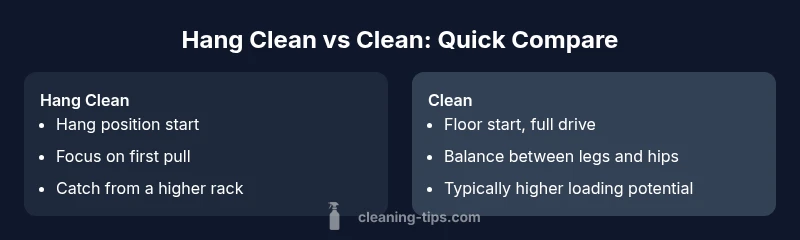
| Feature | Hang Clean | Clean (From Floor) |
|---|---|---|
| Starting Position | Hang position (near knee/hip height) | Floor start (bar on ground) |
| First Pull Emphasis | Hip extension from hang; bar close to body | Floor-to-hip drive; full extension |
| Bar Path | Tighter path from hang, slower initial pull | Longer path with floor-driven momentum |
| Catch/Rack Position | Catch from higher position; accuracy matters | Rack at front of shoulders with floor-assisted momentum |
| Load/Intensity | Typically lighter on first attempts for technique | Potentially higher loads as technique matures |
| Best For | Technical development of start and catch | Maximal power transfer and overall lifting transfer |
Strengths
- Develops precise bar control from the hang position
- Emphasizes starting position and bar path awareness
- Builds bar speed from a shorter lever, aiding transition
- Complements full cleans for a balanced technical profile
Weaknesses
- Generally more technically demanding to learn
- May require lighter loads during early phases
- Transfers less directly to floor-based first pull unless programmed carefully
Hang clean is a valuable technical tool that complements full cleans; use based on goals.
Hang cleans refine starting position and catch control, while full cleans drive raw power and maximal loading. A combined approach often yields the best overall development.
Questions & Answers
What is a hang clean?
A hang clean starts with the bar at a hang position and involves pulling it to the rack or catch, emphasizing the initial pull and transition from a hang. It disciplines bar path and speed before adding floor-driven momentum.
A hang clean starts from the hang position and brings the bar up to the rack, focusing on the initial pull and transition.
Is hang clean harder than clean?
In many cases yes, because you must generate bar speed from a higher start and stabilize the catch without floor momentum. The difficulty is highly influenced by technique and coaching cues.
Yes, many find the hang clean more technically demanding, especially the transition to the catch.
When should I include hang cleans in my program?
Include hang cleans when you want to improve starting position, bar path, or catch stability. Use them in technical blocks or as a bridge between light technique work and heavier full cleans.
Use hang cleans when you’re focusing on technique and the start position.
What drills help with hang cleans?
Drills such as hang pulls, tall cleans, tempo hangs, and paused hang cleans help reinforce bar close control and timing without excessive weight.
Try hang pulls and tempo hangs to improve control.
What equipment do I need?
A standard power bar or Olympic barbell, bumper plates, and a sturdy lifting platform or mat. Proper lifting shoes can improve stability during catches.
You’ll need a barbell, plates, and a safe lifting platform.
The Essentials
- Assess your goal to decide which lift to prioritize
- Prioritize technique before adding heavy loads
- Use hang cleans to fix weak starting pulls
- Incorporate full cleans for maximal power transfer
- Blend both lifts for a well-rounded program