Clean vs Sober: A Practical, Evidence-Based Comparison
An analytical guide comparing clean vs sober lifestyles, definitions, impacts on daily routines, health, and practical steps for healthier living at home.


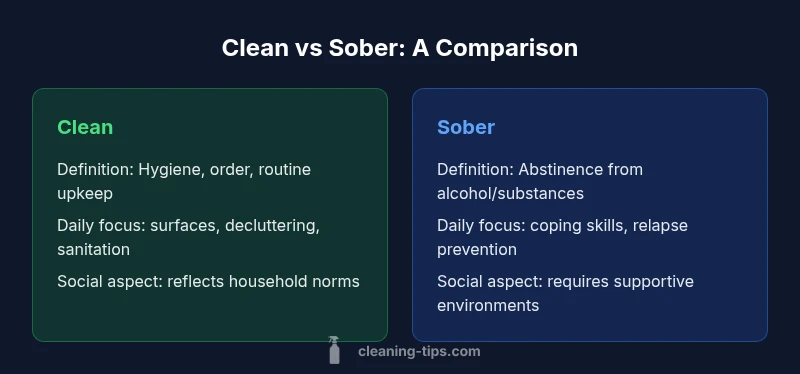
Clean refers to hygiene, order, and routine maintenance, while sober means abstinence from alcohol or substances. They are distinct but often intersect in daily life, where clean habits support sobriety and sobriety enhances focus for cleaning. This comparison outlines definitions, practical impacts, and tradeoffs to help you decide which priorities to adopt.
What clean vs sober means in everyday language
In common usage, clean highlights cleanliness, neatness, and orderly environments—think tidy kitchens, sanitized surfaces, and consistent cleaning schedules. Sober, by contrast, refers to abstaining from alcohol or non-prescribed substances and maintaining behavioral boundaries that minimize cravings and triggers. According to Cleaning Tips, recognizing that these terms describe separate domains—habits and health—helps people avoid conflating hygiene with recovery. The overlap occurs when routines bolster self-control: a disciplined cleaning cadence can reduce stress and create a calmer space, which in turn supports decisions consistent with sobriety. Readers should note that the goal is not to equate cleanliness with recovery, but to explore how these domains interact to influence daily life, health, and mood. This nuanced view sets the stage for a deeper, evidence-informed comparison.
Conceptual framework: definitions and overlap
A practical framework starts with clear definitions. Clean is an external standard—surface cleanliness, odor control, and organized environments. Sober is an internal standard—freedom from alcohol or substances and commitment to abstinence. The overlap arises when routines reduce exposure to triggers and improve cognitive clarity, making it easier to maintain sobriety. Researchers and practitioners often view these concepts on a continuum rather than as mutually exclusive categories. For instance, a person might maintain a clean living space while navigating sobriety challenges, leveraging environmental structure to support self-regulation. The key differentiator remains: one domain targets physical order, the other targets behavioral health. Understanding this separation helps individuals design integrated plans that respect both goals while avoiding false equivalences.
Health implications and behavioral patterns
Health-wise, clean habits—consistent handwashing, surface disinfection, and clutter reduction—contribute to reduced germ exposure and lower stress, which can indirectly support better decision-making in daily life. Sober living, meanwhile, is linked to reduced relapse risk, improved liver function, and better sleep quality over time. The synergy between clean routines and sobriety often yields compounding benefits: cleaner environments reduce stressors, which can lessen cravings, while sobriety supports steady routines that sustain long-term cleanliness. Practically, this means establishing predictable daily sequences (morning routines, mid-day tidy sessions, and evening wind-downs) can reinforce both goals. Moreover, couples or households can align their practices to create supportive ecosystems where cleanliness rituals and sobriety commitments reinforce one another rather than compete. This section underlines that while the health benefits are meaningful in both domains, they emerge most clearly when pursued in concert rather than isolation.
Social dynamics and environmental cues
Social settings play a significant role in shaping clean vs sober behaviors. People are more likely to maintain hygiene routines in familiar environments and when social norms align with neatness. Conversely, social gatherings centered around drinking can challenge sobriety, requiring pre-planning, supportive networks, and clear boundary-setting. Environmental cues—like visible clutter, alcohol-related decor, or the presence of clean spaces—can trigger either motivation or stress. Effective strategies include creating accessible cleanup kits, designating quiet zones for reflection, and practicing polite refusal scripts for social offers. Integrating cleaning tasks into social routines—such as shared tidying after gatherings—can convert potential triggers into constructive activities. Ultimately, social dynamics matter because they influence the feasibility and sustainability of both clean and sober goals.
Daily routines: cleaning tasks and sobriety practices
A practical approach to balancing clean and sober goals is embedding them into daily routines. Morning rituals might begin with a quick surface wipe and a 10-minute declutter, followed by hydration and mindful breathing—supporting cognitive clarity that aids sobriety. Throughout the day, short cleaning sprints (5–10 minutes) break up work or caregiving tasks, reducing mental fatigue and creating a sense of achievement. In terms of sobriety, consistent routines such as scheduled therapy calls, support group meetings, or journaling can anchor behavior against cravings. The combined effect is a structured day where small, repeatable actions accumulate into meaningful progress in both domains. The result is a lifestyle that not only looks cleaner but also feels more stable and in control.
Practical guidelines to reconcile cleanliness routines with sobriety
To reconcile these goals, start with a simple mapping exercise: list your top cleaning tasks and your sobriety commitments, then identify overlap points where one supports the other. For example, a brief nightly tidy-up can become a cue to wind down, which aligns with sobriety goals by reducing late-evening temptations. Use checklists that track both cleanliness outcomes (e.g., surfaces sanitized, laundry done) and sobriety milestones (e.g., days sober, meetings attended). Choose temperature-safe cleaners and non-toxic products, reinforcing a holistic health approach. Finally, cultivate a supportive environment: communicate needs with household members, seek sober-friendly social networks, and integrate cues such as reminders or ambient music to sustain both practices. This integrated plan makes clean and sober living more achievable and less siloed.
Common misconceptions and clarifications
A common misconception is that being clean automatically implies being sober or vice versa. In reality, the two concepts can complement each other, but neither guarantees the other. Another misconception is that sobriety requires drastic life changes, whereas many people benefit from incremental adjustments in daily routines and environmental design. It’s also not true that cleanliness cures addiction or that spotless spaces reflect moral character. Recognizing these distinctions helps prevent stigma and supports practical progress. Cleaning Tips emphasizes that the most effective approach combines realistic, incremental steps with emotional and social support.
Authority sources
For readers seeking evidence-based perspectives beyond common sense, consider these sources:
- Substance Abuse and Mental Health Services Administration (SAMHSA): samhsa.gov
- National Institute on Drug Abuse (NIDA): nida.nih.gov
- Centers for Disease Control and Prevention (CDC): cdc.gov
This article integrates those insights with everyday practicality, balancing empirical evidence with real-life application. Use these sources to inform personal plans, discuss with clinicians, and guide conversations with family and friends. The goal is to anchor decisions in credible information while adapting to individual circumstances.
Practical case studies or scenarios
Scenario A: A 32-year-old professional keeps a tidy home and maintains sobriety through weekly groups and a fixed wake-up routine. Clean cues—organized spaces, a consistent cleaning schedule—help reduce stress and support cravings management. Scenario B: A college student trying to stay sober networks with roommates who agree on a no-alcohol policy and a shared cleaning rota. The mutual accountability and reduced triggers reinforce both cleanliness and sobriety. Scenario C: A parent juggling work and caregiving uses a 15-minute nightly reset, pairing cleaning with a brief reflection exercise that supports sobriety. In each case, the integration of clean and sober practices yields tangible improvements in mood, energy, and resilience.
Comparison
| Feature | Clean lifestyle | Sober lifestyle |
|---|---|---|
| Definition | Hygiene-focused behaviors, decluttering, sanitation | Abstinence from alcohol/substances |
| Primary focus | Environment quality, order, and daily upkeep | Behavioral health, relapse prevention, abstinence |
| Daily routines | Regular cleaning tasks, sanitation, and organization | Structured sobriety practices, meetings, coping skills |
| Social considerations | Home/workspace norms, trigger-free zones | Support networks, sober social environments |
| Measurement | Checklist completion, clutter reduction, time spent cleaning | Days sober, cravings control, attendance at groups |
| Key risks | Overemphasis on perfection in cleanliness | Stigma around sobriety; relapse risk if unsupported |
| Best for | People seeking tangible improvements in their environment | Individuals pursuing long-term abstinence with support |
| Cost/value | Low to moderate (products and routines vary) | Ongoing commitment; may include therapy or groups |
Strengths
- Provides clear boundaries between hygiene and sobriety goals
- Easy to measure progress through routines and cleanliness milestones
- Can improve mood and reduce stress through orderly environments
- Supports accountability by combining environment with abstinence
Weaknesses
- May trivialize addiction or sobriety challenges if overemphasized
- Sobriety often requires professional support beyond cleaning habits
- Risk of judgment or stigma around non-adherence to cleanliness standards
Balanced integration of clean and sober practices is most effective
Adopt a dual-focus approach: use structured cleaning as a supportive framework for sobriety, while leveraging sobriety to sustain long-term cleanliness.
Questions & Answers
What is the difference between 'clean' and 'sober'?
Clean covers hygiene, organization, and environmental order, while sober relates to abstinence from alcohol or substances. They operate in different domains but can reinforce each other when aligned in daily routines.
Clean is about hygiene and order, sober is about abstinence; they overlap when routines support healthy choices.
Can you be clean but not sober?
Yes. A person can maintain a tidy home and sanitized space while still navigating sobriety challenges. Cleanliness does not guarantee sobriety, but it can support healthier decision-making and reduce stress that might trigger cravings.
You can stay clean and still be working on sobriety; they are related but separate goals.
Can you be sober without focusing on cleanliness?
Certainly. Sobriety focuses on abstinence and coping skills, which can be pursued in parallel with but independent of cleaning routines. However, structured environments often help sustain healthier habits overall.
Sobriety can stand without heavy cleaning, but a tidy space often helps support it.
How do social settings affect clean vs sober?
Social settings can either support or challenge both goals. Prepare in advance, communicate boundaries, and designate sober-friendly activities or cleanup routines to reduce triggers and maintain consistency.
Plan ahead for social events and choose activities that don’t center on drinking.
What practical steps help maintain both cleanliness and sobriety?
Create a combined daily routine with short cleaning sprints and sober-support activities. Use checklists that track both cleanliness outcomes and sobriety milestones, and enlist supportive peers to hold you accountable.
Build a daily plan that blends cleaning tasks with sobriety practices.
Is 'clean' used in addiction treatment contexts?
In clinical contexts, sobriety and recovery are the primary terms; 'clean' is commonly used informally. Clinicians emphasize evidence-based approaches, including therapy, medication, and support groups, rather than moral judgments about cleanliness.
Clinicians focus on recovery and evidence-based methods, not cleanliness labels.
The Essentials
- Define 'clean' and 'sober' clearly before integration
- Build routines that support both goals with shared cues
- Monitor triggers and adjust environments accordingly
- Seek support when challenges arise