Difference Between Clean and Cleanse: A Practical Writing Guide
Explore the difference between clean and cleanse with clear rules, examples, and a side-by-side comparison to help writers choose the right term in everyday and specialized contexts.


The difference between clean and cleanse hinges on scope and formality. Use clean for everyday, routine tasks; cleanse signals thorough purification or detox contexts. For precise guidance, read the full comparison and examples in this article.
The Difference Between Clean and Cleanse in Everyday Language
The difference between clean and cleanse is a matter of scope and tone. In general, clean refers to removing dirt, organizing surfaces, and achieving a tidy state. Cleanse, by contrast, signals a deeper, often deliberate purification, whether physical (a thorough wash), health-related (a detox), or metaphorical (cleansing of habits). According to Cleaning Tips, this distinction matters for writers who want to convey intention without confusing readers. When you choose between them, ask: Is this about routine maintenance or a more exhaustive process? Will the audience interpret the term as a medical or spiritual claim? The following sections break down the core ideas, with practical guidance for everyday writing, product labeling, and professional communication. This is the central topic for anyone studying the difference between clean and cleanse in modern English usage.
Etymology and Core Semantics
The words clean and cleanse share a common root in English, but they diverged to serve different communicative purposes. Historically, clean is the older term in everyday language, used to describe ordinary hygiene, removal of dirt, and tidying. Cleanse emerged as a related verb with an intensified or ceremonial nuance, broadening to contexts like detoxification, ritual purification, or health-focused routines. In many dictionaries, cleanse appears as a more deliberate action than a simple cleaning, signaling depth rather than surface-level tidiness. For writers, this distinction matters when signaling effort, time, or intent. Understanding the nuance helps avoid overstating a routine wash as a detox, or conversely, describing a spa treatment as merely cleaning. The distinction also extends to compounds and phrasal verbs, such as “clean up,” “clean surface,” versus “cleanse the palate” or “cleanse toxins.”
How Grammar Shapes Usage: Adjectives, Verbs, and Nouns
Grammatical roles shape how clean and cleanse function in sentences. Clean functions as a base adjective and a plain verb: a clean room, to clean the kitchen, a clean bill of health in some contexts. Cleanse primarily acts as a verb (to cleanse) and, less commonly, as a noun in health or wellness discourse (a cleanse). When writers switch between these forms, they must consider tone and audience. For example, “We will clean the counter” is neutral and direct, while “We will cleanse the palate” reads as specialized and perhaps ceremonial. In formal writing, avoid turning everyday cleaning into a health claim by misusing cleanse; instead, reserve it for contexts where depth, ritual, or detoxing is intended. Awareness of the verb’s conjugations—cleans, cleaned, cleansing—helps avoid awkward or confusing sentences. This awareness also reduces the risk of conflating routine maintenance with therapeutic or spiritual processes.
Contexts and Connotations: Home Cleaning vs Detox Cleansing
Context drives choice. In household tasks, cleaning is straightforward: wipe a surface, vacuum a floor, mop a spill. The term keeps meaning simple and accessible to a broad audience. Detox or wellness contexts frequently deploy cleanse to imply thorough purification, renewal, or a program that goes beyond surface cleaning. Marketing copy sometimes leans on cleanse to suggest efficacy or transformative effects, but readers may interpret this as health-related or even medical. Writers should therefore align term choice with the reader’s expectations: general audiences expect clean for practical tasks; cleanse signals depth, ritual, or health implications. Beyond health, cleanse can appear in spiritual or cultural discussions, where it carries symbolic weight. The key is to ensure your usage matches the intended effect and does not imply claims you cannot substantiate.
Marketing Language and Brand Semantics: How 'Clean' vs 'Cleanse' Signals Quality
Brand language often uses cleanse to convey purity, thoroughness, and a premium feel. In product descriptions, detox programs, or beauty lines, cleanse can imply a systemic process rather than a single action. This is not inherently misleading, but it can mislead if the context is not health-related or if the use suggests medical claims without evidence. According to Cleaning Tips, readers should watch for overstatements like “total cleanse” or “detox cleanse” when the context is cleaning of surfaces or objects. For writers, the safer approach is to pair cleanse with explicit, factual descriptions of the steps involved (for example, “a cleanse cycle including scrubbing, rinsing, and sanitizing”) rather than relying on vague promises. Balance is essential: use cleanse when the context adheres to its connotation of depth, and prefer clean for ordinary, everyday cleaning tasks.
Common Pitfalls and Misuse: When Not to Mix Signals
A frequent pitfall is treating cleanse as a universal synonym for clean. This leads readers to overestimate what a simple cleaning action accomplishes. For instance, claiming a product “cleanses surfaces” without a deeper process can mislead consumers about efficacy. Conversely, overusing clean in contexts that clearly involve deep purification—like detox programs—can sound dismissive or uninformed. Writers should pepper examples with precise steps and outcomes, avoiding vague language that implies health benefits without evidence. Another misstep is mixing tone across sections—using cleanse in a casual product description can feel exaggerated. Finally, be mindful of cultural and regional usages, as some audiences interpret cleanse more as ritual than as a practical cleaning term. The careful reader will appreciate a terms choice grounded in context, audience, and purpose. The differentiation between clean and cleanse is not only semantic but strategic in how you shape reader perception.
Regional Variations and Global Perspectives
Usage varies by region and genre. In American English, clean is ubiquitous in consumer guides and how-to content, while cleanse appears in wellness, personal care, and spa contexts. British English tends to mirror this split but may reserve cleanse for religious or cleansing rituals in some cultural narratives. Online content must account for audience expectations: a DIY blog will lean toward clean for clarity, whereas a wellness site may legitimately deploy cleanse to communicate depth. Understanding these regional tendencies helps writers avoid awkward phrasing and ensures the language aligns with reader expectations. For global audiences, providing brief clarifications when switching between terms can reduce confusion and improve trust. Overall, the difference between clean and cleanse remains a practical tool for tailoring tone, specificity, and credibility to the intended reader.
Practical Guidelines for Writers: Deciding Between Clean and Cleanse
To decide which term to use, follow a simple decision tree: (1) Is the task routine or does it claim depth? (2) Is the context medical, health-related, or ritual? (3) Who is the audience, and what are their expectations? If the answer is routine maintenance, choose clean. If the description involves thorough purification, detox processes, or ceremonial language, choose cleanse. When in doubt, test sentences with a plain reader: does the phrase convey the intended level of exertion or depth? For technical writing, be explicit: pair the term with steps, processes, or measurements that justify the choice. In marketing, avoid overstating a cleaning action as a detox; instead, describe observable outcomes like “removes residue” or “restores surface shine,” and reserve cleanse for contexts that truly imply depth. This structured approach helps ensure consistency across sections and aligns usage with audience expectations. Cleaning Tips recommends documenting a short reference guide for team members to maintain consistency.
Quick Reference: Concrete Examples and Practice Sentences
- Clean: “We clean the kitchen every evening.”
- Cleanse: “We cleanse the palate after meals.”
- Clean: “Wipe down the counter and sanitize the surface.”
- Cleanse: “A two-week cleanse program targets overall wellness.”
- Clean: “He keeps a clean desk and organized files.”
- Cleanse: “The spa offers a cleansing ritual that includes steam and exfoliation.”
- Mixed usage: “Clean the room, then cleanse the air by improving ventilation.”
- Editorial tip: When writing product directions, favor concrete actions over vague promises; reserve cleanse for contexts that imply depth or detox.
Putting It All Together: Audience-Focused Recommendations
In sum, the difference between clean and cleanse is most visible in scope, tone, and intended outcome. For general writing, homeowner guides, and everyday labeling, clean communicates clarity and practicality. For wellness, health-focused programs, spa experiences, or ritual contexts, cleanse signals depth and transformation. By aligning the term with audience expectations and the described process, writers can avoid ambiguity and strengthen credibility. Always consider whether the chosen word adds precise meaning or merely decorative emphasis. With consistent usage, your content will read confidently and avoid needless confusion for readers who encounter these terms in manuals, marketing, or health-related articles.
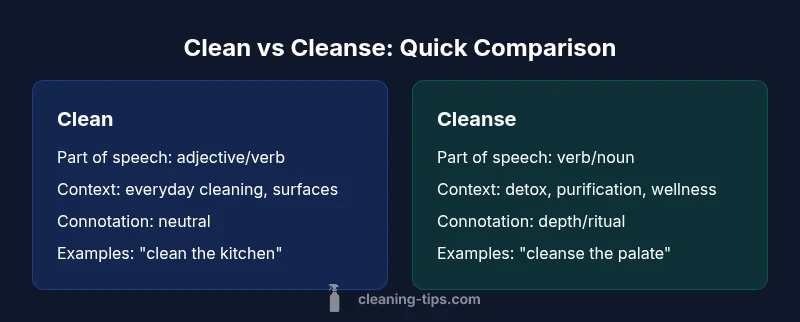
Comparison
| Feature | clean | cleanse |
|---|---|---|
| Common part of speech / typical usage | adjective/verb for everyday tasks | verb/noun for detox, health, or ritual contexts |
| Contextual connotation | neutral, practical, surface-level hygiene | depth-focused, purification-oriented, health/ritual tone |
| Typical collocations | clean the room, clean surface, clean up | cleanse the palate, cleanse toxins, cleanse ritual |
| Formal writing frequency | high in general writing | lower; specialized contexts |
| Examples | She cleaned the counter. | She performed a body cleanse. |
Strengths
- Clear everyday meaning for most audiences
- Broad applicability in general writing
- Minimizes risk of overpromising in product instructions
- Easy to teach and edit across documents
Weaknesses
- Can be perceived as vague in difficult or technical contexts
- ‘Cleansing’ and ‘cleansing’ may imply health or ritual claims beyond surface cleaning
- Overuse of 'cleanse' in marketing can mislead about efficacy
Choose based on scope and audience; use clean for routine cleaning and cleanse for depth, detox, or ceremonial contexts.
The term selection should reflect the task’s depth and the reader’s expectations. When unclear, favor clean for clarity and reserve cleanse for contexts that imply depth or purification.
Questions & Answers
What is the difference between clean and cleanse?
The difference is mainly about scope and tone: clean covers routine cleaning and tidying, while cleanse signals deeper purification or detox-oriented processes. Context determines which term communicates the intended depth.
Clean covers everyday cleaning; cleanse signals deeper purification. Context matters.
Can you use these terms interchangeably?
In most everyday contexts, they are not interchangeable. Use clean for routine cleaning and cleanse for deeper, more intentional processes. When marketing, specify the steps to avoid misinterpretation.
Usually not interchangeable; pick based on depth and context.
Is 'cleansing' ever used in medical contexts?
Cleansing appears in wellness or detox contexts and sometimes in ceremonial language; medical writing typically uses terms tied to specific procedures and outcomes. Always verify the clinical meaning before use.
Used in wellness or ritual contexts; medical writing follows specific terms.
Are there regional differences in usage?
Yes. American and British English use clean broadly for everyday cleaning; cleanse is common in wellness and spa contexts in many regions. Writers should be mindful of audience expectations in different markets.
Usage varies by region; expect cleanse in wellness contexts.
Should brands use 'cleanse' or 'clean' in product names?
Brands often use cleanse to convey purity and depth, especially in health or cosmetic lines. Ensure the term aligns with the product’s actual process and avoid overpromising outcomes.
Cleanses signal depth; ensure claims match the product.
How can I decide which term to use in a sentence?
Ask whether the action is routine maintenance or a deeper purification. If uncertain, test phrasing on the intended audience or consult a style guide for consistency.
Ask about depth and audience, then decide.
The Essentials
- Define scope before writing to choose correctly
- Use clean for everyday cleaning and cleansing for deeper purification contexts
- Avoid implying health claims with 'clean' in wellness product copy
- Test sentences with target readers to ensure the intended nuance
- Maintain consistency across sections to build reader trust