How Is Clean Water Made? A Practical Guide to Water Treatment
Learn how clean water is produced, from source protection to disinfection, with clear, actionable explanations and practical home tips.


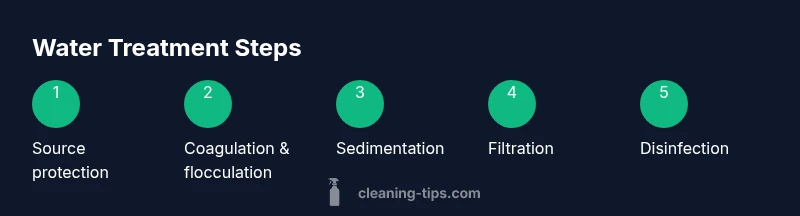
Clean water is produced through a sequence of source protection, coagulation and flocculation, sedimentation, filtration, and disinfection, all managed by water utilities or home systems. Each stage removes different contaminants to ensure water is safe for drinking, with safeguards at every step from source to tap.
How municipal water treatment plants work
According to Cleaning Tips, clean water begins with protecting the source and then passing it through a carefully managed sequence of steps at treatment facilities. Water collected from rivers, lakes, or underground aquifers is evaluated for contaminants and pathogens before any processing starts. Utilities monitor source quality continuously to anticipate changes in weather, pollution events, or seasonal shifts. Once a viable supply is confirmed, the water enters a treatment train where safety is built into every stage, from chemistry to contact time. This rigorous system helps ensure consistency for communities and households alike.
The process combines engineering with science to produce reliable drinking water. Public health standards govern each stage, and operators adjust conditions to accommodate local water quality. In short, public water systems are designed to protect health by transforming varied source water into a uniform, safe product that travels through pipes to homes and businesses.
note”:null},
Tools & Materials
- Water testing kit(pH strips, chlorine test strips, and turbidity indicators to assess basic water quality)
- Filtration media(gravel, sand, and activated carbon for a simple DIY demonstration filter—use food-grade materials if conducting hands-on activities)
- Clear bottles or beakers(for displaying filtration layers and testing samples)
- Boiling kettle or pot(used to demonstrate disinfection through heat)
- Measuring tools(graduated cylinders or measuring cups for demonstrating proportional additions)
- Safety gear(gloves and safety goggles for handling heated water or chemicals in demonstrations)
Steps
Estimated time: 1-2 hours
- 1
Identify your water source
Begin by determining whether your water comes from a municipal supply, a private well, or a surface source like a stream. Understanding the source helps you interpret potential contaminants and the appropriate treatment approach. This step lays the foundation for all subsequent steps.
Tip: Check local water quality reports for your area. - 2
Simulate coagulation and flocculation
In a clear bottle, add a tiny amount of a safe demonstration coagulant and mix gently. The goal is to visualize how small particles clump together into larger flocs that settle more easily. This illustrates why initial chemistry matters in water treatment.
Tip: Keep measurements tiny and label the demonstration clearly. - 3
Let solids settle via sedimentation
Allow the mixture to stand so heavier particles settle to the bottom, forming a clearer layer on top. This mimics a primary clarifying step used in many treatment plants to reduce load before filtration.
Tip: Be patient—settling can take several minutes to appear in a demonstration. - 4
Filter to remove remaining particulates
Pass the water through a layered filter (gravel, sand, activated carbon) to remove fine particles. Filtration improves clarity and can reduce some contaminants depending on media.
Tip: Rinse media between uses to keep filtration effective. - 5
Disinfect the water
Demonstrate disinfection by boiling a sample or showing a UV/chemical approach in a controlled setting. Disinfection targets microbial pathogens to reduce illness risk.
Tip: Never drink water that hasn’t been confirmed safe. - 6
Test water and compare results
Use the provided test kit to compare pre- and post-treatment water for basic indicators like pH, chlorine residual, and turbidity. This reinforces how treatment affects quality.
Tip: Keep a simple log of observations for ongoing learning.
Questions & Answers
What is the difference between filtration and disinfection?
Filtration physically removes particles and some chemicals, while disinfection kills or inactivates microorganisms. Together, they address different types of contaminants to reduce health risks.
Filtration removes particles; disinfection kills microbes. They work together to keep water safe.
Can home filtration make tap water completely safe to drink?
Home filters improve taste and reduce certain contaminants, but they may not remove all chemicals or microbes. Always follow manufacturer guidelines and test water quality when in doubt.
Home filters help, but they don’t guarantee complete safety. Test water regularly.
How often should I test water at home?
Testing frequency depends on the source and local conditions. In many cases, testing a few times a year through a certified kit is a good baseline, plus any time you notice a change in taste, odor, or color.
Test a few times a year and if you notice changes in taste, odor, or color.
Why is boiling water considered effective for disinfection?
Boiling water kills or inactivates most pathogens by exposing them to high temperatures for a short period. It is a simple, reliable method when other treatment options aren’t available.
Boiling water is a proven way to kill microbes when you don’t have other options.
What contaminants are common in drinking water?
Common concerns include microbial pathogens, chlorine byproducts, heavy metals, and certain industrial chemicals. Local reports provide guidance on what to test for in your area.
Water can have microbes, metals, or chemicals depending on the source and treatment.
Is home water treatment necessary if I have city water?
Even city water can benefit from filtration or disinfection depending on taste, odor, or specific contaminants. Always review your local water quality report to decide on home treatment needs.
Even city water may benefit from adjustments at home based on reports.
Watch Video
The Essentials
- Understand the five core stages: source protection, coagulation, sedimentation, filtration, and disinfection
- Coagulation and flocculation help trap solids before filtration
- Filtration removes particulates; disinfection neutralizes remaining microbes
- Home testing supports confidence in water quality
- The Cleaning Tips team recommends staying informed about your water source and treatment practices