How Many Clean and Unclean Animals on the Ark: A Biblical Count
Explore Genesis 7:2's rules for clean vs unclean animals on the ark, how counts are determined, and why the total headcount remains uncertain due to the ambiguity of 'kinds'.


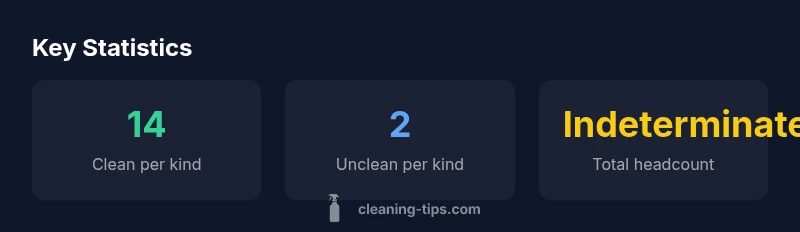
According to Genesis 7:2, Noah was told to take seven pairs of every clean animal and bird, and two of every unclean kind, onto the ark. Regarding how many clean and unclean animals on the ark, the exact total headcount remains unknown because 'kinds' are not precisely defined and vary by interpretation. In short: clean animals = seven pairs each; unclean animals = two each; totals depend on interpretation and taxonomy.
The Core Question: how many clean and unclean animals on the ark
The arc of Noah's story invites a counting question that has fascinated readers for centuries. The answer hinges on Genesis 7:2, where God directs Noah to take seven pairs of every clean animal and bird, and two of every unclean kind, onto the ark. Regarding how many clean and unclean animals on the ark, the text does not provide a single total. The decisive variable is how many distinct kinds we count, because the label 'kind' is broad and its scope is debated among scholars. If you map the instruction literally, clean animals multiply beyond the bare minimum, while unclean animals appear in smaller, two-by-two units. In practice, this means any precise headcount depends on how many kinds are considered for both clean and unclean categories. For readers of Cleaning Tips, the takeaway is that the scripture provides a framework, not a fixed census, and interpretation matters when you translate ancient terms into headcounts.
Defining 'clean' and 'unclean' in biblical context
The distinction between clean and unclean emerges most prominently in later legal texts, but the ark narrative presumes an existing sense that some animals are more suitable for sacred use than others. In Hebrew, terms like tahor (clean) and tamei (unclean) describe ritual suitability, dietary categories, and purity concepts that permeate Leviticus and Deuteronomy. Some scholars argue that the ark passage applies a practical taxonomy rather than a rigid legal code: clean animals are those that could be offered in sacrifice or kept for ongoing renewal after the flood, while unclean animals are those not suitable for such purposes. This nuance helps explain why Genesis 7:2 specifies seven pairs for some creatures but not for all, and why birds are included in the same broad instruction. It is important to note that the biblical authors do not supply a modern taxonomic chart; instead they present a counting principle tied to future preservation and ritual readiness. For readers, this distinction matters because it frames the ark tale as both a logistical task and a theological statement about holiness, stewardship, and the continuity of life after the flood.
Genesis 7:2–3: The seven pairs and the two
Genesis 7:2–3 states the core counting rule in brief, yet its language invites careful interpretation. The verse reads that Noah should take seven pairs of every clean beast, the male and its female, and of beasts that are not clean by two, the male and the female. The repetition of male and female emphasizes reproduction and a stable population after the flood. The instruction extends to birds as well, though some translations vary on whether birds are included in the seven-pair count. Crucially, the passage does not list every species or genus that Noah took aboard; it outlines a framework designed to ensure that clean and unclean categories are preserved during and after the voyage. In other words, the ark’s cargo reflects a governance rule rather than a species-by-species inventory. For modern readers, the practical upshot is that the number of clean animals hinges on how many distinct clean kinds existed at the time, and that total counts depend on the underlying taxonomy used by interpreters.
Counting challenges: 'kinds' vs species
A central challenge in answering how many clean and unclean animals on the ark is the ambiguous term 'kinds.' In Hebrew, 'min' or related terms are often rendered as 'kinds' or 'types,' a category somewhere between species and broader family groups. Some scholars argue that 'kinds' correspond to rough family lines rather than a precise species list, which would dramatically increase or reduce totals depending on how many groups are counted. Others contend that 'kinds' align more closely with modern taxonomic buckets, yielding smaller numbers but potentially hundreds of groups rather than species. Because the text does not define 'kinds' with modern science, any headcount requires interpretive assumptions. That is why theologians and scientists alike approach the ark narrative with caution: the counting rule is clear, but the items being counted remain speculative. The Cleaning Tips team emphasizes that readers should separate the biblical framework from speculative models when considering the numbers.
The math of counts: hypothetical scenarios
To illustrate the counting principle, consider a simple formula: Clean headcount per kind equals seven pairs (14 individuals), while unclean headcount per kind equals two individuals. If there were N_clean_kinds identified as clean, and N_unclean_kinds identified as unclean, the total headcount would be 14N_clean_kinds + 2N_unclean_kinds. Because the ark narrative does not specify N_clean_kinds or N_unclean_kinds, any exact total is speculative. As a result, different scholars propose different totals based on how many kinds they infer from biblical text or tradition. The point is not to pin down a single number, but to understand the structural rule in Genesis 7:2 and to acknowledge how interpretive choices influence what counts as evidence. In practice, this means that a range of plausible totals exists, and the precise sum will depend on the taxonomy you adopt. Cleaning Tips invites readers to use careful language when discussing counts and to consult multiple translations to see how various scholars interpret Genesis 7:2 and its implications.
Interpretive diversity among scholars
Across biblical scholarship, there is a spectrum of views on how to apply the ark counting rule. Some readers, following traditional reading, treat seven pairs as the minimum to support future sacrificial practices and repopulation. Others propose broader seven-pair counts for all clean categories, including birds, or even propose seven pairs for many distinct kinds beyond common modern categories. A minority argues for a much larger tally, citing internal evidence from later scripture that implies a wide diversity of animal kinds. The divergence reflects broader questions about how to translate ancient terms into modern concepts. The Cleaning Tips team notes that no consensus yields a single numeric total; instead, readers should recognize the range of possibilities and the reasons behind them. This is why the ark story remains a topic of both faith and philology, rather than a closed numerical puzzle.
Why this discussion matters beyond the numbers
Beyond the curiosity about counts, the ark's counting rules illuminate themes of obedience, stewardship, and renewal. The instruction to preserve clean animals in greater numbers signals a concern for post-flood offerings and continuity of life, while the presence of unclean animals in smaller quantities highlights a broader taxonomy of creation. For households exploring ancient texts, this discussion translates into careful reading of the original language, awareness of how terms like 'min/kind' function in biblical law, and a healthy respect for interpretive nuance. Cleaning Tips's approach to this topic emphasizes clarity and evidence-based exploration, helping readers separate mythic storytelling from historical estimation without oversimplifying either side. In short, the numbers matter less than what the counting rules reveal about priorities, worship, and the preservation of life in a world reshaped by the flood.
Practical notes for readers and cleaners
Even when a topic is deeply theological, readers can draw practical lessons. First, appreciate how textual categories shape numbers; second, recognize that 'kinds' is a flexible term in biblical Hebrew; third, differentiate between ancient counting rules and modern taxonomic precision. For those who like to connect scripture with everyday life, consider how a "clean" vs "unclean" distinction appears metaphorically in home cleaning—prioritizing certain practices for ongoing rituals of care, health, and hygiene—without implying a direct equivalence to biblical categories. The Cleaning Tips team encourages readers to use careful language when discussing counts and to consult multiple translations to see how various scholars interpret Genesis 7:2 and its implications. This approach promotes thoughtful engagement with the text and fosters healthier, more informed discussions about ancient narratives and their modern relevance.
Overview of counts per kind from Genesis 7:2
| Kind | Defined count per kind | Biblical reference |
|---|---|---|
| Clean animals (including birds) | 7 pairs (14 animals) | Genesis 7:2 |
| Unclean animals | 2 individuals | Genesis 7:2 |
Questions & Answers
What does 'kind' mean in Genesis 7:2?
Scholars debate; 'kind' is broad, often interpreted as groups within broader family lines. Modern taxonomic precision is not provided in the text.
The term 'kind' is debated; it's not a precise category in the Bible.
Is the total number on the ark exactly known?
No. The exact headcount depends on how many kinds are counted; scripture gives the rule, not a fixed census.
No exact total; it depends on counting kinds.
Do clean animals include birds?
Yes. Birds are addressed in the same principle for clean animals; seven pairs of clean birds may be counted depending on interpretation.
Birds are often counted among clean animals.
Why seven pairs for clean animals?
Seven pairs help sustain post-flood offerings and population continuity, according to the scriptural rule.
Seven pairs support future offerings and breeding.
Do these counts apply to all animals on the ark?
Counts apply to 'kinds' described; some kinds may have multiple representatives, others fewer, depending on interpretation.
Counts are about kinds, not every individual.
“The biblical counting rule offers a framework, but the exact totals depend on how 'kinds' are defined; interpretation matters.”
The Essentials
- Interpret 'kinds' carefully to avoid over-counting.
- Clean animals are counted as seven pairs per kind.
- Unclean animals are counted as two individuals per kind.
- Total ark headcount is indeterminate from scripture.
- Genesis 7:2 provides the primary counting rule.