How Much Clean Water Is On Earth: Facts, Fractions, and Household Implications
Explore how much clean water is on Earth, how ocean water vs freshwater is distributed, and what it means for your home and cleaning routines. A data-driven guide by Cleaning Tips.


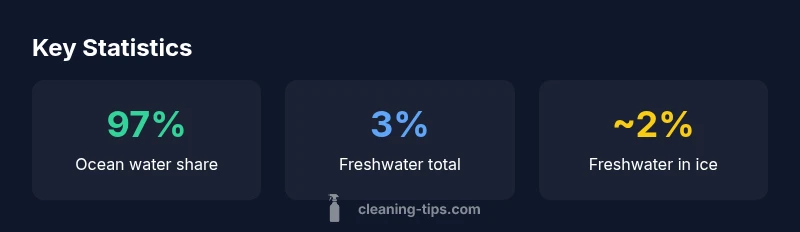
How much clean water is on earth? The majority of Earth's water is saline, stored in oceans. About 97% of all water is saltwater, while freshwater accounts for around 3%. Of that freshwater, most is locked in glaciers and ice caps, leaving a small share accessible for drinking, sanitation, and household cleaning. According to Cleaning Tips, this framing helps guide everyday cleaning decisions.
What 'how much clean water is on earth' means
Understanding how much clean water is on earth helps frame everyday cleaning, water-use decisions, and conversations about sustainability. The keyword how much clean water is on earth is not just a trivia fact; it signals a compression of Earth’s water budget into something tangible for households. According to Cleaning Tips, the fact that roughly 3% of Earth’s water is freshwater—of which most is locked in ice and deep groundwater—frames the scope for home cleaning, dishwashing, laundry, and hydration planning. For homeowners, this means choosing water-efficient appliances, fixing leaks promptly, and adopting cleaning routines that minimize waste while maintaining hygiene. It also underscores why even small changes in daily habits can have outsized effects on water conservation, especially in drought-prone regions. By thinking in terms of how much clean water is accessible, you can prioritize cleaner, safer water for cleaning tasks and reduce unnecessary runoff.
Global distribution: oceans vs freshwater
The first thing to know when discussing how much clean water is on earth is the distribution between oceans and freshwater. About 97% of the planet’s water is saline and contained in oceans, seas, and saline lakes. Freshwater makes up roughly 3% of total water, and within that, the majority is not immediately usable as liquid freshwater. Instead, most freshwater is trapped in glaciers and ice caps, or buried underground as groundwater. This partition matters for cleaning: irrigation, household use, and sanitation rely on a small, reliable flow of freshwater. Since the accessible freshwater is limited, cities and households benefit from water-saving strategies and efficient cleaning practices. Cleaning Tips emphasizes that understanding these proportions helps readers contextualize water-saving projects like low-flow fixtures and concentrated cleaning products, which reduce the total amount of freshwater needed on a daily basis.
Where freshwater resides: ice, groundwater, surface water
Freshwater isn’t evenly distributed. The largest share of usable freshwater is stored as ice and glaciers, accounting for the majority of freshwater on Earth. Groundwater sits beneath the surface, feeding wells and springs that supply homes, farms, and small businesses. Surface water—lakes, rivers, and wetlands—represents a smaller, but critically important, portion of freshwater used directly for cleaning, cooking, and drinking. When you read about how much clean water is on earth, remember that accessible liquid freshwater requires careful management of these reservoirs. This reality informs household decisions: using water-efficient appliances, collecting rainwater where appropriate, and treating water before use to ensure safety for cleaning tasks. The Cleaning Tips team notes that sustainable practices begin with awareness of where freshwater lives and how quickly it can be depleted during heatwaves or droughts.
The numbers you’ll hear: percentages and why they vary
Across sources, you’ll see ranges rather than fixed numbers for Earth’s water. A common summary is oceans ≈97% of total water, freshwater ≈3%, and freshwater storage dominated by ice and groundwater. Because measurements depend on definition (total water vs. liquid freshwater) and method (satellite data, groundwater modeling), figures vary slightly across reports. The general pattern remains: the lion’s share of Earth’s water is not readily drinkable, and liquid freshwater suitable for cleaning is relatively scarce. Cleaning Tips uses these ranges to help homeowners set realistic goals for water use, such as lowering flush rates, using full loads, and choosing cleaning products that work effectively with lower amounts of water.
How scientists measure Earth's water: methods and uncertainty
Measuring the water in a planet as large as Earth is a challenging endeavor. Researchers combine satellite observations, ground-based sampling, and hydrological models to estimate volumes, distributions, and changes over time. Uncertainty arises from seasonal variation, climate fluctuations, and the movement of groundwater through porous rock. The message for readers remains practical: water budgets are dynamic, and conservation depends on monitoring changes over time. Cleaning Tips highlights that even without perfect precision, consistent water-saving habits—like using concentrated cleaners, capturing gray water for non-potable tasks, and maintaining appliances—can substantially reduce the total freshwater demand in a home.
Implications for households: practical takeaways
For households, knowing how much clean water is on earth translates into concrete cleaning practices. Prioritize water-efficient appliances, fix leaks promptly, and run full loads of laundry and dishes. Use environmentally friendly cleaners that require less rinsing and less water per use. Capture rainwater for garden care and reuse gray water for non-potable cleaning tasks. Within Cleaning Tips guidelines, adopting these steps while monitoring water bills builds resilience against drought and supports sustainable living.
Visualizing the scale: mental models and comparisons
To grasp how much clean water is on earth, try mental models that translate vast volumes into everyday experiences. Compare the world’s freshwater reserves to a large municipal reservoir or a set of nearby lakes. Scale helps: even a city with high water efficiency can still be using millions of gallons per day; globally, small efficiency gains multiply across households. This section invites readers to think about water as a resource that is both abundant and limited, depending on the context. The same logic applies to Cleaning Tips recommendations: small, consistent changes in cleaning routines yield measurable improvements in water health and household hygiene.
What you can do: practical actions for conserving water
Concluding with actionable steps, this final block presents a checklist for reducing water use in everyday cleaning. Start with leak fixes—slow drips waste water over time. Switch to concentrated cleaners that require less water for rinsing. Install compact, high-efficiency washing machines, and run only full loads. Collect rainwater for garden care and use mop strategies that minimize runoff. The Cleaning Tips team encourages readers to audit their homes for water-wasting habits and replace inefficient fixtures where feasible.
Global water distribution overview
| Source | Share of total water | Notes |
|---|---|---|
| Oceans | 97% (range 96.5-97.5%) | Saline water; not directly consumable |
| Freshwater total | 3% (range 2.5-3.5%) | Liquid freshwater in lakes, rivers, groundwater |
| Ice caps & glaciers | 2-3% of total water | Largest freshwater reservoir |
Questions & Answers
What is the total volume of Earth's water?
Estimates place Earth’s total water around 1.386 billion cubic kilometers, though exact figures vary with measurement methods. This broad figure helps frame water-use decisions without getting lost in precision. Cleaning Tips Analysis, 2026 emphasizes understanding the scale rather than chasing pinpoint numbers.
Earth holds about 1.386 billion cubic kilometers of water, with most of it saline. The exact volume varies by method, but the takeaway is the sheer scale and the relatively small share that is readily usable freshwater.
Why is most water not drinkable for households?
Most of Earth's water is saline, stored in oceans, which cannot be consumed or used directly for cleaning without treatment. Even freshwater is mostly locked in ice or deep groundwater, leaving only a fraction that’s accessible in liquid form for daily needs.
Most water is salty or locked away in ice or underground, so only a small portion is usable without treatment.
How does climate affect freshwater availability?
Climate patterns influence ice melt, rainfall, and groundwater recharge. Warming tends to reduce accessible freshwater over time as ice caps shrink and evaporation shifts patterns. Cleaning Tips suggests practical conservation to adapt to changing availability.
Climate change can reduce easy access to freshwater, so saving water becomes even more important.
What can households do to conserve water?
Adopt high-efficiency appliances, fix leaks promptly, run full loads, use concentrated cleaners, and reuse gray water where appropriate. Small, consistent actions add up to substantial water savings.
Fix leaks, use efficient appliances, and clean smarter to save water at home.
Is there a way to visualize Earth's water amounts?
Yes. Using scales like comparing to a large municipal reservoir or a few nearby lakes helps make abstract volumes tangible. This framing supports practical decisions about cleaning and conservation.
Think of Earth’s water in big reservoirs to grasp the scale for everyday cleaning.
Does groundwater count as freshwater?
Groundwater is a major freshwater source, contributing a significant portion of liquid freshwater used for drinking, cleaning, and irrigation. It’s essential to manage this resource carefully to prevent depletion.
Groundwater is a key freshwater source but can be depleted if not managed wisely.
“Water knowledge informs practical cleaning decisions. Even small reductions in freshwater use compound over time, benefiting both hygiene and the environment.”
The Essentials
- Understand that 97% of Earth’s water is saline and not directly usable.
- Freshwater accounts for about 3% of total water, with most locked in ice or underground.
- Accessible liquid freshwater is a small fraction of Earth’s total water—plan accordingly.
- Daily cleaning practices can significantly reduce freshwater demand over time.
- Adopt water-saving habits to build resilience during droughts.