Is Clean Spirit the Same as Rubbing Alcohol? A Comprehensive Comparison
A detailed, analytical comparison of clean spirit and rubbing alcohol, explaining composition, labeling, safety, and practical guidance for home cleaning—so you can choose confidently and use each product correctly.


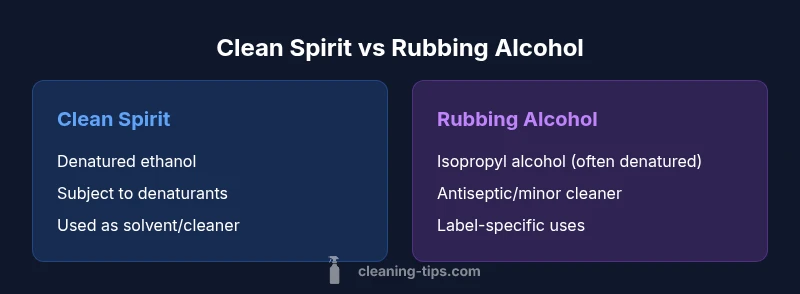
Is clean spirit the same as rubbing alcohol? Not exactly. Clean spirit generally denotes denatured alcohol (ethanol with denaturants) used for cleaning, while rubbing alcohol usually refers to isopropyl alcohol (though ethanol variants exist). They differ in composition, denaturants, and labeling, which affect where and how they can be used. Read labels carefully and consider the application before swapping products. According to Cleaning Tips, misinterpreting labeling can lead to residue, odors, or surface damage.
Defining the terms: is clean spirit the same as rubbing alcohol?
Is clean spirit the same as rubbing alcohol? The short answer is: not necessarily. In household cleaning, these terms often describe two different alcohol-based products with distinct purposes and compositions. Clean spirit typically refers to denatured alcohol—a form of ethanol that includes denaturants to deter ingestion. Rubbing alcohol generally points to isopropyl alcohol (though in some regions ethanol variants exist). The Cleaning Tips team emphasizes that the label, active ingredient, and denaturants dramatically affect where you can safely use each product, what residues may be left behind, and how the product interacts with surfaces. This distinction matters for routine cleaning, surface finishes, and even safety around kids and pets.
Composition and typical formulations
Understanding what each product contains is foundational. Clean spirit is usually denatured ethanol mixed with additives that render it undrinkable. Denaturants may also impart odors and residues that influence suitability for certain tasks. Rubbing alcohol is commonly isopropyl alcohol, often sold at varying concentrations and sometimes denatured to prevent ingestion. In practice, the two products are similar in that they are alcohol-based solvents, but their denaturants, purity levels, and labeling create important differences for users. The distinction is especially relevant when choosing for tasks like cleaning non-food surfaces, removing adhesive residues, or preparing a workspace for electronics. The distinctions highlighted by Cleaning Tips emphasize reading ingredient lists, not just the brand name, to determine compatibility with your cleaning goals.
Denatured alcohol vs rubbing alcohol: labeling and denaturants
Labeling is the dividing line. Clean spirit will usually indicate denatured ethanol with a list of denaturants; these additives can influence odor, surface compatibility, and regulatory status. Rubbing alcohol tends to be labeled as isopropyl alcohol or ethanol with denaturants, and the intended use is often antiseptic or general surface cleaning. Many products are designed to be used on skin or mixed with water for cleaning, while denatured ethanol products may be preferred for dissolving certain residues or for use as a solvent. Always verify the active ingredient and denaturants on the label and avoid ingestion or misuse. Cleaning Tips notes that misinterpretation of these terms can lead to improper usage and unexpected outcomes.
Common cleaning tasks and suitability
For routine home cleaning, you may use rubbing alcohol on glass, metal, and some non-porous surfaces when the material label permits. Clean spirit, with denatured ethanol, is sometimes favored for solvent-based cleaning tasks, such as removing sticky residues or preparing surfaces for painting. However, certain finishes (like some varnishes, lacquers, or delicate plastics) may react differently to ethanol versus isopropyl alcohol. The key is to test in a small, inconspicuous area and consult surface-care guidelines. Cleaning Tips recommends a cautious approach: prioritize manufacturer recommendations for surfaces and avoid using high-odor denaturants on areas where odor transfer would be problematic.
Safety and handling: skin, inhalation, and flammability
Both products are flammable and should be used with adequate ventilation away from open flames. Skin contact can cause irritation, especially with repeated exposure; use gloves when handling larger quantities and wash hands after use. Inhalation of vapors can be uncomfortable in poorly ventilated spaces, so ensure good airflow. Do not mix either product with bleach or other cleaners, and store them in clearly labeled containers away from children and pets. The differences between clean spirit and rubbing alcohol primarily affect odor and residue, so adjust ventilation and surface-testing practices accordingly.
Practical testing and verifying product labels
Always verify the product’s label before use. If you see terms like denatured ethanol or isopropyl alcohol, check the denaturants and the stated uses. Cleaning Tips recommends performing a small test on a hidden area first, especially when applying to sensitive surfaces like finished wood, stainless steel, electronics, or painted walls. If you are unsure, err on the side of caution and substitute with products explicitly labeled for the intended task. The goal is to achieve effective cleaning without compromising surface integrity or health safety.
Regional variations and consumer awareness
Global markets show regional differences in labeling and terminology. In some areas, clean spirit may be commercially marketed as a denatured ethanol cleaner, while other markets may use “rubbing alcohol” to denote isopropyl variants. These variations can create confusion for homeowners who rely on online guidance. Cleaning Tips suggests building a simple decision framework: identify the active ingredient, review the denaturants, assess the intended use, and prioritize labels that specify compatibility with your surfaces and applications.
Reading labels and avoiding common pitfalls
A common pitfall is assuming that a term alone guarantees a certain composition. Always cross-check the active ingredient, denaturants, and recommended uses. Cleaning Tips notes that many consumer products with the same cleaning goal can differ dramatically in odor, residue, and surface compatibility depending on whether denatured ethanol or isopropyl alcohol is used. When in doubt, contact the manufacturer for clarification or seek guidance from trusted sources on cleaning best practices.
Substitution guidelines: when you can substitute and when not
Substituting denatured ethanol for isopropyl alcohol (or vice versa) can be feasible for some cleaning tasks, but it is not universally safe. For electronics, certain finishes, or surfaces sensitive to alcohol type, substitution may cause damage or undesirable residues. For skin-safe uses, isopropyl alcohol is often preferred for topical antisepsis, while denatured ethanol may be better for certain solvent applications. The overarching rule is to follow label instructions and test on a small area first to avoid unwanted outcomes.
Final tips and common mistakes to avoid
Conclude with practical tips: never mix alcohol products with bleach or ammonia, avoid spraying directly onto electronics, and store containers properly sealed. Misunderstanding the distinction between clean spirit and rubbing alcohol can lead to ineffective cleaning, surface damage, or health risks. Keep a clear labeling system in your cleaning cabinet and rely on surface-compatible products for each task.
Conclusion and next steps
The answer to is clean spirit the same as rubbing alcohol involves reviewing composition, denaturants, and labeling to ensure safe and effective use. By understanding the differences and following best-practice guidelines, you can select the right product for each cleaning task and maintain a healthier home. The Cleaning Tips team encourages readers to prioritize label accuracy and test on inconspicuous areas before broad application.
Comparison
| Feature | clean spirit (denatured alcohol) | rubbing alcohol (isopropyl alcohol) |
|---|---|---|
| Primary solvent | ethanol-based denatured alcohol | isopropyl alcohol |
| Typical concentration range | varies by product | varies by product |
| Common uses | solvent for cleaners, degreasing, and residue removal where denatured ethanol is preferred | topical antiseptic and general surface cleaner; often used on non-porous surfaces |
| Labeling/denaturants | denaturants present; odors and residues possible | denaturants may be present; labeling emphasizes antiseptic uses |
| Safety considerations | flammable; skin and eye irritation potential; avoid ingestion | flammable; skin and eye irritation potential; avoid ingestion |
| Price range | varies by region | varies by region |
| Best for | situations needing denatured ethanol or specific solvent properties | general cleaning and antiseptic tasks when labeling permits |
Strengths
- Broad cleaning versatility across surfaces and tasks
- Often affordable and widely available
- Denatured ethanol products can be effective solvents for sticky residues
- Clear labeling helps users select purpose-built products
- Multiple product formulations allow regional availability
Weaknesses
- Both are flammable and require good ventilation
- Denaturants can leave odors or residues on sensitive surfaces
- Skin exposure can cause irritation; avoid contact with damaged skin
- Labeling confusion can lead to improper use if not read carefully
Rubbing alcohol is typically the more straightforward option for common household cleaning; clean spirit is a viable substitute when denatured ethanol is appropriate and labeled for the intended use
Choose rubbing alcohol for general cleaning and antiseptic tasks when labels specify isopropyl alcohol. Use clean spirit when denatured ethanol is indicated and appropriate for the surface or task, ensuring you follow safety guidelines and verify denaturants on the label.
Questions & Answers
Is clean spirit the same as rubbing alcohol?
Not universally. Clean spirit usually refers to denatured ethanol with denaturants, used for cleaning, while rubbing alcohol generally denotes isopropyl alcohol, used as an antiseptic and cleaner. Labels and ingredients determine suitability for each task.
Not exactly. They’re different products with distinct ingredients and uses; always read the label for the active ingredient and denaturants.
What is clean spirit typically made of?
Clean spirit is typically denatured ethanol, meaning ethanol with added denaturants to discourage ingestion. Denaturants can affect odor and residue, influencing where and how it should be used.
Usually denatured ethanol with additives to make it non-drinkable.
Can I use rubbing alcohol on electronics?
Rubbing alcohol can be used on some electronics if the product label allows it and the surface is non-porous; use sparingly and avoid excess liquid. Alternate products labeled for electronics are safer on sensitive components.
Only if the label says it’s okay and you use it sparingly on non-porous surfaces.
Can I substitute denatured alcohol for isopropyl around the home?
Substitution is possible for some tasks, but not all. Denatured ethanol can be harsher on certain finishes and may leave stronger odors. Always test first and follow surface-specific guidance.
Substitutions are task-dependent; test on a small area first.
Are there health risks using these products?
Both products are flammable and can irritate skin and eyes with improper use. Avoid ingestion, ensure good ventilation, and store safely away from children and pets.
They can irritate skin and be dangerous if ingested or used near flames; use with ventilation.
How should I store these products safely?
Store upright in a cool, dry place in clearly labeled containers away from heat sources and flames. Keep out of reach of children and pets, and never store near food.
Keep in labeled containers, away from heat, and out of reach of kids and pets.
The Essentials
- Read labels to confirm active ingredient and denaturants
- Choose isopropyl alcohol for typical cleaning and antiseptic tasks
- Use denatured ethanol (clean spirit) only when labels authorize it for the surface
- Test on inconspicuous areas before broader use
- Keep flammable alcohol products away from heat and children