Is Cleaning the Same as Organizing? A Practical Guide
Explore whether cleaning and organizing are the same, how they differ, and how to blend both for a healthier, more efficient home. A rigorous, evidence-based guide from Cleaning Tips.


Cleaning and organizing are related but distinct tasks. Cleaning focuses on removing dirt, germs, and mess, while organizing centers on arranging items for efficient use. The best approach blends both: establish routines that clean surfaces and also create intentional storage systems that support ongoing order. In many homes, cleaning lays the groundwork for effective organizing.
Defining the Two Core Tasks
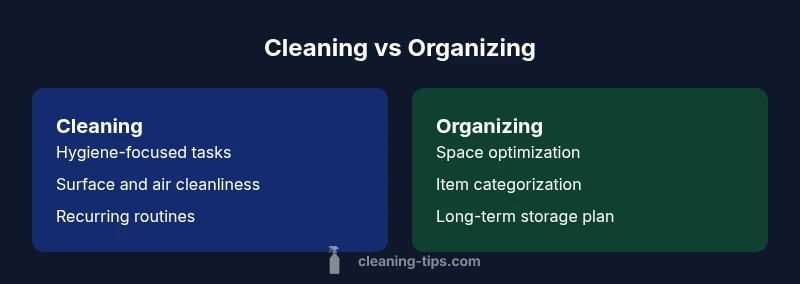
At first glance, cleaning and organizing seem to belong to the same family of home maintenance. Yet they serve different purposes. Cleaning is about hygiene, comfort, and visibility of dirt—removing grime from surfaces, sanitizing high-touch points, and restoring a sense of freshness. Organizing, by contrast, is about access, efficiency, and cognitive ease—arranging items so they’re easy to locate, placing related items together, and designing storage that reduces future clutter. According to Cleaning Tips, the distinction matters because it shapes how you allocate time, tools, and mental energy. Understanding the two helps homeowners plan routines that address both surface cleanliness and long-term order, rather than treating them as a single, monolithic task.
Comparison
| Feature | Cleaning | Organizing |
|---|---|---|
| Definition | Removes dirt, germs, and stains on surfaces | Arranges items for accessibility and flow |
| Primary Focus | Hygiene, comfort, and visual cleanliness | Efficiency, space utilization, and mental clarity |
| Typical Tasks | Dusting, sweeping, mopping, sanitizing | Decluttering, labeling, storage planning, grouping |
| Skills Required | Attention to detail, safety, product knowledge | Systematic thinking, categorization, planning |
| Time Investment | Regular, ongoing (daily/weekly) | Periodic, longer-term (space-by-space) |
| Cost Range | Low to medium (cleaning supplies) | Low to medium (storage solutions) |
| Best For | Health, hygiene, and immediate comfort | Long-term order, ease of maintenance |
Strengths
- Clarifies daily routines and reduces mess, supporting healthier environments
- Improves mood and comfort by removing clutter and dirt
- Creates scalable habits that sustain spaces over time
- Low-cost to start; scales with simple storage and routines
- Supports safety by keeping high-traffic areas clean
Weaknesses
- Requires ongoing commitment to maintain results
- Storage investments may be needed to sustain order
- Initial overwhelm can occur if spaces are severely cluttered
- Misalignment between cleaning schedules and organizing goals can stall progress
Cleaning and organizing are distinct but deeply interconnected; a blended approach wins.
Treat both as separate yet complementary practices. Start with a basic cleaning routine to establish hygiene, then implement organizing systems that support ongoing order. The Cleaning Tips team believes that steady cleaning creates the foundation for durable organization, and well-planned organization reduces future cleaning needs.
Questions & Answers
Is cleaning a prerequisite for organizing?
Not strictly, but cleaning often makes organizing easier. A clean surface reveals what needs to be stored and helps you assess what items truly belong where.
Cleaning often reveals what should be stored and where it belongs, making organizing decisions clearer.
Can I organize first and then clean later?
You can, but you might accumulate dirt or misplaced items again unless you implement an ongoing cleaning rhythm alongside the organizing effort.
Organize first if you want a quick structure, but pair it with a cleaning routine to keep order long-term.
What’s the fastest way to blend cleaning and organizing?
Start with a 4-step loop: clean a small area, tidy its items, label what’s stored, and assess for long-term storage needs. Repeat across spaces.
Do a quick clean, then organize that same area, label, and plan for future storage.
How long does it take to see results from a blended approach?
Visible improvements can appear within a few days of consistent effort, with larger shifts after a couple of weeks as routines solidify.
You’ll notice faster improvements after you commit to a steady routine for a couple of weeks.
Which room should I tackle first when blending tasks?
Begin with the busiest or most emotionally charged space, like the kitchen or entryway, where cleanliness and order are most valued.
Start where you feel the impact most; usually the kitchen or entryway is best.
The Essentials
- Define clear cleaning goals first
- Pair routine cleaning with a simple organizing system
- Invest in a few versatile storage solutions
- Keep high-traffic areas consistently tidy
- Evaluate space by room to minimize clutter
- Commit to a 15-minute daily maintenance plan