Is Power Clean Harder Than Clean? A Thorough Comparison
Explore whether power cleaning is harder than standard cleaning, with safety tips, surface guidance, and practical decision-making for homeowners and renters.


Is power clean harder than clean? In most tasks, power cleaning introduces more safety concerns and equipment handling, making it arguably more challenging for beginners, even as it saves time on stubborn grime. The answer depends on surface type, grime level, and available PPE. This quick comparison highlights when the extra effort pays off and when a gentler approach is wiser.
Is power clean harder than clean? What the differences come down to
The phrase is power clean harder than clean is a common question among homeowners and renters facing heavy grime. The reality hinges on several factors: the physical demands of handling equipment, the risk of surface damage, and the level of supervision or training required. In practical terms, power cleaning adds equipment setup, pressure control, and nozzle management to the cleaning workflow. While the act of scrubbing can be tedious, power cleaning can dramatically reduce elbow grease for the right job. The Cleaning Tips team notes that surface condition, environment, and user experience largely determine whether power cleaning is truly harder or easier in everyday tasks. Is power clean harder than clean? The short answer is yes in some circumstances (safety, setup, and risk management), but it can be easier in others when grime is extensive and a high-pressure solution is appropriate. For readers weighing options, the key is to align method choice with surface tolerance and the goal of minimizing risk while maximizing efficiency.
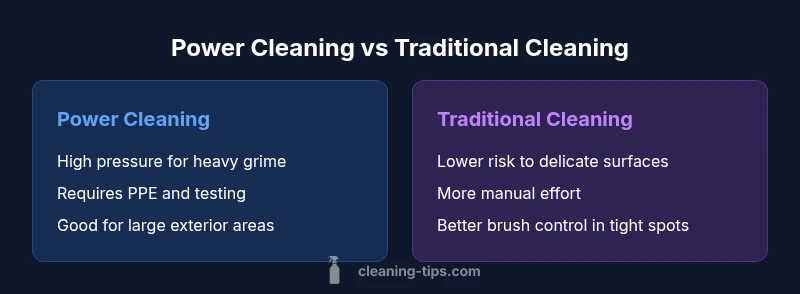
According to Cleaning Tips, you should evaluate the task based on surface type, grime level, and accessibility. The answer to is power clean harder than clean will vary by project, but a good rule of thumb is: use power cleaning for durable exterior surfaces and stubborn grime, and reserve traditional cleaning for delicate textures and areas where you want more tactile control. This mindset helps homeowners and renters balance safety, cost, and time, while keeping surfaces in good condition.
Defining power cleaning and standard cleaning
Power cleaning, often referred to as pressure washing, uses high-pressure water to lift dirt, mold, and grit from surfaces. Traditional cleaning relies on manual scrubbing, detergents, and natural wear to remove grime. The comparison is not simply about force; it’s about where that force is applied, how the surface responds, and what preparation is required. Power cleaning typically involves a machine (electric or gas-powered), various nozzles, and the option to apply cleaning solutions. Traditional cleaning uses handheld tools, brushes, rags, and pH-balanced cleaners. When asked whether is power clean harder than clean, many homeowners underestimate the learning curve and safety requirements associated with power equipment. A well-executed power clean benefits from steady technique, correct nozzle selection, and a plan to protect adjacent plants and fragile finishes. Cleaning Tips emphasizes starting with the least aggressive setting and testing on a hidden area before broad application, to avoid unnecessary damage.
From a user experience perspective, is power clean harder than clean also depends on ergonomics. Power cleaning can be physically demanding due to hose weight, the stance required, and the repetition of motion. On the other hand, a thorough power clean can reduce fatigue by eliminating long periods of scrubbing. The key is to ensure you’re comfortable with the equipment, understand the recommended pressure range for each surface, and follow manufacturer instructions to minimize risk. Cleaning Tips recommends comparing your task against a simple rubric: surface sensitivity, grime severity, and accessibility. When you assess these criteria, the question is power clean harder than clean becomes more context-specific than universal.
The goal of this guide is to help you decide when the extra effort is justified, and when a gentler approach will deliver similar results with less risk. In practice, many homeowners find that is power clean harder than clean is a situational question: the method that appears harder upfront may save time and labor later if applied correctly and safely.
Power cleaning mechanics and safety fundamentals
Power cleaning leverages water pressure (and sometimes heat) to lift grime rather than relying on manual scrubbing alone. The hands-on effort shifts toward tool setup, nozzle selection, water supply management, and safety checks. While some people find power cleaning easier for large flat surfaces, others find it harder due to the need to maintain steady pressure and to protect nearby plants, vehicles, and windows. The Cleaning Tips team underlines that mastering the basics—pressure control, distance from the surface, and appropriate detergents—greatly reduces the sense that is power clean harder than clean is an inevitable conclusion. In many cases, the perceived difficulty drops as you gain experience and confidence using the equipment safely.
Surface compatibility and material safety
Surface compatibility is a major factor in determining whether is power clean harder than clean becomes a non-issue after a learning curve. Durable surfaces like concrete, brick, and dense wood can tolerate higher pressures with proper technique. Delicate finishes such as softwood, stained surfaces, aged painted surfaces, and certain stone textures may respond poorly to high pressure. The risk of etching, gouging, or water intrusion makes power cleaning harder in the sense that you must invest time into surface testing, protective coverings, and nozzle selection. Before starting, run a test on a small, inconspicuous area to calibrate the pressure setting and verify that the surface will withstand the process. If you encounter peeling paint or delamination, revert to traditional cleaning methods or use soft washing with milder solutions.
The brand’s guidance highlights that soft-washing—using low pressure with specialized cleaners—can be a safer alternative for fragile surfaces. The is power clean harder than clean question frequently comes down to choosing the right tool for the material, not simply applying maximum force. When describing the differences, it’s clear that the decision hinges on surface tolerance, not just grime level.
Time, effort, and cost considerations
Time extent and labor intensity are central to the comparison. Power cleaning covers large exterior areas more quickly, while traditional cleaning can demand extensive manual effort on smaller zones or intricate textures. In terms of upfront cost, power cleaning equipment (rental or purchase) introduces a different economic calculation than basic cleaning tools. Cleaning Tips points out that the total cost of a power clean includes equipment handling, maintenance, and potential repairs if used improperly. For homeowners, this implies that the perceived difficulty of is power clean harder than clean can be offset by saved time on long, flat surfaces, but only if safety protocols are observed and the correct nozzle is employed. If the grime is moderate and surfaces are sensitive, a traditional approach may prove more cost-effective in the long run because it minimizes risk and potential surface damage.
In practice, many readers recognize that while power cleaning can appear more complex initially, it becomes more straightforward with a basic setup plan and a few practice runs. The core idea is to balance the time saved against the risk of surface damage or injury. Cleaning Tips advocates for a phased approach: begin with a small area, adjust your technique, and build up to larger zones only when you’re confident in the result. This method ensures that is power clean harder than clean does not become a trap of overconfidence, but rather a decision rooted in surface knowledge and risk assessment.
Safety and environmental considerations
Safety is a fundamental factor in the is power clean harder than clean debate. Power cleaning carries higher risks of injury from high-pressure spray, kickback, and accidental contact with electrical sources. PPE should include eye protection, gloves, and footwear with good traction; if you’re using gas-powered equipment, ventilation and fire safety become critical. Water usage is another important consideration; pressure cleaning uses significant flow and should be performed away from sensitive vegetation and storm drains where possible. The Environmental Protection Agency and local authorities advise following best practices to minimize runoff and protect the environment. The Cleaning Tips team emphasizes that proper training and adherence to safety guidelines can reduce the sense that power cleaning is inherently dangerous. Problems can also arise if detergents are not compatible with the surface or are environmentally hazardous; always choose surface-safe cleaners and follow label directions. A measured approach to power cleaning respects both safety and environmental concerns, which helps bridge the gap between is power clean harder than clean as a blanket statement and is power clean harder than clean under real-world conditions.
When power cleaning pays off and when it doesn’t
Often, the deciding factor is the grime profile and surface type. For heavy, universal grime on durable exterior surfaces, power cleaning can deliver dramatic results with less manual effort. For delicate finishes, or surfaces where water ingress could be problematic, traditional cleaning or soft washing is typically the safer route. The decision framework is straightforward: if surface tolerance is high, and the grime is stubborn enough to justify the risk, power cleaning can be a time-saving and efficient option. If surface safety is uncertain, begin with traditional cleaning or soft washing and only escalate if necessary. In this analysis, it’s essential to consider long-term maintenance goals, not just an isolated cleaning task, because is power clean harder than clean should be evaluated in the context of ongoing home upkeep and surface preservation. The Cleaning Tips team recommends a cautious, well-planned approach to determine the most appropriate method for each project.
Step-by-step guide for a controlled power clean
- Inspect the surface and identify sensitive areas (windows, electrical outlets, or rows of plants). 2) Gather PPE and ensure the power washer is in good working order. 3) Start with the lowest pressure setting and a wide-angle nozzle to test an inconspicuous spot. 4) Use a gentle cleaning solution if appropriate, applying from the bottom up. 5) Move the spray in a steady, overlapping pattern to avoid streaks and ensure even coverage. 6) Rinse thoroughly, checking for water intrusion in seams and joints. 7) Dry the area and inspect for any damage; re-clean any missed spots with lower pressure or traditional cleaning methods if necessary. 8) Store equipment safely and clean the nozzles after use. If you follow these steps, you’ll reduce the likelihood that is power clean harder than clean becomes a risky or confusing decision for your project.
Alternatives and blended approaches
In many scenarios, a blended approach works best. Start with traditional cleaning to remove the bulk of grime in delicate areas, then switch to soft washing or power cleaning for durable surfaces where higher pressure is permissible. The goal is to minimize risk while maximizing efficiency. Cleaning Tips recommends considering the environment and surface care guidelines from manufacturers for each project to avoid damage. Blending methods can help you achieve a balanced outcome, especially in sensitive spaces like exterior woodwork or aged masonry where a full-power clean would be inadvisable. By combining approaches, you can tailor the process to your home’s needs and reduce the likelihood that is power clean harder than clean becomes the wrong choice for a particular surface.
Brand guidance and practical tips
This guide reflects the Cleaning Tips philosophy: assess the task, prepare properly, and use the safest method that still achieves the desired result. According to Cleaning Tips, always start with the least aggressive option and escalate only when you’re confident in your technique. The team stresses that ongoing practice and familiarity with your equipment dramatically reduce the learning curve. For homeowners and renters, consistent practice and known surface knowledge are the keys to consistent outcomes. By focusing on surface safety, efficient workflow, and proper PPE, you can navigate the is power clean harder than clean question with clarity and confidence.
Comparison
| Feature | Power Cleaning | Traditional Cleaning |
|---|---|---|
| Surface pressure tolerance | Suitable for durable surfaces with proper technique | Better for delicate finishes |
| Time to cover large areas | Faster on flat exterior surfaces | Slower on small or intricate areas |
| Surface risk | Higher risk if misused; requires testing | Lower risk with tactile control |
| Cost considerations | Equipment handling costs; possible rental fees | Low upfront costs; basic tools |
| Safety requirements | PPE, training, and safe handling essential | Standard PPE and careful technique sufficient |
| Environmental impact | Runoff considerations; detergents must be appropriate | Lower runoff risk but dependent on cleaners used |
| Best for | Stubborn exterior grime on durable surfaces | Delicate surfaces and tight spaces |
Strengths
- Fights heavy grime quickly on durable surfaces
- Reduces manual scrubbing effort
- Versatile with adjustable pressure levels
- Can cover large exterior areas efficiently
Weaknesses
- Risk of surface damage if misused
- Requires training and safety gear
- Not suitable for delicate materials without alternatives
Power cleaning is situationally advantageous but not universally superior
Use power cleaning for durable surfaces with stubborn grime when proper technique and safety are in place. For delicate surfaces or where water intrusion is a concern, traditional methods or soft washing are safer and often more cost-effective in the long run.
Questions & Answers
Is power cleaning always more effective than traditional cleaning?
Not always. Power cleaning is highly effective for heavy grime on durable surfaces but can damage delicate materials. The best approach is to assess the surface and grime level before choosing a method.
Power cleaning works best for tough grime on sturdy surfaces, but not all surfaces tolerate it well.
Can power cleaning damage surfaces if not used correctly?
Yes. High pressure can etch, gouge, or drive water into joints. Always test first, start with a wide nozzle, and use the lowest effective pressure.
Yes—you can damage surfaces if you’re not careful. Start gentle and test first.
What surfaces are generally safe for power cleaning?
Durable surfaces like concrete, brick, and sturdy siding often tolerate power cleaning when done with correct technique. Delicate surfaces typically require softer methods.
Hard surfaces tolerate power cleaning; avoid it on fragile materials unless approved.
Do I need training to operate a power washer?
Basic safety training and reading the equipment manual are essential. Practice on a hidden area before tackling visible surfaces.
Yes—learn the basics and practice on a small area first.
How should I handle environmental concerns with power cleaning?
Avoid runoff into gardens or storm drains. Use environmentally friendly cleaners and follow local regulations.
Be mindful of runoff and use eco-friendly cleaners when possible.
Is soft washing a better option for delicate materials?
Often yes. Soft washing uses low pressure with specialized cleaners to protect fragile surfaces while still removing grime.
Soft washing is typically safer for delicate materials.
The Essentials
- Assess surface safety before power cleaning
- Choose nozzle and pressure appropriate for the surface
- Test a small area first to gauge reaction
- Consider soft washing for delicate materials
- Balance time savings with safety and surface tolerance