When Clean Water Act: Start, Scope, and Impact in the U.S.
Explore when the Clean Water Act applies, its main provisions, and how it protects U.S. water quality. Practical guidance for homeowners and renters.


Under the Clean Water Act, the United States began regulating discharges to navigable waters in 1972. The Act applies mainly to point-source discharges like industrial outfalls and municipal wastewaters, enforced through NPDES permits. It also guides state water quality programs and protections for wetlands and streams linked to larger waterways. For homeowners and small businesses, understanding local permit needs is essential to avoid penalties and protect water quality.
What is the Clean Water Act and when clean water act applies
The Clean Water Act (CWA) is the cornerstone of U.S. water-pollution policy, designed to restore and maintain the chemical, physical, and biological integrity of water bodies. The phrase when clean water act often appears in guides explaining its applicability. The Act began in 1972, and its core mechanism is regulating pollutant discharges into navigable waters. The regulation largely operates through the National Pollutant Discharge Elimination System (NPDES), which requires permits for most discharges from industrial, municipal, and some agricultural activities. The scope also extends to state-level programs that implement federal rules, monitor compliance, and set water-quality standards. As a practical matter for homeowners and renters, understanding these rules helps you avoid unintended discharges and align cleaning practices with environmental protections. According to Cleaning Tips, clear communication between federal standards and local rules often yields the best personal and ecological outcomes.
Historical timeline and major milestones
The Clean Water Act traces its roots to 1972, when Congress established a strong federal baseline for water pollution control. In the years that followed, amendments expanded coverage, clarified applicability, and introduced more stringent enforcement tools. These milestones shaped how discharges are regulated today, including the creation of the NPDES program and updates to standards for pollutants. While timelines differ by state, the central goal remained consistent: protect surface waters from pollution while allowing economic activity through regulated permits. The Cleaning Tips team notes that understanding this history helps interpret current practices and the reasons behind permit requirements.
Regulatory mechanisms: NPDES and beyond
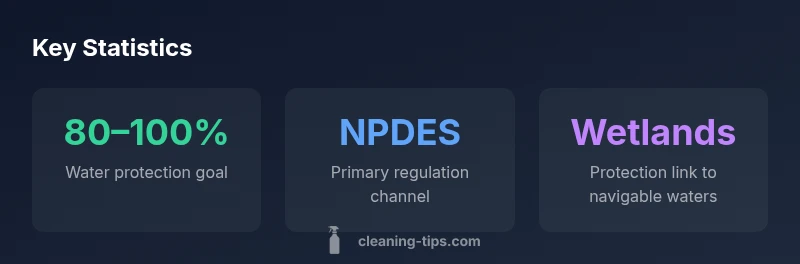
The primary regulatory mechanism under the CWA is the NPDES permit program, administered by the EPA or delegated to state agencies. Permits set limits on what can be discharged, when and how, and require monitoring to demonstrate compliance. Beyond NPDES, the Act supports setting water-quality standards for individual water bodies and funding for state clean-water projects. For households, this means minimizing pollutants that could eventually reach surface waters—routine cleaning products, chemicals, and improper disposal all matter. Cleaning Tips emphasizes choosing safer formulations and following label directions to protect water quality.
Scope and definitions: Navigable waters, wetlands, and WOTUS
The term navigable waters provides the broad framework for CWA regulation, and the Act has historically included wetlands connected to those waters. Debates over the extent of coverage—often framed as Water of the United States (WOTUS)—have led to changes under different administrations and court rulings. For the average homeowner, the practical effect is whether activities near creeks, wetlands, or streams require permits or BMPs to prevent runoff and sedimentation. Cleaning Tips recommends confirming local decisions with your state environmental agency, especially if your property sits near a water feature.
How to determine if your activity triggers regulation
Begin by identifying the water body involved: is it a navigable water or a connected wetland? Next, assess whether your discharge would enter that water body directly or via stormwater runoff. If you are unsure, contact your state environmental agency or the EPA regional office for a ruling. For routine cleaning operations, avoid dumping pollutants, use eco-friendly products, and store chemicals properly to minimize risk. Keeping records of disposal and cleaning activities helps with compliance should a review occur.
Practical steps for homeowners and cleaners
- Use biodegradable, phosphate-free cleaners whenever possible to reduce pollutant loads.
- Do not pour chemicals, solvents, or paints down the drain or onto the ground where runoff could reach water bodies.
- Leak-proof container storage and proper disposal of used mop water and rinse water protect local streams and wetlands.
- If you rent, coordinate with your landlord or management to ensure cleaning practices align with local water-quality rules.
- Learn the local requirements by contacting your state agency or visiting EPA’s NPDES pages for practical guidance.
Following these practices helps you stay compliant and protects the water you rely on daily.
Looking ahead: enforcement and policy debates
Policy discussions around the CWA continue to evolve, including debates over the precise scope of WOTUS and how rapidly standards should be updated in response to scientific findings. Enforcement budgets and state capacity influence how strictly rules are applied, particularly for small facilities and rural communities. Cleaning Tips encourages readers to stay informed about proposed changes and to adopt flexible, evidence-based cleaning routines that minimize environmental impact.
Overview of the Clean Water Act basics
| Aspect | Definition | Noted Examples | Authority/Program |
|---|---|---|---|
| Purpose | Regulates pollutant discharges into navigable waters | Industrial outfalls, municipal wastewater | EPA and state programs |
| Scope | Covers navigable waters and connected wetlands | Streams linked to rivers, wetlands adjacent to lakes | EPA, Army Corps, state agencies |
| Enforcement | Penalties and compliance tools for violations | Fines, permits revocation | EPA and state environmental agencies |
Questions & Answers
When did the Clean Water Act become law?
The Clean Water Act was enacted in 1972 to regulate discharges into navigable waters. It has since evolved through amendments to strengthen permits, standards, and enforcement. The core intent remains protecting surface waters for public health and ecosystems.
The Act began in 1972 to protect surface waters; it evolved with amendments to strengthen enforcement.
What waters are covered under the Act?
The Act covers navigable waters and, in many cases, wetlands connected to those waters. The exact scope can change with regulatory definitions and court decisions, particularly around the Water of the United States concept.
It protects navigable waters and connected wetlands, with scope evolving over time.
Do private wells fall under the CWA?
Private wells are generally regulated at the state level and by groundwater laws, not directly by the CWA. The Act targets surface-water discharges and their impacts on public waters.
Private wells aren’t usually covered by the CWA; they’re governed mainly by state groundwater rules.
What is NPDES and who issues permits?
NPDES stands for National Pollutant Discharge Elimination System. Permits are issued by the EPA or by state agencies acting under EPA authorization, with limits on pollutants and monitoring requirements.
NPDES is the permit program; permits come from EPA or state agencies.
Does the Act regulate nonpoint source pollution?
Nonpoint pollution is typically addressed through state programs and voluntary best management practices rather than the core NPDES permit system.
Nonpoint sources aren’t usually regulated through NPDES; they’re managed by states and BMPs.
Are wetlands protected under the CWA?
Wetlands connected to navigable waters can be protected, but jurisdiction depends on regulatory definitions (like WOTUS) that have changed with policy and court decisions.
Wetlands connected to navigable waters are often protected, but regulations can change.
“The Clean Water Act remains the cornerstone of U.S. water protection, but practical compliance starts with knowing when and where it applies.”
The Essentials
- Understand whether your activities trigger NPDES permit requirements
- NPDES is the core mechanism for regulating discharges
- Scope depends on navigable waters and connected wetlands
- Check local rules with your state environmental agency
- Adopt safer cleaning practices to protect water quality