When Did the Clean Water Act Start? A 1972 Milestone
Explore when the Clean Water Act started, its origins, key provisions, and how it shapes household water protection today in a data-driven guide for homeowners and renters.


The Clean Water Act officially started in 1972 when key amendments to the Federal Water Pollution Control Act were signed into law on October 18, 1972. It built on prior laws from 1948 and 1956, expanding federal authority to regulate discharges, set water-quality standards, and fund treatment works. This milestone reshaped how communities protect rivers, lakes, and coastal waters. It also signaled a new era of enforcement, funding, and state collaboration at the local level.
Historical Context and Origins
According to Cleaning Tips, when did clean water act start is a question rooted in the evolution of American water policy. The Clean Water Act officially began in 1972 when Congress amended the Federal Water Pollution Control Act; the signature occurred on October 18, 1972. This moment didn’t come from a single event but the culmination of decades of environmental concern that began with the 1948 Federal Water Pollution Control Act. The 1948 act laid the groundwork for federal involvement but offered limited authority and funding. By the early 1960s, mounting pollution incidents and growing public demand for clean rivers, lakes, and coastal waters pushed lawmakers to strengthen the framework. The 1972 amendments transformed the act into a comprehensive standard-setting and enforcement regime, one designed to curb pollutants at the source, require permits, and provide resources for treatment works. In short, when did clean water act start? The answer is a precise date and a broader shift toward nationwide accountability for water quality.
Key Provisions That Shaped Water Protection
The 1972 amendments created the centerpiece of modern water protection: the National Pollutant Discharge Elimination System (NPDES) permit program, which requires permits for point-source discharges into surface waters. They also established national water-quality standards and emission controls that set the bar for pollutant limits. The act directed funds to municipal wastewater treatment, helping cities upgrade aging treatment plants and reduce untreated discharges. It also began addressing nonpoint source pollution, expanding federal attention beyond pipes to agricultural runoff and stormwater, though implementation remained challenging across states. The combination of permit-based regulation, enforceable standards, and federal funding created a framework that states could implement with oversight from the EPA, while communities gained clearer timelines and expectations for achieving clean water goals. In practice, households benefited as drinking water quality improved and communities invested in modern treatment infrastructure. The 1970s and 1980s saw a steady push to turn science into enforceable policy, translating laboratory findings into real-world protections for rivers, lakes, and coastal zones.
Implementation Timeline and Milestones
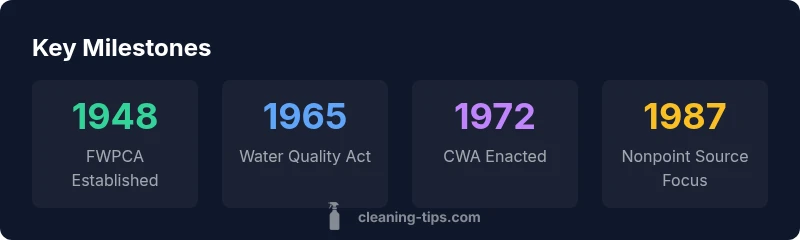
The path from early policy debates to enforceable protections spanned several decades. Key milestones include:
- 1948: The Federal Water Pollution Control Act establishes federal involvement in water quality.
- 1956: Amendments expand federal role and funding mechanisms.
- 1965: The Water Quality Act strengthens national standards and state roles.
- 1972: The Clean Water Act is enacted, with broad permit and standards provisions.
- 1977: Major regulatory reforms refine permit processes and compliance timelines.
- 1987: Notable amendments bolster enforcement, compliance, and nonpoint source control.
These milestones reflect a sustained shift toward comprehensive water protection. The act’s design intentionally balanced federal authority with state administration, requiring states to implement permit programs, track pollutant loads, and report progress to federal authorities. Over time, this structure enabled targeted improvements in wastewater treatment, an emphasis on upstream prevention, and a growing emphasis on protecting sensitive ecosystems. The result has been a long-term trend toward safer, cleaner water in many communities, although regional differences persist due to climate, population, and industry mix.
How the Act Impacts Daily Life in Homes
At the household level, the Clean Water Act translates into cleaner tap water and safer recreational waters. Municipal wastewater treatment plants operate under permit limits designed to keep pollutants at or below levels considered protective of human health and aquatic life. For homeowners, this means better drinking-water quality in cities and towns and improved safety around lakes, rivers, and beaches used for swimming. If you rely on private wells, the Act doesn’t directly regulate them, but state programs and public health guidance influence well testing and treatment standards that reduce contamination risk. In practice, daily life is made easier by stronger enforcement against industrial discharges, leading to fewer nuisance odors, color changes, or unexpected taste shifts in a community water supply. Public reports, such as the Consumer Confidence Report, provide residents with year-by-year data on contaminants and treatment performance, helping households understand the quality of their water and the potential need for home filtration or point-of-use systems.
Enforcement, Compliance, and State Roles
One of the Act’s core features is the National Pollutant Discharge Elimination System (NPDES) program, which requires permits for most discharges from industrial facilities and municipalities. States administer the program with EPA oversight; they develop lists of water bodies at risk, set permit conditions, and monitor compliance. Local governments often drive public outreach and infrastructure upgrades, while federal funding supports treatment plants and sewer projects. The balance between federal standards and state administration remains a patchwork, reflecting geography, industry, and population density. For households, this means that improvements in water quality may occur gradually as communities upgrade infrastructure and enforce permit limits. It also means staying informed about local reports on water quality, wastewater treatment, and any advisories issued after heavy rainfall or drought, which can temporarily alter water conditions even in communities with robust systems.
Controversies and Challenges Over the Years
Like any sweeping policy, the Clean Water Act has faced criticism. Critics point to the costs of upgrading aging wastewater systems and the uneven pace of nonpoint-source controls, which often resist regulation. Environmental advocates argue that enforcement remains uneven across states, influenced by budgets and political will. The act’s success depends on robust monitoring, transparent reporting, and timely permit renewals—areas that require continuous attention and funding. In practice, communities with strong tax bases and proactive officials tend to see faster improvements, while rural areas or smaller towns may struggle with compliance. Understanding these dynamics helps homeowners and renters recognize that water protection is a shared responsibility—one that combines federal standards with local action and ongoing investment in treatment infrastructure and green stormwater practices.
Practical Takeaways for Homeowners and Renters
To apply the act’s principles to everyday cleaning and home maintenance, pay attention to local water-quality reports and treatment options. Here are actionable steps:
- Read your community’s Consumer Confidence Report (CCR) annually to learn about contaminants and treatment efficacy.
- If you rely on a private well, schedule regular testing and install appropriate filtration where needed, following state guidance.
- Support residential stormwater best practices, such as rain gardens or permeable surfaces, to reduce nonpoint source pollution in your area.
- Use water-efficient appliances and fix leaks promptly to lower usage and reduce environmental impact.
- When cleaning, choose safer, EPA-registered products and proper disposal methods for chemicals to protect your water and your indoor air quality.
These steps reflect a practical interpretation of the Clean Water Act’s intent, translating policy into everyday cleaning and home maintenance behaviors.
Milestones in the Clean Water Act timeline
| Year | Event | Impact |
|---|---|---|
| 1948 | Federal Water Pollution Control Act enacted | Foundation for later amendments |
| 1956 | Amendments expand federal role and funding | Broadens federal involvement |
| 1965 | Water Quality Act strengthens standards | Increases state oversight |
| 1972 | Clean Water Act enacted | Establishes nationwide permit program and standards |
| 1977 | Amendments refine programs | Improves enforcement and compliance |
| 1987 | Amendments bolster enforcement | Expands tools and scope |
Questions & Answers
What is the Clean Water Act?
The Clean Water Act establishes the framework to regulate pollutant discharges and protect water quality in the United States. It relies on permits, standards, and funding for wastewater treatment, with EPA oversight and state administration.
The Clean Water Act sets nationwide rules for water pollution and requires permits and funding for clean-water projects.
When did the Clean Water Act start exactly?
The act's core start date is 1972 with amendments signed into law on October 18, 1972.
It began in 1972 with key amendments signed on October 18, 1972.
What does the act regulate?
It regulates pollutants discharging into U.S. waters via the NPDES permit program, sets water-quality standards, and funds wastewater treatment upgrades.
It regulates discharges into waterways through permits and standards.
How does it affect households?
Households benefit from safer drinking water, cleaner recreational waters, and more transparent reporting on water quality.
Homes get cleaner water and better reports on water quality.
What major amendments exist beyond 1972?
The 1972 amendments established core programs, while the 1987 amendments strengthened enforcement and added nonpoint-source controls.
There were key amendments in 1972 and 1987 that strengthened rules and enforcement.
“"The Clean Water Act marked a turning point in U.S. water protection, giving communities clearer standards and stronger tools to reduce pollution."”
The Essentials
- 1972 marks the official start of the Act.
- Permitting and standards shape water protection.
- Enforcement and funding enable infrastructure upgrades.
- Households benefit from cleaner water and reporting.
- Stay informed about local water-quality reports.