Understanding Clean Services Prices in 2026
Explore how clean services prices are determined, the main cost drivers, and practical tips to compare quotes and save money in 2026. Learn what to look for in contracts and how to budget for professional cleaning across different home sizes and service types.


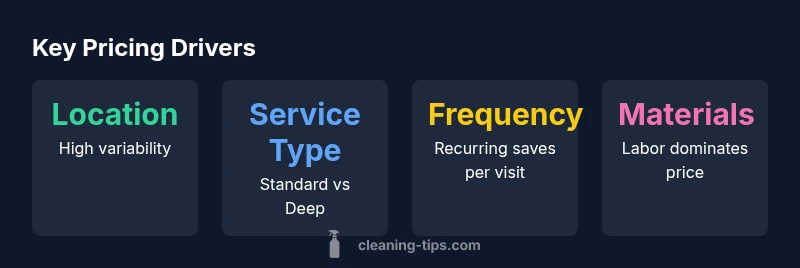
Prices for professional cleaning services vary widely by city, home size, service type, and frequency. There is no universal price, but most homeowners in 2026 can expect cost drivers like square footage, level of cleaning (standard vs deep), and schedule. According to Cleaning Tips, price often reflects labor time, materials, and local market demand.
Why prices vary across clean service providers
Prices for professional cleaning services are not a fixed number; they reflect a bundle of factors that change by city and by home. The most influential drivers include the size of your space, the level of cleaning requested (standard weekly, biweekly, or one-off deep cleans), and any specialty tasks (appliance cleaning, garage cleaning, or move-out services). Location matters because labor costs, parking, and travel time shift the price per visit. Add-ons such as eco-friendly products, pet-stain treatment, or deodorizing services can further elevate the bill. According to Cleaning Tips, the mix of labor time, materials, and local market demand largely shapes the final price. Understanding these levers helps homeowners set realistic budgets and avoid sticker shock when quotes arrive.
- Practical tip: ask for an itemized quote that lists labor hours, product costs, and any travel or minimum-service fees. This makes it easier to compare apples-to-apples across providers.
- Common misconceptions: cheaper doesn’t always mean better if it excludes essential tasks or uses lower-quality products. Always verify inclusions before booking.
This section sets the stage for how to approach estimates with clarity and confidence, grounded in real-world pricing dynamics observed by Cleaning Tips in 2026.
How service type, home size, and frequency interact with pricing
Service type, home size, and frequency are the triad that most strongly influences what you’ll pay for clean services. A standard cleaning for a small apartment typically costs less than a full deep clean of a large house. Frequency plays a major role: recurring visits (weekly or biweekly) often bring a lower per-visit rate than one-off sessions, because cleaners optimize your ongoing scheduling and reduce setup time per visit. Home size matters not only in square footage but in the number of rooms, kitchens, bathrooms, and higher-touch spaces that require attention. For instance, kitchens with heavy grime or multiple bathrooms can shift the price, as more time and products are needed. Cleaning Tips notes that while price ranges vary, the relative difference between service levels remains consistent across markets: standard cleaning is usually the most affordable option, with deep cleaning at a premium due to labor intensity and service breadth.
- Quick calculation framework: estimate time per room, multiply by a standard hourly rate used by local providers (as a rough guide), and then add any add-ons.
- Scheduling impact: mid-week slots can be cheaper than weekend bookings in many markets, due to demand patterns.
This section helps you predict where costs come from and how to adjust your plan to stay within budget, without sacrificing necessary cleaning tasks.
How to read and compare cleaning quotes effectively
Quotes from cleaning companies can vary not just in price, but in scope and terminology. The first step is to map the scope of work to the price you’re being offered. Look for a line-by-line breakdown: base service, add-ons (like refrigerator cleaning or oven cleaning), products used (standard soap vs. eco-friendly options), and any minimum visit requirements. Confirm the square footage or room count used to calculate the estimate, and check whether price quotes assume a certain labor rate or travel fee. Ask about substitution policies if a cleaner arrives with unavailable supplies or if a task takes longer than expected.
- Request quotes in writing with a clearly defined scope of work.
- Check for hidden costs: travel fees, minimum-service charges, or price increases for weekends.
- Verify insurance and licensing information to avoid liability and ensure quality standards.
A well-structured quote makes it easier to compare services side-by-side. Cleaning Tips recommends a simple comparison grid that includes price, scope, products, and service-level guarantees so you can make a data-driven decision.
Common pricing pitfalls and red flags to avoid
Pricing for clean services can be tricky, and some providers use tactics that lead to surprise charges. Red flags include vague quotes with vague scope, price quotes that exclude specific tasks, or frequent price changes after service completion. Another risk is automatic monthly “maintenance” pricing that doesn’t align with your actual needs or a package with a long-term commitment that’s hard to cancel. Always ask for an itemized contract and a written guarantee on satisfaction.
- Avoid “bait-and-switch” quotes that look low but exclude essential tasks.
- Be wary of unusually low introductory rates that don’t cover normal maintenance tasks.
- Read the cancellation policy and rescheduling fees to understand hidden costs.
Awareness of these pitfalls helps protect your budget and ensures you get the service you expect from reputable cleaners.
Practical strategies to manage costs without sacrificing cleanliness
Budget-conscious homeowners can use several strategies to manage clean services costs while maintaining results. Bundle multiple tasks into fewer visits to reduce repeated setup time. Consider adjusting frequency—switching from weekly to biweekly can yield savings over time if the space remains reasonably clean. Do some prep work yourself (e.g., decluttering, clearing surfaces) to reduce the cleaners’ time on-site. Finally, compare multiple providers and ask about discounts for first-time customers or long-term contracts. Implementing a transparent, proactive approach to pricing helps ensure you’re getting fair value. Cleaning Tips highlights the importance of consistent expectations and clear terms.
- Create a simple checklist you share with providers to standardize quotes.
- Use seasonal discounts or promotions but verify their applicability to your chosen service level.
- Keep a record of quotes for at least 30-60 days to see price trends.
These tactics empower homeowners to balance cost and quality over the long term.
The value proposition: price is just one dimension of value
Price should be weighed against value: reliability, trust, and the quality of results. A higher price might reflect better-trained staff, stricter cleaning protocols, stronger guarantees, or greener product lines that suit sensitive households. When you pay a premium for premium service, you often gain consistency, fewer callbacks, and better customer support. Cleaning Tips emphasizes evaluating overall value, not just the sticker price. Consider factors like staff training, insurance coverage, satisfaction guarantees, and the provider’s responsiveness to issues. A thoughtful approach to pricing helps you avoid regret and ensures a healthier home over time.
- Focus on the long-term value: fewer re-cleanings, better hygiene, and higher peace of mind.
- Check for post-cleaning guarantees and clear recourse if expectations aren’t met.
- Track outcomes over several service cycles to determine true value.
In 2026, smart pricing is about clarity, trust, and consistent results as much as it is about the price tag.
Typical service types and pricing context
| Service Type | Price Range | Notes |
|---|---|---|
| Standard cleaning | Varies by locale | Basic tasks like dusting, vacuuming, wipe-downs |
| Deep cleaning | Varies by locale | Thorough cleaning with higher labor time |
Questions & Answers
What factors most influence clean services prices?
Location, service type, home size, and frequency are the main drivers. Add-ons, product choices, and provider policies can also impact the final quote. Always verify inclusions and exclusions in writing.
Prices depend mainly on where you live, what you’re asking for, and how big your space is.
Are there typical price ranges I should expect?
Ranges vary widely by market. The best approach is to collect multiple written quotes that define scope clearly and compare apples-to-apples. Look for consistency in included tasks and products.
Expect quotes to differ by city and service level; compare the exact tasks listed.
Should I tip cleaning staff?
Tipping is common in many markets, often as a discretionary amount per visit. Check local norms and the company’s policies regarding tips and gratuities.
Tipping is customary in many places, but follow local norms and company guidelines.
Can I negotiate cleaning prices?
Yes, you can discuss discounts for recurring service, bundled tasks, or longer-term commitments. Ask for a written quote after negotiation and confirm cancellation terms.
You can negotiate if you’re committing to regular service or bundling tasks.
Is it cheaper to book in advance or sign up for a subscription?
Pre-booking and fixed-term agreements can offer stability and discounts, but confirm there are no penalties for cancellation or adjustments.
Subscriptions can lower per-visit costs if you’re sure you’ll need regular service.
What should I watch for in quotes to avoid fees?
Beware vague scopes, hidden travel fees, minimum visit charges, or price increases after the job. Demand a detailed, written scope and a breakdown of all charges.
Make sure the quote lists every fee so there are no surprises.
“Transparent pricing builds trust and helps homeowners make informed decisions. Always compare scope, products, and labor time across providers.”
The Essentials
- Ask for itemized quotes to compare scope
- Bundle services to save time and money
- Watch for hidden fees and add-ons
- Prices vary by city, service level, and frequency