Do You Put Cleaner in a Steam Cleaner? A Practical Guide
Learn whether you can add cleaners to a steam cleaner, when it’s safe to do so, and practical steps to avoid damage. Includes manufacturer guidelines, safe alternatives, common mistakes, and a step-by-step readiness plan.


No, you generally should not put household cleaner into a steam cleaner. Steam cleaners are designed to use only water, unless your manufacturer explicitly states that a cleaning solution is safe to add. Using cleaners can cause chemical residues, damage seals, and void warranties. If your device has a detergent option, only use products recommended by the manufacturer and follow their dilution instructions.
Why this question matters
Do you put cleaner in a steam cleaner? This question has real consequences for device longevity and home safety. The decision hinges on your model, the cleaning solution, and the manufacturer's guidance. According to Cleaning Tips, most steam cleaners are designed to operate with water unless the manual explicitly permits a cleaning solution. Using an unapproved chemical can leave residues, corrode seals, and void warranties. If your device does support a detergent option, always follow the exact product and dilution instructions provided by the manufacturer to avoid damage or unsafe steam.
Different surfaces and tasks demand different approaches. You might be cleaning floors, upholstery, or tile grout, and the surface tolerances vary. By understanding your unit’s design and the manufacturer’s stance, you protect both your surfaces and the steam cleaner’s internals. Cleaning Tips’s analysis shows that sticking to water or manufacturer-approved additives minimizes the risk of mineral buildup, residue, and mechanical wear over time.
How steam cleaners work
Steam cleaners heat water in a small boiler to create high-temperature steam that travels through a nozzle or wand. The heat loosens dirt, kills many germs, and allows for rinsing with minimal chemical use. Because the steam carries heat and moisture, the device relies on pure water to avoid chemical reactions, residue, and corrosion.
Most consumer models are designed to emit steam rather than dispense cleaning agents. The rationale is safety, material compatibility, and ease of rinsing. When you introduce cleaners, you change the chemistry inside the boiler and on the surface, which can alter cleaning effectiveness and potentially damage seals, gaskets, or hoses. If your goal is extra cleaning power, check if your model has a built-in detergent mode or a dedicated tank that the manufacturer approves for certain solutions.
Manufacturer guidelines and detergent options
Always consult your device’s manual before attempting any detergent or additive. Some steam cleaners include a detergent or cleaning solution option, along with precise dilution ratios and usage instructions. Others prohibit any additives entirely and prescribe only water for steam generation. The critical rule is: follow the manufacturer’s guidance to avoid warranty voids, chemical exposure risks, and clogged components.
In many cases, the detergent feature is only safe with products specifically designed for steam cleaning. Using a general-purpose cleaner or a concentrated chemical can leave residues that clog jets or react with surfaces. If a detergent option exists, ensure you use the exact product recommended by the manufacturer and perform any required flushing after cleaning.
Safe alternatives and best practices
When in doubt, use plain water and allow the steam to do the work. If a manufacturer approves cleaning solutions, use only those products and follow dilution instructions carefully. Consider these safer practices:
- Distilled water can reduce mineral buildup and extend the life of the boiler.
- Pre-treat stubborn stains with a small amount of approved solution on an inconspicuous area, then test first.
- Use short, overlapping passes rather than long, continuous strokes to prevent moisture pooling on delicate surfaces.
- Rinse naturally by running a pure water cycle after any cleaning solution use to flush residues.
When it's safe to use a cleaning solution
Only proceed with a cleaning solution if the manual explicitly allows it and the device includes a detergent option or a dedicated tank. In these cases, follow the exact product and dilution guidelines provided by the manufacturer. Never improvise with household cleaners that aren’t approved for steam cleaning, and never mix chemicals.
If you’re unsure, contact the manufacturer’s support line or consult official instruction materials. The goal is to maintain device integrity, ensure user safety, and avoid chemical exposure on treated surfaces.
Common mistakes and risks
Common mistakes include using non-approved cleaners, using concentrated solutions, and skipping the flushing step after cleaning. Residues can form on internal valves and jets, leading to reduced steam output or clogged pathways. Misusing a cleaning solution may also void the warranty and introduce fumes on sensitive surfaces. Always verify compatibility and perform a small test patch before wide cleaning.
Surfaces and maintenance after steam cleaning
Not all surfaces react the same to steam and cleaners. Test on a small, hidden area of any fabric, wood, or tile before broader use. After cleaning with any solution, flush the system with plain water by running a full water-only cycle to remove residual chemicals. Wipe surfaces dry when possible to prevent water spots and humidity-related damage.
Tools & Materials
- Water source (as specified by device: tap or distilled)(Check device manual for acceptable water type)
- Distilled water (optional)(Use to minimize mineral buildup if recommended by manufacturer)
- Manufacturer-approved cleaning solution(Only use products explicitly approved by the manufacturer)
- Soft microfiber cloth(For wiping surfaces and drying after cleaning)
- Measuring cup or dropper(Only if the solution requires precise dilution)
- Protective gloves(Wear when handling concentrates or concentrated cleaners)
Steps
Estimated time: 45-60 minutes
- 1
Check the manual for compatibility
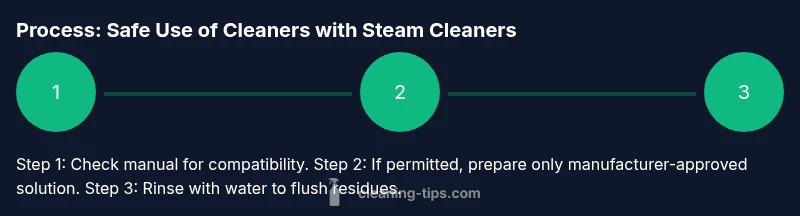
Read the device manual to confirm whether your model allows any cleaning solution beyond water. If the manual forbids additives, do not add cleaners under any circumstances. Understanding compatibility prevents damage and warranty issues.
Tip: If you can’t find explicit language, contact the manufacturer before proceeding. - 2
Confirm approved products (if available)
Identify any detergent or cleaning solution that the manufacturer explicitly approves for your model. Use only those products and follow the provided dilution guidelines. Using an unapproved chemical is a common cause of problems.
Tip: Never substitute with general cleaners unless explicitly approved. - 3
Prepare the tank and solution
If your model has a detergent tank, ensure it is clean and properly connected. Measure and dilute the solution exactly as instructed, avoiding overfilling or mixing products.
Tip: Accurate dilution minimizes residue and protects components. - 4
Run a test on a non-visible area
Before broad cleaning, run a short cycle on a hidden surface to check for adverse reactions or spotting. This step helps you catch issues without damaging a prized surface.
Tip: Always test first in case of dye transfer or surface sensitivity. - 5
Begin cleaning with short, controlled passes
Clean with slow, overlapping passes to maximize contact and minimize moisture pooling. Keep the nozzle at a safe distance from the surface to avoid oversaturation.
Tip: Overlapping strokes help avoid missed spots and streaks. - 6
Flush with plain water and air dry
After cleaning, run a full water-only cycle to flush chemicals from the system and surfaces. Wipe surfaces dry or allow them to air dry to prevent moisture damage.
Tip: Flushing prevents residue buildup and keeps the unit ready for next use.
Questions & Answers
Can I run a steam cleaner with cleaning solution in the tank?
Only if your manufacturer explicitly allows it and provides a detergent option. Using unapproved cleaners can damage the unit and void warranties.
Only if the manual says you can; otherwise do not use cleaners in the tank.
What cleaners are safe to use in a steam cleaner?
Use only products specifically approved by the manufacturer for your model. General household cleaners are typically not safe.
Only use manufacturer-approved cleaners for your model.
Will using cleaner damage my steam cleaner?
Yes, improper chemicals can damage seals, clog jets, and void warranties. Always follow the manual.
Using unapproved chemicals can harm the device and void warranties.
Is it safe to use vinegar or harsh chemicals in steam cleaners?
Most manufacturers discourage vinegar or harsh chemicals unless explicitly approved. Check your manual before use.
Check the manual—most steam cleaners should not use vinegar or harsh chemicals.
How do I flush the system after using a cleaner?
Run the device with plain water until no residue remains. This protects the boiler and improves performance.
Run a water-only cycle until the system is clear of any cleaner.
Can I use a steam cleaner on all surfaces after using a cleaner?
Surface compatibility varies. Test on a small area first and follow surface-specific guidelines in the manual.
Test first on an inconspicuous area and follow surface guidelines.
Watch Video
The Essentials
- Always check the manual before adding any cleaner
- Use only manufacturer-approved solutions if permitted
- Flush thoroughly with plain water after any solution use
- Test on an inconspicuous area first
- Maintain proper water quality to extend device life