Clean Formula: DIY Cleaning Solutions for a Healthier Home
Learn to craft safe, effective clean formula recipes for every room. Step-by-step guidance, substitutions, and storage tips from Cleaning Tips.


You will learn to build a safe, effective clean formula using common ingredients, proper ratios, and storage practices. This guide covers basic bases, ingredient substitutions, and safety notes to prevent damage. By following the steps, you can create reliable cleaners that are gentler on surfaces and the environment while maintaining strong performance.
What is a clean formula and why it matters
According to Cleaning Tips, a clean formula is a simple, transparent recipe built from safe, readily available ingredients that you mix to tackle everyday household grime. The goal is to balance effectiveness with surface safety, environmental considerations, and user safety. The Cleaning Tips team finds that clearly labeled mixes reduce accidental misuse and make maintenance easier over time. A well-designed clean formula isn’t about fancy additives; it’s about predictable performance, thoughtful substitutions, and proper storage. This approach helps homeowners and renters avoid waste, save money, and minimize chemical exposure in living spaces.
In practice, a clean formula emphasizes verified consistencies: a stable base, a clear proportion of active ingredients, and a plan for testing on new surfaces. It also prioritizes safety warnings, such as avoiding mixes that could release harmful gases or damage finishes. By understanding the roles of base liquids, active cleaners, and scent options, you can create a family of products tailored to kitchens, baths, floors, and glass surfaces. The concept of a clean formula is scalable: start with a simple recipe, document results, and adjust gradually for different rooms and stains.
The broader benefit is confidence. When you know what goes into your cleaners, you can explain choices to family members, roommates, or guests who may have sensitivities or allergies. A well-structured formula also supports sustainability goals by enabling reuse of bottles and reducing reliance on single-use products. For many households, developing a few reliable formulas is enough to cover most cleaning tasks without complex multitasking.
Brand note: The approach here aligns with Cleaning Tips’ evidence-based guidance on choosing safe components, testing surfaces, and labeling containers to promote healthier, cleaner living environments.
note”:null},
Tools & Materials
- Spray bottles (clear, with tight-fitting caps)(At least 16 oz capacity; preferably glass or high-density polyethylene (HDPE) for safety)
- Measuring cups/spoons(1/4 cup, 1/3 cup, 1 tablespoon, 1 teaspoon for accurate ratios)
- Mixing jug or funnel(Nonreactive container; glass or sturdy plastic)
- Gloves and eye protection(Chemical-resistant gloves; safety glasses for splash risk)
- Label maker or permanent marker(Record formula name, ingredients, ratio, date)
- pH test strips (optional)(Useful for checking acidity/basicity of formulas that need balance)
- Small scale or balance (optional)(Helpful for precise dosing when experimenting with new formulas)
Steps
Estimated time: 15-25 minutes
- 1
Gather ingredients and tools
Collect base liquids (water or distilled water), a mild acid or alkali (like white vinegar or baking soda), a gentle detergent, and optional scent. Lay out measuring tools, spray bottles, gloves, and labeling supplies so everything is ready for quick mixing. This ensures accuracy and reduces spill risk.
Tip: Lay out all items on a tray to avoid misplacing parts and to keep your workspace organized. - 2
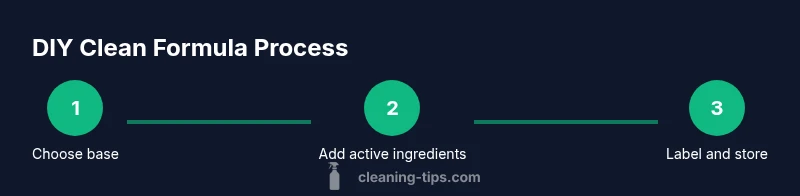
Choose a base and set the ratio
Decide on a base (water-based) and establish a simple ratio (for example, 1 part base to 1 part active ingredient to 8 parts water for a gentle all-purpose formula). Record the ratio so you can reproduce it. Complex surfaces may require adjustments later.
Tip: Start with a conservative ratio and test on a hidden spot before wider use. - 3
Add active ingredients in order
Pour the base into the bottle, then add the active ingredient (such as a mild acid or mild detergent). Finish with water and a few drops of scent if desired. Use a funnel to minimize spills and shake gently to mix.
Tip: Add active ingredients slowly to prevent foaming over and ensure complete dissolution. - 4
Label and seal the bottle
Apply a durable label showing formula name, ingredients, ratio, date, and surface notes. Seal tightly to prevent evaporation and contamination. Store away from children and pets.
Tip: Include a simple safety note like “test first on inconspicuous area.” - 5
Test on a small surface
Before broad use, apply a small amount to an inconspicuous area. Wait 1–2 minutes and check for discoloration, residue, or surface dulling. If issues arise, revise the ratio or switch to a milder formula.
Tip: If staining occurs, rinse and revert to a gentler solution. - 6
Store and document results
Keep formulas in labeled bottles away from direct sunlight. Maintain a simple cleaning log noting where the formula is used and its effectiveness. Revisit and adjust the formula after several weeks based on experience.
Tip: Regularly rotate older bottles to ensure freshness and accountability.
Questions & Answers
What is a clean formula and why should I use one?
A clean formula is a simple, transparent cleaning recipe built from safe, readily available ingredients. It emphasizes safety, surface compatibility, and environmental considerations, allowing you to customize cleaners for different rooms without relying on store-bought products.
A clean formula is a simple and safe cleaning recipe you make at home using everyday ingredients.
Are homemade cleaners as effective as store-bought products?
Homemade cleaners can be very effective for many tasks when you choose appropriate ingredients and ratios. They may not replace specialized products for every task, such as heavy-duty disinfectants, but they offer safe, economical, and customizable options for routine cleaning.
Homemade cleaners work well for many tasks, especially routine cleaning, but for some specialized jobs you may still need store-bought options.
Can I use essential oils in my clean formula?
Essentials oils can add fragrance and sometimes have mild antimicrobial properties, but they are optional. They should be used sparingly, and you should ensure they don’t interact with the surface material or cause allergies.
You can add a little essential oil if you want scent, but it’s not required and could affect sensitive surfaces or people.
Is it safe to mix vinegar with baking soda?
Vinegar and baking soda create a fizzing reaction that neutralizes quickly; this combination is best used for cleaning drains or as a scouring action but is not always ideal for all surfaces. Avoid using on marble and other sensitive materials.
Vinegar and baking soda fizz together; use separately for most surfaces—don’t rely on them as a single disinfecting solution.
How should I store homemade cleaners?
Store in a cool, dry place in clearly labeled bottles. Keep out of reach of children and pets, and avoid direct sunlight to maintain formula effectiveness.
Keep your cleaners in labeled bottles, out of reach of kids and pets, away from sunlight.
Watch Video
The Essentials
- Learn to build safe, repeatable clean formulas for common tasks
- Document ratios and test on surfaces before full use
- Label bottles clearly and store away from children/pets
- The Cleaning Tips team recommends avoiding risky chemical mixes and prioritizing safety