Cleaning Vinegar vs White Vinegar: A Practical Cleaning Guide
Explore the differences between cleaning vinegar and white vinegar, including acidity, uses, safety, and surface compatibility. A data-driven, practical guide from Cleaning Tips to help homeowners and renters choose the right option for each task.


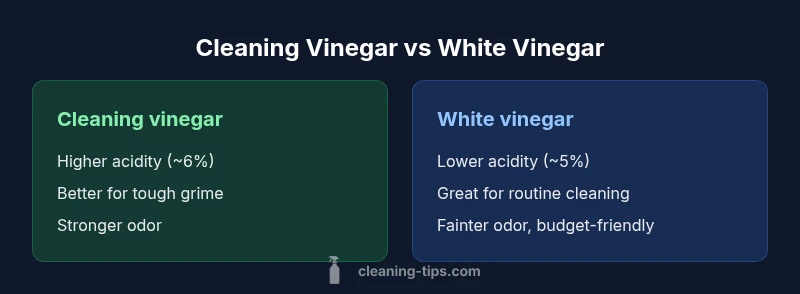
White vinegar (about 5% acetic acid) and cleaning vinegar (about 6%) both clean well, but differ in strength, scent, and price. White vinegar is a general-purpose cleaner; cleaning vinegar is stronger, better for mineral deposits and tougher stains. Pick based on task, budget, and safety needs.
Cleaning vinegar vs white vinegar: definitions and origins
Both cleaning vinegar and white vinegar are water-based solutions derived from fermented ethanol. White vinegar is commonly sold as distilled vinegar and is widely used in cooking and cleaning. Cleaning vinegar, a label you’ll see in grocery shelves, is a cleaning-grade product with a higher acetic acid content. The distinction isn’t about a different chemical backbone, but about concentration and intended use. The two products share a common solvent—acetic acid—but the cleaning-grade version is formulated for tougher tasks. The difference in labeling can be confusing for first-time buyers, so it’s important to read the percent acidity on the bottle. In the United States, white vinegar is often around 5% acetic acid, while cleaning vinegar labels frequently indicate higher acidity. Across markets, the exact numbers vary, but the principle holds: higher acidity equals stronger cleaning power, with potential safety trade-offs. According to Cleaning Tips, the key takeaway is that you can generally substitute when the task isn’t ambitious, but you should scale your approach based on surface sensitivity and the desired outcome. This article uses the phrase cleaning vinegar vs white vinegar to frame the discussion and to guide practical use in daily cleaning routines.
Understanding that both products are inexpensive, widely available, and effective for many tasks helps homeowners and renters plan a balanced cleaning strategy. These are not exotic chemicals; they are common household products with different labels that reflect intended use. For most routine chores, the cheaper, milder white vinegar will suffice; for stubborn grime and mineral buildup, the stronger cleaning vinegar may deliver quicker results. This nuance is central to the rest of the guide, where we’ll examine acidity, safety, specific tasks, and best practices. The guidance here is grounded in general cleaning science and practical experience, with the Cleaning Tips team emphasizing careful testing on delicate finishes before broad application.
-1type1dummy-
Comparison
| Feature | Cleaning vinegar | White vinegar |
|---|---|---|
| Acidity/strength | Higher (about 6% acetic acid) | Lower (about 5% acetic acid) |
| Scent and odor | Stronger, sharper aroma | Milder, less noticeable odor |
| Surface safety | Effective on mineral deposits; test on porous surfaces | Generally safe for many surfaces; use caution on stone |
| Best for | Tough stains, mineral buildup, heavy cleaning | Everyday cleaning, dilution, budget tasks |
| Price range | Often slightly higher | Typically lower per use |
Strengths
- Low cost and easy to find
- Versatile across many cleaning tasks
- Non-toxic and biodegradable
- Useful for broad surface cleaning and deodorizing
- Higher strength for stubborn grime
Weaknesses
- Stronger odor can be unpleasant
- Potentially harsher on sensitive surfaces
- Not suitable for all natural stone surfaces
- Label variations across brands may cause confusion
Use white vinegar for routine, everyday cleaning and budget tasks; save cleaning vinegar for stubborn grime and mineral deposits.
White vinegar is the go-to for most households due to its balance of cost and effectiveness. Cleaning vinegar shines on tougher cleaning jobs, where higher acidity can improve results. The Cleaning Tips team recommends matching the product to the task and surface, and always performing a spot test first.
Questions & Answers
What is the main difference between cleaning vinegar and white vinegar?
The main difference is acidity and intended use. Cleaning vinegar is formulated for higher acidity and tougher cleaning tasks, while white vinegar is milder and suitable for everyday cleaning and dilution. Both can be effective, but match the strength to the job and surface.
Difference is acidity and purpose: cleaning vinegar is stronger, better for stubborn grime; white vinegar covers everyday cleaning. Test first on delicate surfaces.
Can I use white vinegar for tough stains?
Yes, white vinegar can handle many routine stains and odors, but for stubborn mineral buildup or heavy grime, cleaning vinegar may perform better due to its higher acidity. Always test on an inconspicuous area first.
White vinegar handles common stains. For stubborn grime, consider cleaning vinegar with caution.
Is it safe to use vinegar on natural stone surfaces?
Vinegar can etch and damage some natural stones like marble or limestone. Use it only on sealed or non-porous surfaces, or opt for stone-safe cleaners. When in doubt, perform a small test in an inconspicuous area.
Be careful with stone surfaces; test first and consider stone-safe cleaners.
Can I mix vinegar with bleach or hydrogen peroxide?
No. Mixing vinegar with bleach releases chlorine gas, which is hazardous. Mixing vinegar with hydrogen peroxide can form peracetic acid, a strong irritant. Use vinegar separately and rinse well between cleaners.
Never mix vinegar with bleach or hydrogen peroxide.
Where can I buy cleaning vinegar, and does it differ by country?
Cleaning vinegar is widely available in many countries and often sold in the same aisle as standard vinegar. Availability and labeling vary by country, so check the label for acidity and usage guidance.
Cleaning vinegar is common in many places; check acidity on the bottle.
Is vinegar effective for mold remediation?
Vinegar can help inhibit some mold growth on non-porous surfaces, but it is not a replacement for professional mold remediation when mold is extensive. For serious cases, consult a professional.
Vinegar may help with light mold on non-porous surfaces, not a replacement for professionals.
The Essentials
- Choose white vinegar for daily cleaning and low-risk tasks
- Reserve cleaning vinegar for stubborn grime and mineral deposits
- Always read label percentages and test on delicate surfaces
- Avoid mixing vinegar with bleach or hydrogen peroxide
- Store in a cool, labeled container away from children and pets