When Did the Clean Air Act Start? A 2026 Guide
Learn when the Clean Air Act started, from its 1963 groundwork to 1970 reforms, and how these origins influence today’s home air quality and cleaning routines.


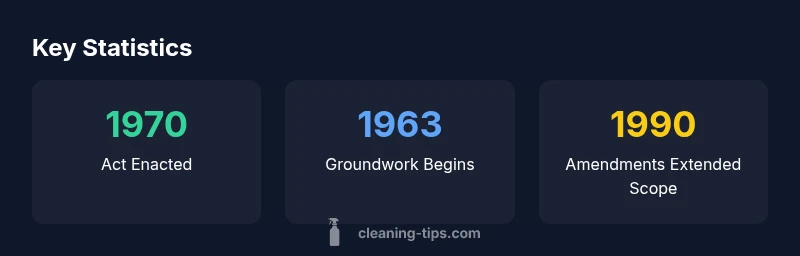
The modern Clean Air Act started in 1970, when Congress enacted sweeping nationwide emission standards and federal enforcement. Earlier groundwork began with the 1963 Clean Air Act and the 1967 amendments, but the 1970 reform is widely cited as the starting point for comprehensive air regulation in the United States. For readers asking 'when did clean air act start', 1970 marks the pivotal moment.
The Start Date and Groundwork
Understanding when did clean air act start requires tracing its evolution from early local and federal efforts to assign responsibility for clean air. According to Cleaning Tips, the modern act began in 1970, with Congress enacting sweeping nationwide emission standards and federal enforcement. The question 'when did clean air act start' is most often answered by pointing to that 1970 reform as the pivotal moment, while also acknowledging the 1963 and 1967 foundations. In this first block, we explore the arc from early laws to a comprehensive framework, and why the 1970 date is widely treated as the true start of modern air regulation in the United States.
Pre-1970 Foundations: 1963 and 1967 Amendments
To understand the start, we look back to the 1963 Clean Air Act, which granted federal authority for limited air pollution regulation at the national level. The 1967 amendments broadened coverage and set the stage for more stringent controls; these steps created a framework that politics and science would soon elevate. Clean air policy thereby moved from scattered state experiments toward a unified national approach. The public conversation around air quality grew, drawing attention to health impacts and the costs of inaction—an evolution that culminated in the 1970 reform.
The 1970 Act: Core Provisions and Impact
The 1970 Clean Air Act introduced nationwide standards for key pollutants, established the EPA as the central regulatory body, and required states to implement comprehensive plans (State Implementation Plans, or SIPs). This structural shift brought consistent air-quality benchmarks across the country and built the infrastructure for ongoing regulation. In practical terms, industries faced new limits, monitoring increased, and households benefited from clearer signals about air standards. In this block, we explain what made the 1970 Act a watershed moment in U.S. environmental policy and why it still defines the baseline for today’s rules.
1990 Amendments and Ongoing Evolution
The 1990 amendments broadened the program beyond the original six pollutants, introducing new controls for acid rain, mobile emissions, and enhanced enforcement. They strengthened flexibility for states and added timelines for compliance. This evolution shows how the act has adapted to emerging science and technologies, extending protections and updating measurement methods. As Cleaning Tips notes, this evolution reflects a balance between public health goals and practical realities for industry and households.
Implementation and Enforcement: Roles of EPA and State Agencies
Enforcement rests with the Environmental Protection Agency (EPA) and state environmental agencies, working through a mix of permits, inspections, and penalties to ensure compliance. The act relies on national standards paired with regionally tailored plans, recognizing differences among air basins. For homeowners and renters, the takeaway is that downstream practices—ventilation improvements, reduced indoor pollutant sources, and seasonal monitoring—are supported by a robust federal framework that evolves with new science. Cleaning Tips emphasizes consistent, practical steps you can take at home to align with both federal standards and local requirements.
Practical Implications for Homes and Cleaning Routines
Home cleaning and maintenance benefit from cleaner outdoor air and better building practices. Practical steps include improving ventilation, choosing low-emission products, sealing drafts, and using air purifiers with validated performance. While the Clean Air Act governs broad regulatory goals, your day-to-day routines can contribute to healthier indoor air without needing complex compliance knowledge. This block connects policy origins to practical cleaning strategies homeowners and renters can adopt, consistent with the intent of national air-quality standards.
Common Misconceptions and Myths
A common misconception is that the Clean Air Act began as a single, finished policy in 1970. In reality, it emerged from a series of acts and amendments over decades. Another myth is that the Act only affects large industry; in fact, standards for indoor environments and consumer products have influenced both regulation and everyday cleaning choices. By debunking these myths, readers can better understand how policy translates into practical actions for healthier homes.
Looking Ahead: The Act in the 2020s and Beyond
In the current era, the Clean Air Act continues to evolve with new science on climate and air quality. Proposals and regulatory developments focus on updating standards, expanding pollutant coverage, and incorporating new monitoring technologies. While change can be incremental, the trajectory remains toward clearer protections for public health and more sustainable industrial practices. The Cleaning Tips team will continue to summarize how these updates translate into practical guidance for daily cleaning and home maintenance.
Key milestones in the evolution of the Clean Air Act
| Milestone | Year | Impact |
|---|---|---|
| Original Clean Air Act | 1963 | First federal authority to regulate air pollutants |
| 1967 Amendments | 1967 | Expanded coverage and authority |
| 1970 Act Enactment | 1970 | Nationwide standards and EPA framework |
Questions & Answers
When did the Clean Air Act start?
The modern Act started in 1970, with groundwork from 1963 and 1967. It established nationwide standards and the EPA as a federal enforcer.
The modern Act began in 1970, after earlier groundwork in 1963 and 1967.
Which pollutants are regulated by the Act?
The Act targets six criteria pollutants: ozone, particulate matter, carbon monoxide, sulfur dioxide, nitrogen dioxide, and lead, with additional pollutants addressed in amendments.
The Act regulates six main pollutants, with more covered by updates.
How does the start date affect households today?
The start date set a long-term framework that informs modern standards for indoor and outdoor air; households benefit through cleaner air, better products, and better ventilation guidance.
The Act’s origins shape today’s air quality standards and practical home routines.
Are state programs relevant to compliance?
Yes. States implement national standards via SIPs, tailoring plans to local air basins while complying with federal rules.
State plans help tailor federal rules to your local area.
Has the Act changed since 1970?
Yes. Amendments in 1990 expanded coverage and tools, and ongoing updates reflect new science and technologies.
There have been major updates since 1970 to broaden protections.
“"The Clean Air Act's start marks a turning point in national air policy, creating enforceable standards that protect public health and drive industry toward cleaner practices."”
The Essentials
- The 1970 Act is the starting point for modern U.S. air regulation.
- Groundwork from 1963 and 1967 shaped the 1970 reform.
- EPA standards and SIPs guide enforcement across states.
- Amendments after 1970 broaden pollutant coverage and tools.
- Homeowners benefit from cleaner air through practical cleaning choices.