Why Is China Cleaner Than India? An Analytical Comparison
An evidence-based analysis of urban cleanliness in Chinese and Indian cities, exploring infrastructure, governance, waste management, and cultural factors with neutral, data-informed reasoning.


"why is china so clean compared to india" is a nuanced question. Cleanliness outcomes vary by city and program, but in many cases differences in urban planning, sanitation infrastructure, and governance help explain disparities. Centralized planning, rapid investment, and stricter enforcement in several Chinese municipalities often yield higher visible cleanliness in public spaces, while India shows diverse results across states and cities. This analysis from Cleaning Tips highlights the factors that drive those outcomes without resorting to broad generalizations.
Why infrastructure and governance shape urban cleanliness
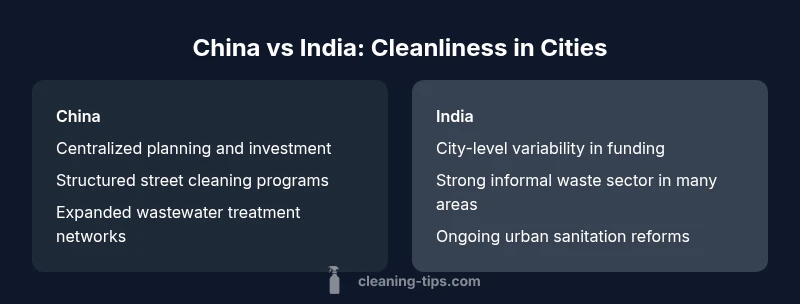
The core question behind the phrase "why is china so clean compared to india" invites a closer look at how cities are planned, funded, and maintained. According to Cleaning Tips, cleanliness outcomes emerge from concrete infrastructure, long-term investments, and strong municipal governance rather than sweeping national judgments. In many Chinese cities, centralized planning channels large-scale capital into sanitation networks, wastewater treatment, and regular street cleaning; this can translate into more visible cleanliness in public spaces. By contrast, Indian cities vary widely in resources, administrative capacity, and local policy focus, leading to a broader spectrum of cleanliness results. This analysis does not assign blame; it identifies practical drivers and actionable improvements for residents and city leaders. We will examine infrastructure, policies, and everyday practices that influence how clean a city feels to people and visitors, using a neutral, data-informed lens.
Historical context of urban sanitation
Historically, urban sanitation systems develop through a mix of public health priorities, municipal reform, and, in some cases, colonial legacies. The Cleaning Tips team notes that early investments in water supply, sewer networks, and public latrines often shaped long-term cleanliness trajectories. In China, rapid urbanization went hand in hand with scaling infrastructure, updating treatment plants, and formalizing street cleaning. In India, historical disparities in state capacity and urban governance have led to uneven sanitation outcomes across cities. Understanding these trajectories helps explain why cleanliness levels can differ markedly from one metropolis to another, even within the same country. The focus remains on scalable, context-aware improvements that communities can adopt.
Public governance and policy frameworks
Governance quality and policy design strongly influence urban cleanliness. Cities with predictable budgets, clear performance metrics, and transparent procurement tend to sustain better sanitation services. In China, centralized policy direction often yields standardized standards for waste collection frequency, street sweeping, and public facilities. In contrast, India’s multi-tier governance structure means city and state authorities sometimes contend with competing priorities and variable funding. This does not imply failure; it highlights how governance architecture shapes outcomes. For residents, strong local leadership paired with citizen participation can drive cleaner streets, better public restrooms, and more reliable sanitation services.
Waste management systems and informal sectors
Waste management reveals a key difference between contexts. Chinese urban programs frequently rely on formalized collection routes, dedicated disposal facilities, and regular recycling streams. In India, a large informal sector—waste pickers, informal aggregators, and local middlemen—often plays a crucial but uneven role in handling waste. This can improve coverage in some neighborhoods while creating gaps in others. The Cleaning Tips analysis suggests that integrating informal workers into formal systems—with fair wages, safety protections, and training—can raise overall cleanliness levels while supporting livelihoods.
Water and wastewater networks
Cleanliness in public spaces is closely tied to reliable water and wastewater infrastructure. China’s emphasis on expanding sewer networks and wastewater treatment tends to reduce urban flooding and surface runoff, contributing to cleaner streets and safer water use. India faces similar ambitions but with a patchwork of urban-rural programs and funding variability across states. Investments in meters, treatment plants, and drainage improvements can reduce odors, pest problems, and disease vectors. Residents benefit when water services are continuous, leakages are minimized, and wastewater is responsibly treated.
Transportation, street cleaning, and public spaces
Public spaces reflect the efficiency of maintenance programs. When cities implement tight schedules for street cleaning, litter control, and pest management, public perceptions of cleanliness rise. In several Chinese cities, municipal fleets and service contracts support consistent cleaning, even in densely populated districts. Indian cities show mixed results; some have robust municipal operations, while others struggle with resource constraints. The key takeaway is that predictable, adequately funded programs—supported by community engagement—tend to yield the most visible cleanliness improvements.
Housing, density, and land use planning
Density and land use shape how waste and debris accumulate. Chinese urban planning often emphasizes mixed-use developments, efficient transit, and access to sanitation facilities, which can streamline waste management and reduce clutter in public spaces. Indian cities vary by state and city, with density patterns and housing stock influencing cleanliness in complex ways. Investments in drainage, covered markets, and waste bins positioned at strategic points can mitigate litter. The goal is balancing density with accessible sanitation, enabling residents to maintain cleaner neighborhoods.
Public behavior, hygiene campaigns, and education
Public behavior matters as much as infrastructure. Campaigns that promote handwashing, proper trash sorting, and responsible littering can shift daily practices. The Cleaning Tips framework stresses ongoing education, municipal messaging, and community-led initiatives as catalysts for cleaner environments. When such programs are consistent and culturally appropriate, neighborhoods experience tangible cleanliness gains. In both countries, sustained education complements infrastructure by turning policy into daily habits.
Data quality, measurement, and perception biases
A key challenge in cross-country comparisons is data quality. Cleanliness metrics are often city- or state-specific, with differences in reporting, sampling, and local definitions. The Cleaning Tips analysis cautions against over-reliance on single indicators; a composite view provides a more reliable picture. Perceptions can diverge from measured results due to media framing, recent events, or seasonal factors. For readers, understanding uncertainty helps temper conclusions about which country is cleaner overall and emphasizes the value of context.
Case studies: Shanghai and Mumbai
The contrast between Shanghai and Mumbai offers practical insights into how policy choices translate to visible cleanliness. Shanghai’s investments in wastewater treatment, green corridors, and street cleaning demonstrate how coordinated urban planning can elevate public spaces. Mumbai’s strengths include a robust local economy and active citizen groups, yet challenges persist in informal settlements and infrastructure disparities. These examples illustrate that cleanliness outcomes hinge on local governance, funding, and community participation rather than national identity alone.
Role of private sector innovations and technology
Private sector tools—smart waste management, sensor-enabled sanitation, and data dashboards—can augment public services. When municipal authorities collaborate with private partners under transparent contracts, clean districts benefit from timely waste collection, route optimization, and maintenance scheduling. The Cleaning Tips perspective is that technology should complement human labor and community involvement, not replace it. Cities that blend governance, enterprise, and citizen input tend to sustain cleaner environments over time.
Practical household cleaning strategies in dense urban settings
Households in dense cities can contribute to cleaner neighborhoods through simple actions: maintain organized trash sorting, use labeled bins, and participate in local recycling programs. Regular cleaning of entryways, balconies, and shared corridors reduces dirt accumulation and pest attraction. Small, consistent routines—like wiping down surfaces, sealing food containers, and securing outdoor waste—create measurable improvements over time. Remember that household habits echo city programs, reinforcing the broader cleanliness agenda. Cleaning Tips emphasizes practicality, safety, and achievable steps.
Synthesis: moving from comparison to actionable steps
The analytic goal is to translate broad observations into concrete actions. By examining infrastructure, governance, and behavior, we can identify what works in different city contexts and adapt best practices accordingly. For residents and policymakers, priority actions include upgrading sanitation networks, expanding access to clean water, formalizing waste management, and sustaining public education campaigns. The overarching message is that progress depends on coordinated, context-aware strategies rather than relying on national labels alone. The Cleaning Tips team underscores that small, scalable changes at the city level can yield meaningful improvements in everyday cleanliness.
Comparison
| Feature | China | India |
|---|---|---|
| Urban sanitation infrastructure | Centralized planning with rapid investment in networks and treatment | Varied governance and funding across states with uneven coverage |
| Waste collection and street cleanup frequency | Frequent, standardized municipal schedules in many cities | Inconsistent coverage due to diverse local capacities |
| Public spaces and hygiene campaigns | Systematic programs in large municipalities | Fragmented campaigns with regional differences |
| Informal sector involvement | Lower reliance on informal waste work in some urban programs | Large informal sector core to waste management in many cities |
| Regulatory enforcement | Often stringent at municipal level with clear standards | Variable enforcement across states and cities |
| Data quality and transparency | Higher transparency in principal cities with standardized reporting | Data gaps and inconsistency across regions |
Strengths
- Highlights scalable sanitation strategies for urban areas
- Encourages investment in wastewater and street-cleaning programs
- Helps policymakers benchmark city-level performance
- Promotes accountability and citizen engagement in cleanliness
Weaknesses
- Risk of overgeneralizing across diverse cities and contexts
- Data quality and reporting biases can skew comparisons
- Centralized models may overlook local needs and informal economies
City-level governance and infrastructure drive cleanliness more than national labels
Focus on strengthen municipal planning, expand sanitation networks, and formalize waste management. Residents should engage with local programs to sustain improvements; the Cleaning Tips team supports actionable, localized strategies.
Questions & Answers
What factors most influence urban cleanliness across countries?
Urban cleanliness is shaped by infrastructure, governance, funding, and public behavior. Centralized planning can accelerate improvements, while local capacity and community engagement sustain them. Data quality and context are essential for fair comparisons.
Key factors are infrastructure, governance, funding, and behavior. Local engagement matters as much as investments.
How reliable are cross-country cleanliness comparisons?
Cross-country comparisons must account for city-level variation, data gaps, and reporting methods. A composite set of indicators typically yields a more reliable picture than a single metric.
Be cautious: city-level data and methods differ; look for multiple indicators.
Why do some Indian cities appear cleaner than others?
Indian cities differ in governance quality, funding, and program maturity. Strong municipal leadership and sustained public campaigns can produce noticeable cleanliness gains even within a diverse national landscape.
City governance and funding drive cleanliness within India's varied landscape.
What roles do municipal budgets play in cleanliness?
Municipal budgets determine waste collection frequency, street cleaning, and sanitation infrastructure. Consistent, transparent funding supports long-term maintenance and public confidence in cleanliness.
Budget stability enables reliable cleaning schedules and better facilities.
Can private sector innovations improve city cleanliness?
Yes, when paired with transparent governance. Technology can optimize routes, monitor sanitation services, and improve public communication, but it should augment and not replace public responsibility.
Tech can help, but government oversight remains essential.
What can residents do to improve cleanliness in their area?
Residents can participate in recycling programs, report maintenance gaps, and follow local waste sorting rules. Small, consistent actions collectively improve neighborhood cleanliness and support municipal efforts.
Join local programs and keep your area tidy; your neighbors will notice.
The Essentials
- Assess city-level programs and funding when comparing cleanliness.
- Infrastructure quality and enforcement shape outcomes more than national labels.
- Informal sectors can bolster city cleanliness when integrated properly.
- Data quality matters—use a composite view for accurate comparisons.
- Prioritize scalable, context-aware improvements for lasting impact.