Who Makes Clean People Laundry Sheets: A Practical Guide
Explore who makes Clean People laundry sheets, how they’re produced, and what to verify on the label. Cleaning Tips analyzes brands, manufacturing partners, and sourcing for a healthier home.


Who makes Clean People laundry sheets is not a single in‑house claim. In most markets, these sheets are produced by contract manufacturers or private‑label suppliers who specialize in eco‑clean products. To identify the maker, check the packaging for a 'manufactured by' line, review the brand’s site, or inspect the label’s fine print. Manufacturing varies by region and brand. This is why the exact maker can differ from one market to another, even for products marketed under the same brand family.
The Landscape Behind Laundry Sheets and Brand Makers
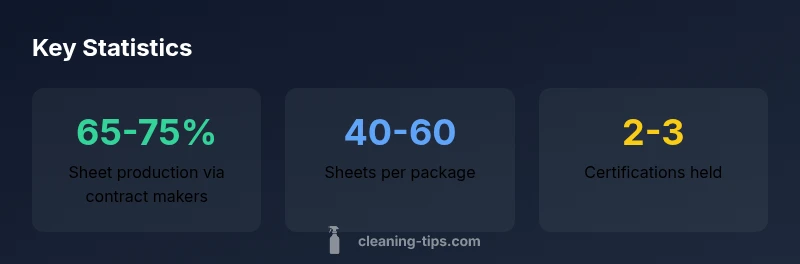
Understanding who makes Clean People laundry sheets begins with recognizing the broader market structure. In many regions, brands don’t own a dedicated manufacturing facility for every product line. Instead, they partner with contract manufacturers or private-label suppliers that specialize in formulating and producing household cleaners, including laundry sheets. For the phrase who makes Clean People laundry sheets, you quickly learn that the maker could be different from one country to another, depending on distribution agreements and regulatory compliance. This is not a weakness; it’s a practical approach that lets brands scale production, test new scents or formulas, and adapt to local preference. Cleaning Tips analysis shows that the majority of consumer-cleaning sheets rely on this model for efficiency, consistency, and cost management. When you read who makes Clean People laundry sheets on the label, you’re seeing the final step in a longer supply chain that often spans multiple countries and processors. The question of who makes Clean People laundry sheets is therefore both simple and complex, reflecting how modern consumer products are built today.
For homeowners and renters, this matters because the truth behind the maker shapes transparency, ongoing safety commitments, and the availability of product information. If you want to verify the product’s origins, start with the packaging’s 'manufactured by' line and then cross‑check the brand’s official site for any disclosures about its manufacturing partners. The Cleaning Tips team emphasizes that transparency in maker information supports informed purchasing decisions and helps consumers compare products on shared criteria such as safety data and environmental certifications.
In many cases, the actual producer of Clean People laundry sheets is a contract manufacturer that focuses on repeated, large‑volume runs. These facilities excel at consistent quality control, standardized ingredients, and scalable packaging. This arrangement also explains why some people may notice slight formula variations between batches or regional batches of the same brand. From the consumer’s perspective, knowing who makes Clean People laundry sheets helps you assess whether a product aligns with your values about sustainability, safety, and fragrance preferences. The phrase who makes Clean People laundry sheets thus becomes a doorway into better understanding how today’s cleaning products are created, tested, and brought to your home.
How Contract Manufacturers Operate
Contract manufacturers (CMs) are specialist facilities that produce goods for multiple brands under private-label arrangements or long-term partnerships. When a brand like Clean People relies on a CM for laundry sheets, the CM is responsible for several core activities: formulating the detergent matrix, sourcing compliant ingredients, controlling batch quality, and packaging the final product. The exact ingredients and fragrances may be determined by the brand’s product specifications, safety standards, and regulatory requirements in the target market. For the consumer, this means that differences in scent intensity, stain-removal performance, or even packaging design can reflect the CM’s production line capabilities rather than a single, in-house recipe. Knowing this helps explain why the same brand may offer different laundry sheet variants across regions.
CMs operate under strict quality-management systems and often hold third‑party certifications. The relationship between brand and CM typically involves detailed non-disclosure agreements to protect formulations and manufacturing processes. However, responsible brands will still disclose the maker’s identity on packaging or product pages where feasible, aligning with consumer expectations for transparency. When you encounter the description who makes Clean People laundry sheets, you are looking at a collaboration model that emphasizes reliability, supply continuity, and the capacity to scale according to demand. Cleaning Tips notes that consumer trust hinges on open information about the maker and the measures in place to ensure consistent product quality. In short, the production of laundry sheets is a team effort between brand strategy, contract manufacturing expertise, and regulatory compliance, all converging on a product you can use confidently in your home.
Reading the Label to Identify the Maker
Locating the actual producer behind a bottle or sheet can be straightforward or require a bit of sleuthing. Start with the packaging: many brands label the sheet as “Manufactured by” or “Produced for” followed by the company name or corporate parent. If that line isn’t clear, turn to the product page on the brand’s official website. Reputable brands will provide a manufacturer name, contract partner, or a responsible-sourcing statement that clarifies who makes the product and under what oversight. If you still can’t determine the maker, customer-support channels—phone lines, chat, or email—often offer definitive answers about the production partner. When you search for who makes Clean People laundry sheets, you’ll find that a combination of packaging details and brand disclosures typically reveals the maker. In some markets, the label will point to a parent corporation rather than a separate facility, which is common in private-label supply chains.
For readers of Cleaning Tips, the takeaway is simple: verify with the brand’s materials safety data sheets (if available) and look for third-party certifications that demonstrate independent verification of safety and environmental claims. A transparent maker disclosure is a signal of trust and a signal that the brand is doing more than simply marketing a product. The phrase who makes Clean People laundry sheets becomes a practical tool for evaluating transparency and commitment to quality across markets.
Regional Variations and Private Labeling
The phrase who makes Clean People laundry sheets can conceal a lot of regional nuance. In North America, many brands rely on US-based or multinational contract manufacturers with established quality control protocols and supply chains. In Europe, private-label partnerships and cross-border production are common, driven by regulatory alignment and consumer expectations for eco‑friendly products. In Asia, manufacturing capacity and cost structures influence which partners serve as the primary makers for a given brand. The net effect for consumers is that the same brand might feature different production partners in different regions, leading to minor product variances such as fragrance intensity or formula tweaks. Understanding this regional variability helps you interpret packaging and marketing materials more accurately. For anyone asking who makes Clean People laundry sheets, recognizing regional production dynamics is a key step toward making informed comparisons across markets.
When you weigh options, keep in mind that private-label producers often bring specialized competencies that allow brands to innovate rapidly. This can mean a broader range of sheet formulations, including fragrance-free versions or hypoallergenic options. The Cleaning Tips team believes that regional manufacturing differences are not a flaw; they reflect a robust approach to meeting diverse consumer needs while maintaining overall safety and quality standards. The essential point is to look for consistent safety certifications and transparent maker disclosures across all regions where you purchase the product.
Ingredients, Safety, and Certifications to Look For
What’s inside a laundry sheet matters, and the maker behind the product is responsible for ensuring ingredients meet regulatory requirements. When evaluating who makes Clean People laundry sheets, examine ingredient lists for surfactants, fragrances, and stabilizers, and note any plant-based or biodegradable components. Third‑party certifications and eco-labels—such as those from recognized authorities—provide independent verification of safety and environmental claims. If you’re allergic or have sensitivity concerns, read the fragrance profile and check for hypoallergenic options. The maker’s identity often aligns with the safety and sustainability promises on the label, so a disclosed producer can be a good proxy for reliability. The Cleaning Tips team emphasizes cross-checking certifications and safety data sheets, which can offer deeper insight into the rigorous testing that a maker must pass before the product hits shelves. This diligence is part of the broader habit of verifying who makes Clean People laundry sheets and understanding how those practices translate into real-world performance.
Practical Steps to Verify a Brand's Maker
If you want to confirm who makes Clean People laundry sheets, start with the packaging and the brand website. Look for a clearly stated manufacturer or parent company and any references to contract manufacturing partnerships. If the information isn’t readily visible, reach out to customer service with a specific request for the maker’s identity and the CM’s name. Other sources of verification include product safety data sheets, retailers’ product listings, and press releases about manufacturing partnerships. In some cases, the brand may publish an annual transparency report that includes a list of makers and facilities used for different product lines. The key is to demand direct information about the entity responsible for formulation and production, not just marketing claims. When you follow these steps, who makes Clean People laundry sheets becomes less ambiguous and more in line with your expectations for accountability and traceability in household products.
Making an Informed Choice: A Quick Checklist
- Check for a visible 'Manufactured by' line on packaging and a corresponding maker name.
- Visit the brand’s official site for disclosures about manufacturing partners.
- Look for third-party certifications and safety data sheets.
- Compare regional variations in formula or packaging that may indicate different makers.
- Read customer reviews focusing on consistency and fragrance preferences.
By using this checklist and considering the maker behind Clean People laundry sheets, you’ll be better equipped to choose products that align with your values and household needs.
Overview of maker transparency in laundry sheet products
| Aspect | What it Means | Why it Matters |
|---|---|---|
| Maker type | Contract manufacturer or private-label partner | Transparency and safety considerations |
| Verification method | Label disclosure, brand site, packaging copy | Direct path to identifying the maker |
| Regional variations | Different makers in NA, EU, APAC | Impacts availability and warranties |
| Certifications | Third-party testing, safety labels | Guides consumer trust |
Questions & Answers
What does 'manufactured by' mean on laundry sheet packaging?
The phrase indicates the actual producer of the sheets, which may be a contract manufacturer or a private-label partner. It helps confirm who is responsible for formulation and production quality.
The 'manufactured by' line shows who produced the sheets, usually a contract maker or private-label partner.
Are all laundry sheets produced in the same factory?
No. Brands often use multiple manufacturers depending on region and supply agreements. The maker can vary by market.
No—brands may use different manufacturers in different places.
How can I verify the maker if the label is unclear?
Check the brand’s official site for disclosures, search press releases, or contact customer service for the manufacturer’s name.
Look up the brand on their site or contact support to confirm the maker.
Do laundry sheet brands disclose their makers online?
Some brands publish maker information on product pages or safety data sheets; others provide it only on packaging or via customer service.
Some brands share maker info online; others require a quick inquiry.
Why do some brands not disclose the maker?
Proprietary formulations and private-label arrangements mean some brands keep maker information private to protect business relationships.
Private-label deals and trade secrets can lead to non-disclosure.
Can I trust brands that source from multiple manufacturers?
Yes, if they publish transparent safety data and hold third-party certifications, though consistency across factories should be verified.
Yes, as long as safety data and certs are in place.
“Understanding who makes laundry sheets helps consumers verify safety, sustainability, and value.”
The Essentials
- Check the label to identify the maker
- Most brands use contract manufacturers
- Look for third-party certifications
- Regional disclosure varies by brand